Print Story
X




From crude oil and cooking gas to milk, the cost of a distant war is landing hard on ordinary Pakistanis. Experts say renewable energy offers a way out
| W |
hen US strikes targeted Iranian energy and military infrastructure in late February, the shockwave did not stop at the Strait of Hormuz. Within days, crude oil prices surged by nearly 30 percent, LPG cylinders became more expensive across Pakistan’s rural heartland and the government announced what economists are calling the largest single-day fuel price raise in the country’s history. For millions of Pakistanis already struggling under an IMF-backed stabilisation programme, the war in the Middle East has arrived not just as headlines, but as a higher bill at the petrol pump, the kitchen and the marketplace.
Shams-ul Islam Khan, the Karachi Chamber of Commerce and Industry’s former vice-president and a veteran commodities expert, sets the scene bluntly. “The aftermath of the Middle East conflict, a war imposed on Iran, may not remain confined to the Gulf region. Shockwaves are swiftly spreading through global commodity markets. US crude WTI, which was around $67 per barrel and Brent which stood at $72 on February 28, surged to $120 per barrel before falling back to $81 by March 10.”
“Pakistan meets 90 percent of its energy requirement with import of oil from Saudi Arabia and the UAE and LNG from Qatar. If oil prices remain volatile, the consequences can be immediate and painful.”
The government responded on March 7 by raising petrol and diesel prices by Rs 55 per litre in a single go, an all-time high increase. Khan describes this as a hasty decision, whose main beneficiaries are oil marketing companies.
With crude now hovering between $90 and $100 per barrel, Pakistan is bracing for another inflationary wave rippling across energy, fertilisers, chemicals and agricultural commodities in the weeks ahead.
Ahsan Mehanti, Arif Habib Commodities chief executive officer, puts numbers to the macroeconomic risk. “Pakistan’s import bill will rise by $6 billion if this price level persists over a year. Local inflation could top 15 percent compared with the current 6 percent,” he says. “The government should maintain fiscal discipline, manage oil inventories beyond 28 days and negotiate a $5 billion credit facility with Saudi Arabia given the massive surge in oil prices.”
G7 nations are already deliberating on releasing emergency reserves. This, Mehanti believes, should keep prices around $100 per barrel for the near term. However, that remains cold comfort for a country with Pakistan’s import dependency.
Dr Khaqan Najeeb, an economist and former adviser to the Ministry of Finance, explains why oil shocks transmit so widely. “A sustained increase in petroleum prices rarely remains confined to the oil market. Petroleum is a key input in transportation, petrochemicals, fertilisers and industrial production. This means rising oil prices quickly translate into higher logistics costs, more expensive fertilisers and costlier manufacturing inputs.”
“For Pakistan, rising crude oil prices raise the import bill, pressures the current account and the exchange rate. They also raise electricity and production costs across the economy. Managing this pass-through becomes a delicate challenge, balancing fiscal pressures, inflation control and energy affordability in an already fragile macroeconomic environment.”
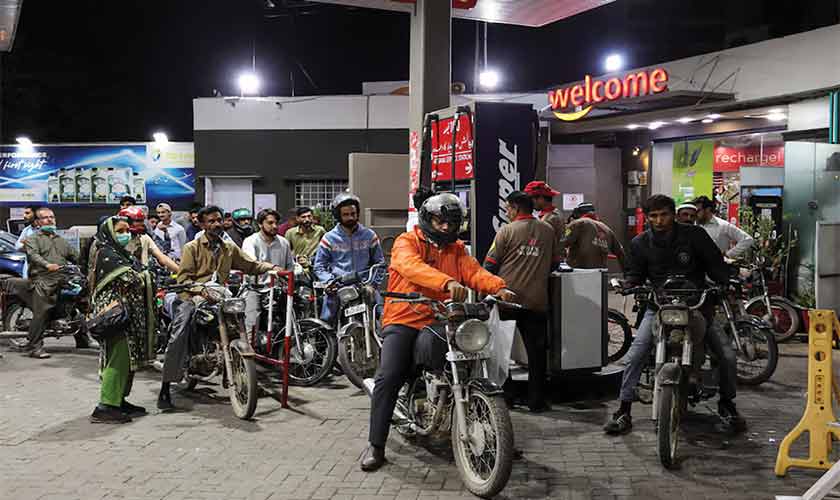
The inflationary chain does not stop at the fuel pump.
LPG prices have already been raised, hitting hardest in rural areas where it serves as the primary fuel for over 70 percent of households. The Dairy Farmers’ Association has demanded a revision of milk prices, citing higher feed, fuel and transportation costs.
Fertiliser costs are also set to rise ahead of the Kharif sowing season between April and June. Wheat farmers in Sindh, whose harvesting has already begun, are facing the immediate sting of higher diesel prices.
There is, paradoxically, some relief buried within the crisis. Export demand for rice, meat, eggs, potatoes and onions has contracted due to shipping and airline disruptions, causing domestic prices for these items to fall. But Khan warns the relief has not reached the consumers.
“The wholesalers blame retailers and retailers blame wholesalers. In fact, bulk sellers are behind price hikes; they store essential goods and control prices. Provincial governments must restore a system of stock reporting on a weekly or fortnightly basis and register warehouses. Hoarding must be checked.”
He also cautions that while edible oil and pulses were imported at lower prices before the conflict began, speculators are expected to exploit segments of the electronic media to manufacture panic and inflate prices artificially.
Certain policy decisions risk compounding rather than cushioning the blow. The government’s Drawback of Duty and Local Taxes and Levies scheme, offering 3 percent support for coarse rice exports and 9 percent for Basmati, has already pushed domestic rice prices upward by incentivising traders to divert supplies abroad. Pakistan has seen this pattern before with wheat and sugar.
“What appears to be an export incentive can become an indirect subsidy for exporters that fuels food inflation at home,” Khan notes, adding that targeted direct subsidies to growers to boost production would be a more prudent path.
Experts agree that the deeper cure lies in structural reform.
Majid Bilal Khan, a PhD scholar in wind energy and manager of programmes at the Indus Consortium, argues that reducing fossil fuel dependence is no longer just an environmental choice, but an economic imperative.
“Pakistan possesses vast renewable energy potential that has remained largely untapped. The country has an estimated solar power potential of nearly 2,900 gigawatts and a technical wind capacity of around 340 GW, primarily along the coastal areas of Sindh and Balochistan. The Gharo wind corridor alone holds potential of about 50,000 megawatts, one of South Asia’s most attractive zones for wind power.”
“Pakistan’s electricity demand peaks at roughly 40 to 45 GW. Harnessing even a fraction of these resources could meet a significant portion of national power needs while substantially reducing dependence on expensive fuel imports.”
Khan calls on the government to set long-term renewable energy targets, offer tax incentives, revive concessional green financing schemes similar to the State Bank’s FSRE facility, and modernise the grid to absorb large-scale renewable generation. Linking renewable electricity with electric mobility, he adds, would further blunt the impact of future oil shocks.
For now, the war rages on.
Thousands of kilometres away, at petrol stations, LPG dealers and grocery counters across Pakistan, ordinary people are already paying the price.
As Shams-ul Islam Khan puts it: “Wars reshape commodity markets quickly. For countries like Pakistan, the challenge is not merely surviving the shock but preventing it from turning into another prolonged inflationary spiral.”
The writer is a senior financial correspondent at The News. He holds Alfred Friendly, Daniel Pearl and Geo Journalism fellowships. He can be reached at [email protected]