Print Story
X




Pakistan’s social and political dilemma on account of the Middle East conflict
| P |
akistan is grappling with a tricky situation: balancing its foreign policy amid the Middle East conflict, as its own war with Afghanistan rages on in the backdrop of the looming threat from India.
When there is conflict in the Middle East, Pakistan often feels the tremors long before those are fully acknowledged. Geographically, Pakistan is hundreds of miles away from the battlefield. But, economics, faith and history strongly connect the Pakistani society to the region. As tensions intensify between regional rivals such as Iran and the bloc led by Saudi Arabia and the United Arab Emirates, supported by the US and its allies, its resonance can be felt in Pakistan’s political and religious discourse and urban spaces.
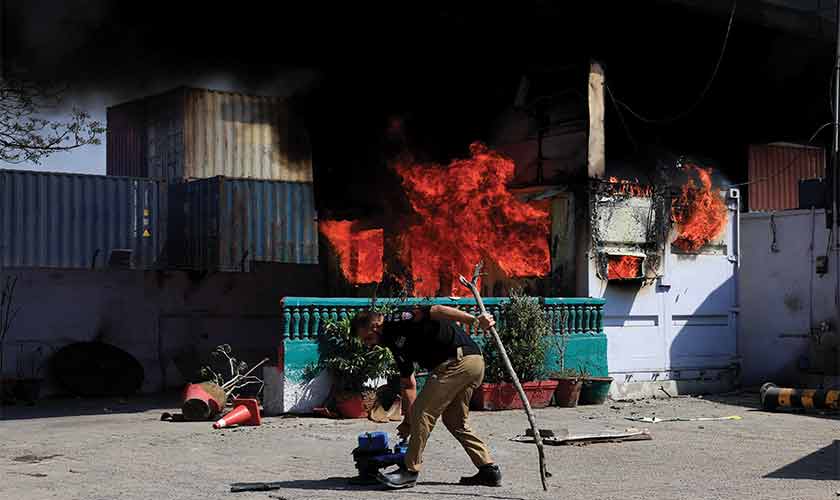
The recent clashes between protesters and security forces, which claimed 23 lives, following the killing of Iran’s supreme leader in a US-Israeli attack, show how easily geopolitical rivalries can challenge Pakistan’s frail social fabric. Such incidents are rarely isolated events, often reflecting international conflicts in domestic grievances, ideological and sectarian undercurrents.
Pakistan has always found it hard to remain aloof from the conflicts that characterise the politics of the Middle East. Millions of Pakistani expatriates work in the Gulf states. Remittances from the region form the economic backbone of the national economy. Religious ties have deep roots with the clerical establishments in both Iran and the Arab states.
When tensions are high in the Middle East, these channels become a conduit through which ideas, emotions and rivalries permeate the Pakistani society.
In cities like Karachi, where political and sectarian faultlines have historically overlapped, even distant conflicts can ignite emotional reactions. Protest rallies, fundraising campaigns and political messaging increasingly mirror the rhetoric emerging from the Middle Eastern capitals.
The sectarian balance in Pakistan has always been tricky. While the country has managed to achieve a degree of success in tackling sectarian militancy in the past decade, the underlying sectarian divide has always been a feature of the social fabric.
Any further intensification of the rivalry between Iran and Saudi Arabia can trigger a resurgence in sectarian tensions. This is particularly because religious groups and political forces aligned with either side tend to promote a narrative that often attempts to portray regional conflicts in sectarian terms.
Unlike past decades, today, conflicts travel instantly through digital platforms. Graphic images from battlefields, speeches by regional leaders and ideological propaganda circulate rapidly among audiences.
This digital amplification has two consequences. First, it intensifies emotional responses among ordinary citizens who feel connected to the conflict through religious or cultural identity. Second, it provides extremist networks with fertile ground to recruit sympathisers and frame local grievances within global narratives.
In many cases, misinformation spreads faster than facts, deepening anger and suspicion within already polarised communities. This creates a situation where foreign policy debates gradually spill into domestic politics, sometimes fuelling protest movements and street demonstrations.
Taking a position on the geopolitics of the Middle East has always been a delicate balancing act. The country has close economic and strategic relations with Saudi Arabia and the UAE, and a long border and complex relationship with Iran.
It will be difficult for the government to maintain a balance as geopolitical situation and public opinion continue to shift. Religious groups, diaspora communities and ideological networks are always trying to pressure the government to take a position that is favourable towards one side.
An unstable situation in the Gulf can impact the livelihood of millions of Pakistanis working there. These countries are an important source of remittances.
Energy imports are another important factor. Rising tensions in the Middle East can lead to further increases in oil prices, impacting Pakistan’s already unstable economic situation.
The mood in big cities like Lahore, Karachi and Islamabad has historically been a useful barometer of geopolitical spillover effects in Pakistan. Karachi is home to a range of ethnic and sectarian groups, with a large expatriate population with ties to the Gulf region.
When international tensions run high, Karachi is often where these narratives are played out in the form of protests, security incidents or political mobilisation.
The attack on the US diplomatic facility in Karachi and protests in Islamabad and Lahore exposed the underlying vulnerability of Pakistan’s cities to international conflicts.
The challenge for Pakistan is to ensure that conflicts from abroad do not rekindle divisions within its own society. This is not simply about policing or intelligence work. This is about regulating sectarian rhetoric, enhancing interfaith dialogue, tracking international financial networks and fighting online propaganda.
Pakistan has so far pursued a flexible, non-partisan foreign policy toward the Middle East crisis. Condemning the US-Israel attack on Iran and sending a condolence message to Iran’s new supreme leader, Mojtaba Khamenei, have been good gestures. Pakistan has also supported the Arab countries’ resolution against Irani attacks on the Gulf states and others in the region. At the same time, it endorsed the Russian resolution against the attack on Iran.
However, it may become harder for Pakistan to maintain such a policy for long. Over the coming days, pressure will mount on Pakistan to pick a side. Pakistan must double its efforts to defuse the escalation in the Middle East and with Afghanistan to protect its own territorial, economic and social interests.
The writer is a journalist, teacher of journalism, writer and analyst. His X handle: @BukhariMubasher.