Print Story
X




Hanif’s reimagining of history opens a doorway to understanding the complexities of our country’s past
| I |
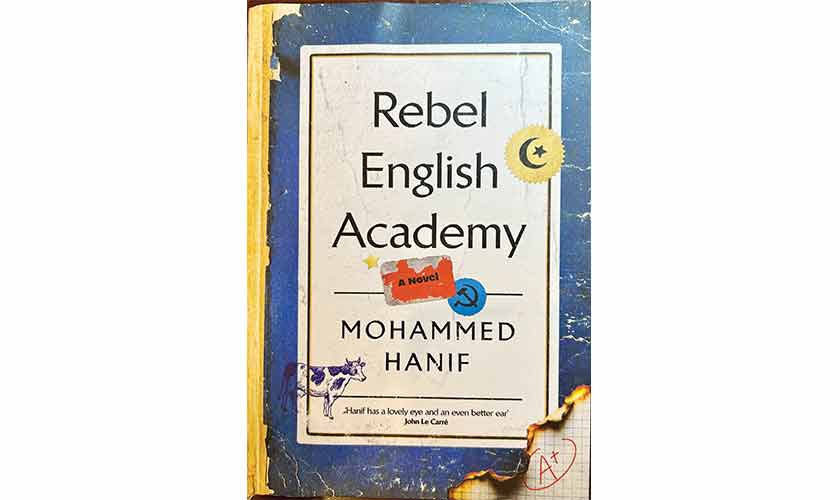
n Rebel English Academy, celebrated author Mohammed Hanif carries forward the subversive, satirical energy that won the hearts of those who read his debut work of fiction. A richly imagined, darkly humorous take on General Zia’s authoritarian rule, A Case of Exploding Mangoes established Hanif as one of Pakistan’s sharpest and most incisive political novelists. Much like his first book, Hanif’s much-awaited fourth novel begins with the demise of a venerated but divisive statesman. This time around, however, the death isn’t framed as a political whodunnit. Instead, the narrative takes a more sinister turn, exposing the conscience of a fractured community.
On a cloudless, starless night in Rawalpindi, Zulfikar Ali Bhutto, Pakistan’s first elected premier, is executed in prison. In contrast to General Zia’s death in a plane crash under mysterious circumstances, Bhutto’s execution is a state-sponsored, politically motivated act, later condemned as judicial murder. This moment in history is unmarked in Rebel English Academy by omens and clichés. “There are no meteor showers,” Hanif writes, “no storms brewing on the horizon, the sky is not going to shed tears of blood, the earth is not about to split open and swallow its wretched inhabitants and their grief.”
Guided by Hanif’s skilled and fearless pen, this pivotal political event escapes the trappings of melodrama. Instead it becomes an opportunity for the author to showcase his trademark satirical flair. The omniscient narrator walks the tightrope between fact, myth and hearsay, stretching the gallows humour to rarely imagined heights.
After Bhutto is hanged, Captain Gul and a professional photographer are left alone with the deceased prime minister’s corpse to “perform the most shameless [and] the most high-powered assignment.” When this final humiliation fails to achieve its intended effect, the beleaguered captain is banished to the fictitious OK Town — a punishment echoing the original sin, albeit in a far more diabolical form.
Trapped in this dreary town, the unscrupulous captain must confront a peculiar ordeal: a string of self-immolations by grieving jiyalas (Bhutto supporters), prodded by a misguided desire to resurrect their fallen leader. “There was a Bhutto hanged that night, and there is another haunting this city,” Hanif writes, “He has to get rid of them both.”
Captain Gul’s quest leads him to Gol Mosque, an unusual space where religious precepts coexist alongside secular impulses. The mosque is a safe haven for Baghi, an atheist with a colourful yet traumatic past as a revolutionary as well as a poet. It is the site where he operates an English tuition centre — the eponymous Rebel English Academy — without paying rent. At the novel’s outset, Molly Rafique, a morally questionable imam, asks Baghi to shelter a “lady guest,” the enigmatic, long-suffering Sabiha Bano, in his quarters. Baghi’s decision to grant this request sets the stage for an action-packed tale driven by political upheaval and the pernicious effects of the abuse of religion.
The strength of Rebel English Academy lies in a diverse and eccentric cast of characters. Poets, astrologers masquerading as legal experts, clerics with a taste for mysterious women, and Himalayan men peddling aphrodisiacs strut across the pages of Hanif’s new novel with playful ease.
Hanif’s much-awaited fourth novel begins with the demise of a venerated but divisive statesman. This time around, however, the death isn’t framed as a political whodunnit.
The honourable and intensely humane Baghi is the veritable beating heart of the novel. The many facets of his sexual, political and pedagogical life are rendered with care and revealed in vivid, realistic hues. He emerges not merely as a staid English teacher, but also as a former patron of the Mazdoor Militia. Curiously, he is also the author of an incriminatory letter addressed to the leaders of the Muslim Ummah, written in an attempt to sabotage a major global summit in the mid-1970s. The missive had earned Bhutto’s ire and ultimately led to Baghi being found “whimpering and convulsing” in police custody. These episodes from the English teacher’s life defy the adage that teachers seldom possess real-world experience or have the courage to act. In fact, Baghi encourages his students to wield English as a weapon of survival and revolt — a testament to his practical wisdom.
Hanif has struck gold with a character as full-blooded and compelling as Baghi. Some readers might wish the narrative focused entirely on him. However, the omniscient narrator alternates between inhabiting the perspectives of Baghi, Captain Gul and Sabiha Bano, a technique that steers the novel towards a satisfying denouement. The trajectories of some of the other characters reveal the complex nature of sociopolitical realities. For instance, Molly Rafique embodies the archetype of the dubious religious figure who exploits the faith of the community for personal gain.
The chapters titled Homework are a clever narrative device. They enable Sabiha Bano to chronicle how her family life unraveled amid the transformative yet gritty politics of labour unions during the Bhutto years. These struggles are seldom represented in Pakistani fiction in English, which has usually leaned towards liberal sensibilities. Rebel English Academy deserves to be lauded for drawing attention to this significant dimension of Pakistan’s history. The Homework chapters resemble ornate, formulaic school essays. These stylistic choices lend the chapters an otherworldly quality.
The crowning glory of Hanif’s fourth novel is its rollicking, rib-tickling humour that is, by turns, subversive and refreshing. At no point does it seem gratuitously contrived or excessive. Far from being weighed down by forced humour, the novel seems to be enriched by it. “I am here to teach you the Queen’s English,” Baghi tells his student, “I hate her, but at least I know that she exists.”
At a time when historical texts are left to gather dust on bookshelves, the past can be appreciated through rich, impactful storytelling. Hanif’s reimagining of a crucial historical event, as well as its lingering impact on the conscience of small-town Pakistan, is rewarding as it opens a doorway to understanding the complexities of our country’s past.
Rebel English
Academy
Author: Mohammed Hanif
Publisher:
Maktaba-e-Danyal, 2026
Pages: 315
Price: Rs 3,000
The reviewer is the critically acclaimed author of No Funeral for Nazia and Typically Tanya.