Print Story
X




Nation-building has always been a challenge for the ethnically diverse state
| A |
fghanistan’s political instability cannot be understood without reference to the historical foundations of the state and the ethnic complexity that have shaped its political trajectory. Before the emergence of a unified Afghanistan, the territory was home to diverse ethnic communities — primarily Pashtuns, Tajiks, Uzbeks and Hazaras — each occupying relatively distinct geographic zones and governed through tribal, regional and localised power arrangements rather than a centralauthority.
The modern Afghan state emerged in the mid-18th Century under Ahmad Shah Durrani, also known as Abdali. Following the decline of the Mughal and Safavid empires, Ahmad Shah united various Pashtun tribes and consolidated control over a vast territory through military conquest and political alliances. His rule laid the foundation of what became known as the DurraniEmpire. The state-building was largely Pashtun-centric, rooted in tribal loyalty, military dominance and patrimonial governance not inclusive, institutionalised political participation.
After Ahmad Shah’s death, Afghanistan struggled to maintain cohesion. Successive rulers exercised fluctuating degrees of authority. Many were limited to major cities, trade corridors and strategically significant regions. Large parts of the country functioned with de facto autonomy as ethnic leaders and tribal networks maintained control. The central government frequently claimed sovereignty but lacked effective administrative penetration across the mountainous and geographically fragmented landscape.
Today Pashtuns constitute 40-42 percent of the population and Tajiks 25-27 percent. Hazaras and Uzbeks account for approximately 9 percent each. Smaller communities include Turkmen, Baloch,Aimaq, Pashai, Nuristani, Arab and Pamiri groups. Pashto and Dari (Afghan Persian) are the country’s official languages. Despite sizeable Turkic-speaking populations, Uzbek and Turkmen languages have not enjoyed the same prominence as Pashto and Dari.
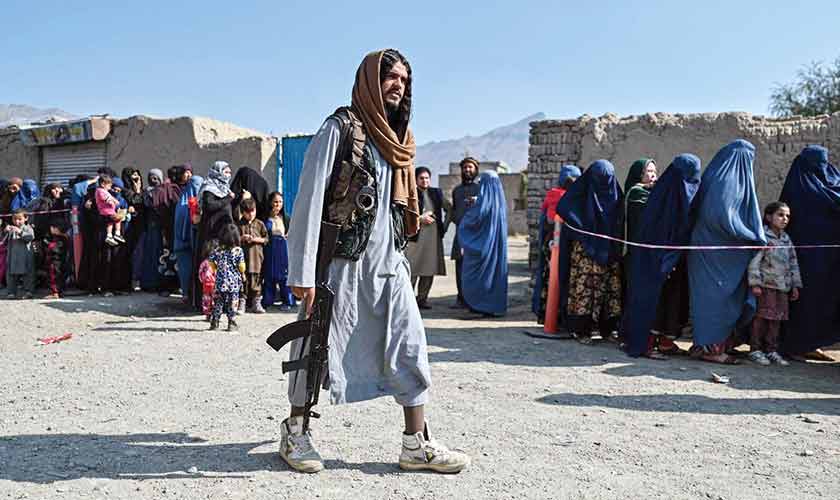
Ethnic diversity has remained a challenge for the project of nation-building. Pashtuns have traditionally dominated the south and east; Tajiks the northeast and some urban centres; Uzbeks the north; and Hazaras the central highlands. Over time, wars, forced migration, internal displacement and political engineering have altered demographic balances in several regions, deepening grievances and mistrust among communities.
The perception of systemic imbalance in political power has been a recurring theme in Afghan history. Pashtuns, as the largest and historically dominant group, have disproportionately occupied key positions in state structures, including the military and executive leadership. Some non-Pashtun communities have viewed this pattern as political marginalisation. The term Afghan, historically associated with Pashtuns, has itself been a subject of debate. Some of the minority groups have expressed discomfort with a national identity they perceive as ethnically loaded.
Cross-border ethnic linkages have added another layer of complexity. Tajiks share linguistic and cultural ties with neighbouring Tajikistan; Uzbeks with Uzbekistan; and Pashtuns with Pakistan. These trans-national affiliations have, at times, influenced political alignments, external patronage networks and regional rivalries, complicating efforts to build a cohesive national framework within Afghanistan’s borders.
Beyond internal fragmentation, Afghanistan’s prolonged instability has had profound regional and global security implications. Weak central authority, porous borders and limited state control over peripheral areas have enabled militant and extremist groups to establish operational bases. Various armed organisations have used ungoverned spaces for training, recruitment and logistical coordination. Violence has often spilled beyond Afghan borders. This dynamic has repeatedly drawn regional and international actors into Afghan affairs, reinforcing cycles of intervention and instability.
Looking forward
Against this backdrop, some analysts have proposed a radical rethinking of Afghanistan’s territorial and political structure. One such proposal envisions a peaceful restructuring of the country along ethnic and regional lines. Under this framework, Uzbek-majority regions might integrate with Uzbekistan; Tajik-majority areas with Tajikistan; and Pashtun-majority territories with Pakistan. The remaining territory, largely inhabited by Hazaras and other minorities might form a newstate.
Proponents argue that such a restructuring could reduce ethnic domination, align political boundaries with demographic reality and potentially diminish conflict. Smaller, more ethnically coherent political units, they contend, might foster stronger local governance, reduce grievances rooted in power imbalances and improve accountability. Integration with culturally aligned neighboring states could, in theory, enhance economic connectivity and administrative efficiency.
Supporters of the idea also suggest that reconfiguration might have security benefits. Clearly defined and manageable borders, stronger local authority structures and enhanced cooperation with neighboring states could improve counterterrorism coordination and reduce safe havens for militant groups. With appropriate international guarantees and safeguards for minority rights such a transformation could open pathways toward long-term stability.
Scepticism
The proposal raises complex legal, political and humanitarian questions. Redrawing international borders requires the consent of affected populations, neighbouring states and the broader global community. Issues of mixed-population areas, resource distribution, citizenship, displacement and minority protection will necessitate difficult negotiation. Historical experiences elsewhere suggest that territorial partition does not automatically eliminate conflict and may, in some cases, generate new fault lines.
Afghanistan’s enduring crisis reflects the tension between a centralised state model and a deeply plural social fabric. Whether through federal restructuring, decentralisation, power-sharing arrangements or more radical territorial solutions, apath forward must address core issues of representation, inclusion and equitable governance. The challenge lies not only in managing ethnic diversity but also in transforming it from a source of fragmentation into a foundation for cooperative coexistence.
Reimagining Afghanistanrequires more than redrawing maps. It demands an honest reckoning with history, a recognition of legitimate grievances across communities and a commitment — domestic and international — to buildpolitical arrangements that reflect the country’s social realities.
The author works for The News. He can be contacted at [email protected].