Print Story
X




The stories about the Partition are so horrendous that the generosity of nationalist versions does little justice to the horror of individual accounts
| T |
he Partition of India continues to inform the statistical and societal dynamics in the nation-states of India, Pakistan and Bangladesh. The communal tensions that led to the partition of 1947 and cultural factors, among others, that yielded in the separation of East Pakistan and the making of Bangladesh, are still constructing and re-constructing their ‘selves’ and ‘others,’ making the whole subcontinent a cauldron the religious minorities live in.
This volume stresses that the 1947 partition of British India not only divided people and territories but drove cultural fault lines, which, over the years, involved movies, the press and television in perpetuating a narrative of religion based cultural differences. The chapters in this anthology analyze how language, cinema and textbooks contributed to dividing rather than bridging gaps, further communalising the Urdu and Hindi languages, and making textbooks narrate selective sources to build selective narratives.
The Partition Plan paved the way for the division of two provinces, the Punjab and Bengal, located at the opposite ends of the subcontinent. The two had Muslim-majority populations but cultural dynamics quite different from each other. The fate of these two provinces became a battleground between the Congress and the Muslim League, which argued for their respective claims to rule them. Consequently, the representatives of legislative assemblies of both, in the words of the British prime minister, were “empowered to vote whether or not the province should be partitioned” on the lines that the whole of India was being partitioned. Thus, on the eve of independence, Jawaharlal Nehru had to tell his listeners that “the India of geography, of history and traditions, the India of our minds and hearts cannot change.” A lot was to change, however, forever.
A history writing project was initiated, immediately after independence, in both India and Pakistan. It projected the nationalist discourse into the future trajectories, making it a straightjacketed teleology that can still be viewed in the black and white photographic exhibitions throughout the nationalist museums of major South Asian cities and in the school children’s history textbooks. On the other hand, the stories about 1947 and 1971 are so horrendous that the generosity of nationalist versions does little justice to the horror of individual accounts. These are difficult, even for the most hardened and dispassionate readers, to digest.
Despite adopting a secular constitution in 1950 that promised equal political and civic rights to all its citizen, India has seen a large number of communal riots between citizens belonging to majority and minority religious groups. The political rise of Hindutva ideology in the 1980s and its ascendance in government in the shape of the Hindu nationalist Bhartiya Janata Party in the 1990s led to sharpened faith-based attacks on the country’s religious minorities, particularly the Muslims. In Pakistan, with the increasing Islamisation of the state and society, the Hindus, the Sikhs, the Christians and the Ahmadis have suffered violence, repression and forced conversions. Several clauses of the constitution undermine the enunciated equality of rights and duties.
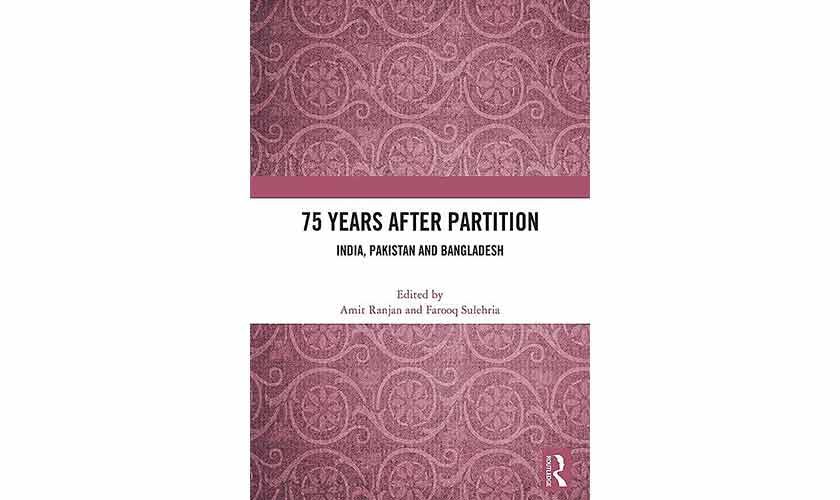
The book, 75 Years After Partition - India, Pakistan and Bangladesh, an edited volume of eight chapters, endeavours to do justice to the impact of the Partitions from multiple angles. Amit Ranjan argues that the two languages, Urdu and Hindi, are associated with religious communities: Hindi with Hindus and Urdu with Muslims. The religious identity assigned to these two languages was contested and debated during the colonial period, but in post-colonial India, too, it widened the distance between the Hindus and Muslims. Ranjan’s argument partly explains and extends what Tariq Rahman, in the chapter titled Identity: The Islamisation of Urdu in his book From Hindi to Urdu: A Social and Political History, argued.
Ritika Verma and Anjali Gera Roy’s chapter analyses selected recent mainstream Bollywood movies, which explain “Partition as an absent presence that continues to inhabit and shape the lived experiences of individuals and communities.” The writers divide movies into two categories: ones that depict cultural loss and argue for a shared humanity undivided by geographical boundaries; and the other - nationalistic movies - that provide an ultra-nationalist version in the dichotomous positioning of India versus Pakistan.
The chapters contributed by Devika Mittal and Mazhar Abbas use similar source material, i.e, curriculum and textbooks, but in different contexts: Mittal focuses on narratives produced and circulated through state-sponsored curriculum and textbooks in India; Abbas reflects on the process of re-imagining and reproducing the Partitions of 1947 and 1971 in the textbooks during the dictatorial regimes of Zia and Musharraf.
Qaisar Abbas’s chapter argues that despite embarking on divergent political trajectories, India and Pakistan are amazingly similar in their nationalistic and majoritarian dogmas, used by political elites as sources of power and control. He analyses Khadija Mastoor’s Urdu novel Zameen (Land) in the context of patriarchy during the migration process and, afterwards, under the ideological thrust of the states.
Farooq Sulehria focuses on Lollywood movies, which, he says, rarely explore the uneasy topic of the 1947 and 1971 partitions. Islamabad denies the alleged genocide in East Pakistan. Fahmid-ul Haq observes in the seventh chapter that, in the memory of the Bangladeshi people, 1971 is relatively fresh and plays a vital role in the politics of nationalist construction. The last chapter by Afroja Shama argues that the Partition in 1947 and the birth of Bangladesh in 1971 are distinct events, yet many researchers have identified commonalities. She explores how the people in Bangladesh perceive the partition of British India and whether they recognise the Liberation War as an extension of the Partition.
The book is a timely academic intervention, highly relevant and instructive for students, researchers and scholars interested in the history of South Asia.
The author heads the History Department at the University of Sargodha. He has worked as a research fellow at Royal Holloway College, University of London. He can be reached at [email protected]. His X handle: @AbrarZahoor1