Print Story
X




Lahore’s celebration of Faiz Ahmed Faiz proved livelier and more layered this year than before
| T |
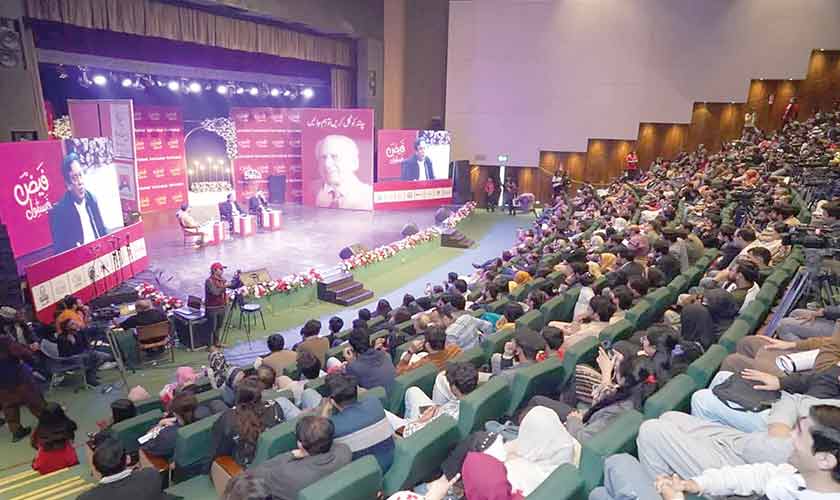
his year’s Faiz Festival in Lahore reminded me of Helen Keller’s essay, Three Days to See. From February 13 to 15, the three days of the 10th Faiz Festival at Alhamra, The Mall, were imbued with all that one’s heart could long to see and experience before the onset of spring. I had the good fortune of spending two days at the well-adorned, spick-and-span venue, replenishing my literary appetite through hearty, intimate and candid discussions, as well as book launches. In keeping with the legacy of the revolutionary poet, his kalaam (oeuvre) was recited in almost every session. It was also sung and even danced to.
The first session I attended was a thought-provoking discussion on the absence and importance of reading in contemporary times. Titled Gen Z, Gen Alpha and Faiz, it featured Anjum Altaf as one of the panellists. The speakers agreed that poetry is layered with meaning and requires certain prerequisites to be understood satisfactorily, though complete comprehension remains elusive. When it comes to the poetry of Faiz Ahmed Faiz, the meaning of the basic word mohabbat (love) differs from poem to poem. For instance, the line mujh say pehli si mohabbat meri mehboob na maang (Do not ask of me, my beloved, the love I once had for you) carries a meaning quite different from that generally assumed by readers. Here, as one of the panellists pointed out, Faiz addresses his watan (homeland) as his beloved.
Picking up on this, Altaf added that one needed an adequate vocabulary to grasp the nuances of poetry. He regretted that people had lost their connection with books and the habit of reading. “One must have an adequate vocabulary to understand the poetry of Faiz, not to speak of the poetry of maestros such as Mirza Ghalib and Mir Taqi Mir, which is quite complex and requires a certain degree of finesse and skill,” he concluded.
This was followed by the much-anticipated launch of Mohammed Hanif’s new novel, Rebel English Academy. He sat down for a conversation with Navid Shehzad, the actor, writer and academic. Hanif arrived slightly late and entered the hall to a rousing welcome. Before formally beginning the session, Shehzad playfully stroked his arm and remarked: “I am just checking if your limbs are safe and sound, because after writing a book like Rebel English Academy, anything can happen.”
Hanif replied: “Times have changed quite a bit;such things are less frequent these days.”
They discussed power dynamics, the role of the mosque as a community centre in a city such as Lahore, misogynistic elements and the depiction of sex, both good and bad. Towards the end of the session, Shehzad said: “I suspect that you really love women.” Hanif handled this deftly, replying: “I do not know about other women, but I love you.”
“Power hunger is a basic instinct in humans.”
The following day, Sunday – and the final day of the festival – I attended the launch of Sarmad Sehbai’s oxymoronically titled novel The Blessed Curse. The panel comprised Dr Waseem Anwar, professor of English and director of ICWPE, and Mehvish Amin, editor-in-chief of The Aleph Review. With no holds barred, the panellists shed considerable light on the themes of hunger for power, sex and religious hypocrisy in the novel.
Anwar compared the book with much-acclaimed allegories such as Aesop’s fables and Geoffrey Chaucer’s fabliau The Nun’s Priest’s Tale, and discussed in detail the phallic proclivities of the protagonist, Nawabzada Noor Mohammad Ganju. Aminelaborated on the similarities among megalomaniacs across continents. Commenting on the novel’s macho element, Anwar observed: “Power hunger is a basic instinct in humans.” He added: “We can take examples from Julius Caesar, Macbeth and Doctor Faustus. It shows that lust for power has existed since time immemorial.”
As the session drew to a close, Anwar read a brief excerpt from Chapter 6: “Elections are a season of intrigue. The wounds of old rivalries are scratched open and crime rates go up. Bets are laid, voters are bribed, booze flows, predictions are floated by astrologers, and journalists clamour for pay-offs. Time to make serious money.”
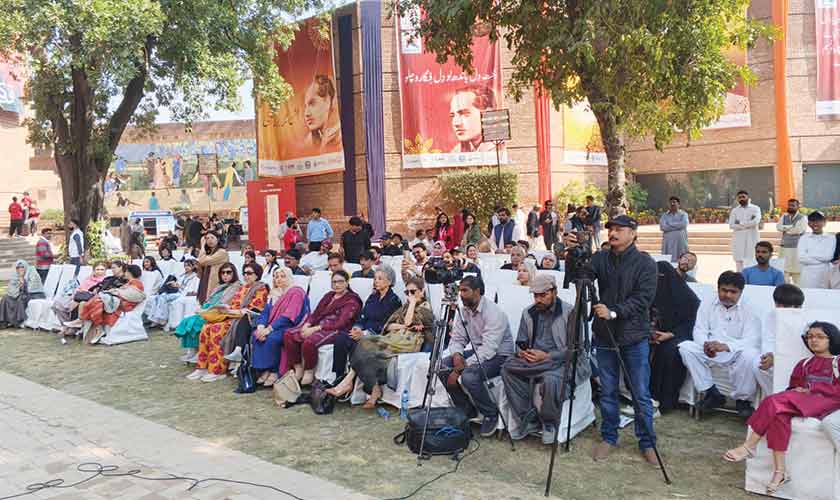
Outside the halls, the resplendent gardens of Alhamra, with their colourful decorations, played host to musical concerts, occasional kathak performances and ever-energetic drum circles, alongside food stalls and other attractions. Before night fell and brought the festival to an end, I sat in the food court with friends, sipping tea and taking in the lively ambience, alive with laughter, music and the hum of conversation. It was, without doubt, a brighter and more vibrant event than last year’s.
The writer is a storyteller and literary critic. He may be reached at [email protected]