Print Story
X




Discussions at the Munich conference made it clear that the global order is being redefined
| T |
he 62nd Munich Security Conference, which concluded last week, highlighted a world in transition and traditional alliances under pressure. Unlike some of the past gatherings that had followed predictable routines, this year’s conference reflected an era of strategic flux. From the war in Ukraine to growing doubts over trans-Atlantic cohesion, the discussions showed that the global order was being redefined.
In his opening address, German Chancellor Friedrich Merz spoke with unusual clarity. He said that Europe could no longer rely on old certainties or assume indefinite security guarantees from others. His message was simple and powerful: Europe must step forward, strengthen its defence capabilities and prepare for a world where responsibilities will be shared more equally.
Other European leaders, including Ursula von der Leyen and Emmanuel Macron, reinforced this message, stressing closer military coordination, higher defence spending and a stronger European pillar in NATO.
Meanwhile, US Secretary of State Marco Rubio reaffirmed America’s commitment to NATO, delivering a measured and conciliatory message. His tone was notably softer and more diplomatic than some other US officials. He sought to reassure Europe while subtly highlighting expectations on defence contributions.
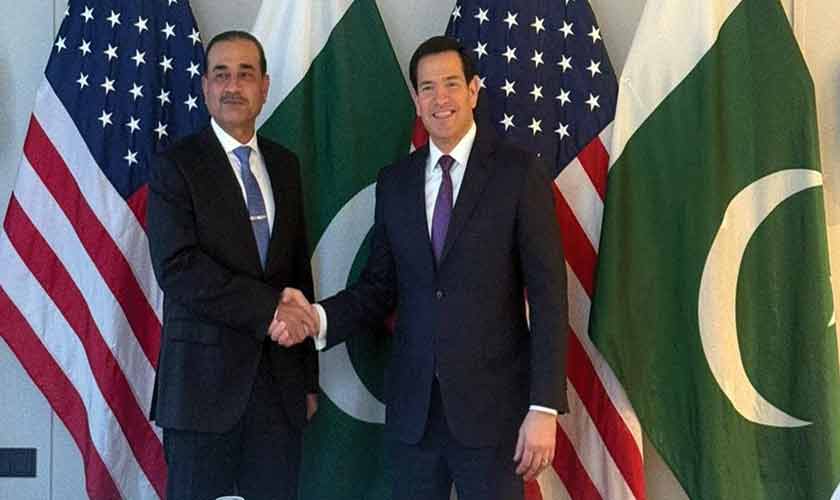
Amid this strategic recalibration, the Pakistani delegation maintained a robust and purposeful presence. Field Marshal Syed Asim Munir and Secretary Rubio discussed matters of mutual interest, including global and regional security dynamics and counterterrorism cooperation. During his interactions with German authorities, the COAS also met with Alexander Dobrindt, the federal minister of the Interior of Germany; Günter Sautter, the foreign policy and security advisor to the federal chancellor; and General Carsten Breuer, the chief of defence of the German Armed Forces. The discussions focused on contemporary security challenges, bilateral defence cooperation and the promotion of global peace and stability through both bilateral and multilateral dialogue.
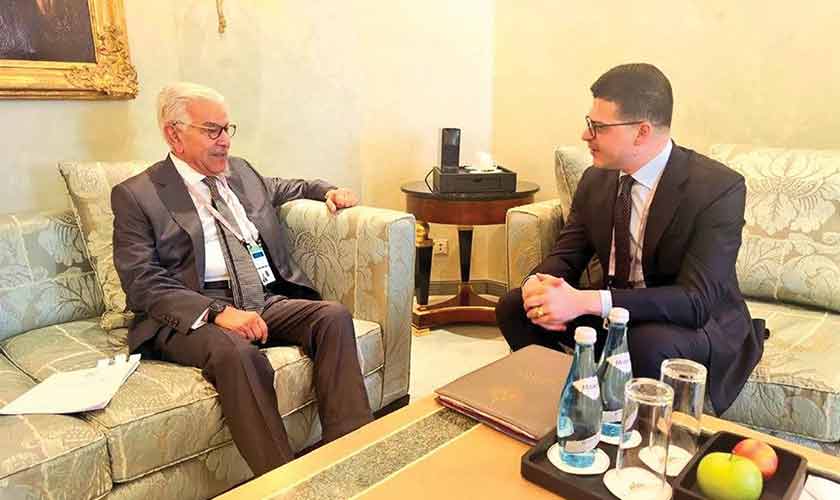
Defence Minister Khawaja Muhammad Asif participated in high-level discussions with European counterparts and other global leaders, including meetings with the Italian defence minister; the defence minister of Albania; the Iranian foreign minister; the chairperson of China’s Foreign Affairs Committee; and the British and Belarusian defence ministers. The discussions covered global security developments, regional stability and prospects for future cooperation. He also engaged with the Pakistani diaspora in Germany and Italy, including a community meet-up and dinner, reinforcing Pakistan’s connections with overseas Pakistanis and highlighting the role of expatriate communities in strengthening bilateral ties and strategic outreach.
The overall tone of MSC 2026 was sober and forward-looking. While divisions within the trans-Atlantic alliance were acknowledged, there was consensus that cooperation remains indispensable. For Pakistan, engagement at this level is not symbolic; it is strategic. It allows Islamabad to strengthen partnerships and project clarity amid a rapidly shifting global landscape.
Secretary of State Marco Rubio and Field Marshal Syed Asim Munir discussed matters of mutual interest, including global and regional security dynamics and counterterrorism cooperation.
Speaking on the sidelines of the conference, Defence Minister Asif described this year’s gathering as “good and productive.” He said that Prime Minister Shshbaz Sharif had originally been scheduled to attend. However, due to upcoming engagements in Washington, the prime minister was unable to travel to Munich. Asif said that several meetings planned at the level of heads of government could, therefore, not proceed as envisaged. Still, he said, Pakistan maintained a “robust presence,” with the chief of the defence forces participating in key discussions.
Reflecting on the overall tenor of the conference, the minister said what stood out most was the evolving European perspective. he said a clear message appeared to be emerging: “Europe has decided to assert itself.” According to Asif, there is a growing sentiment in European circles to move beyond the traditional American influence orbit. The perception, he observed, is that American security policy is increasingly out of sync with European interests.
Asked about India’s expanding engagement with the European Union — particularly in light of what the EU leadership recently termed the “mother of all deals” — and how Pakistan intends to position itself strategically in response, Asif framed his answer in a broader reflection on global fragmentation. He said that international politics had entered a markedly fluid phase, in contrast to the clearer bipolar alignments of the 1950s, ’60s and ’70s when power blocs were more structured and predictable.
Referring particularly to the speech delivered by the German chancellor, Asif said it could be interpreted as signalling Europe’s desire for greater strategic autonomy. The implicit message, in his assessment, was that Europe was seeking to reduce its dependence on the United States as Washington was reassessing the extent to which it should continue bearing the financial burden of European defence.
“At this stage, it is difficult to clearly understand the dynamics,” he said. “Perhaps in four to six months, the picture will be clearer.” He said it will depend on how the situation in Ukraine evolves.
About Pakistan’s GSP+ status with the European Union, Asif expressed cautious optimism that it will continue beyond 2027. “InshAllah, we will be able to continue with it,” he said while acknowledging the inherent uncertainty of periodic reviews. In candid remarks, he said Pakistan must remain pragmatic and responsible in multilateral frameworks until it achieves true economic self-reliance.
In his role as aviation minister, Asif discussed expansion plans for Pakistan International Airlines. Following the restoration of routes to the United Kingdom and Paris, he confirmed that destinations such as Frankfurt, Oslo, Barcelona, Milan and Copenhagen remain available. However, he said, limited fleet capacity continued to constrain expansion. The planned acquisition of five to six additional aircraft, he said, would significantly enhance operational outreach. He also said that flights to New York were expected to resume in the near future.
Asif dismissed speculation regarding former prime minister Imran Khan being sent abroad for medical treatment. He said there had been no such demand from Khan’s side either.
On a lighter note, he said he had missed the kite flying Basant in Lahore as he was in Saudi Arabia attending a defence conference at the time.
The writer is an accountant based in Munich, Germany. He tweets at @SaudBinNauman1