Print Story
X




At Urdu Worlds in Dubai, Zarina and Ali Kazim explore the widening divide between Urdu and English
| F |
or European colonial administrators, language became the most effective, far-reaching and enduring weapon. Once a people were dispossessed of their tongue, they were delinked from their histories, systems of knowledge, rituals, customs and aesthetic practices. The existence of multiple languages in a society is not a unique phenomenon, but once a language is tied to power and subsequently translated into class differences, it carries a heavier and often unbearable burden.
The gap between Urdu and English in our society is an example. If Urdu was a sign of identity for most South Asian Muslims, in place of their regional languages, English, introduced and imposed by the British rulers, established its supremacy as the medium of instruction, a means of acquiring lucrative jobs, a symbol of higher status and a tool for becoming modern and hence international. The increasing influence of North American industrial, intellectual and cultural products has, in some ways, erased the demarcation between former colonies and independent states. Not only is English heard everywhere, its American accent is also common, even among children who have never been to the United States but have picked it up from cartoons and Hollywood films.
Thus, the divide between speakers of English and Urdu is widening and becoming increasingly unbridgeable, particularly when it is linked to income. English is associated not only with affluence but also with seriousness, politeness and etiquette. For example, a swear word in Urdu is considered vulgar, whereas its literal translation into English may not carry the same offence. The same applies in literature and journalism. Because of its elitist aura, English permits printed material that would not be possible, or permissible, in Urdu. This disseminates the former as a language of freedom and sophistication, while the latter is perceived as coarse and uncouth, a distinction that extends to the users of both tongues.
Urdu Worlds, an exhibition of Zarina Hashmi and Ali Kazim’s work (January 16- May 31, Ishara Art Foundation, Dubai), focuses on the multiple layers of Urdu. Curated by Hammad Nassar, it “stages a conversation between a distinct body of work by the legendary artist, Zarina (1937-2020), and an expansive survey of two decades of work by Ali Kazim (b 1979).”
For both artists, language is as significant as faith, two poles of identity. Just as Muslims around the globe offer their prayers in Arabic, language becomes a binding force. When travelling, one passes through a multitude of skins, costumes, ages and genders. The moment one hears a stranger speaking in one’s mother tongue, a bond is established.
Language not only remained a valid passport, but also a permanent hometown for a Zarina, a perpetual traveller. In her intaglio print Travels with Rani I (2008), a map with interconnected dots, superimposed on a page, is filled with the names of cities in India and Pakistan, though not in their geographical order. It becomes an atlas of memory, which in many instances feels more real than a physical one.
She similarly transforms the temporary into the tangible. In Home Is a Foreign Place (1999), a set of 36 images on paper, Zarina recalls the experience of a house in the subcontinent, drawing its spaces and alluding to its light, temperature, high ceilings, blinds, windows and various points of entry. Through selective, almost text-like delineation, the imagery is turned into collective memory.
The other marker of identity for an individual, whether practicing or merely born into it, is religion. In the interwoven culture of South Asia, beliefs are knotted together, particularly at shrines, in processions and through artefacts of faith. Zarina’s Tasbih (2011), comprising 99 beads, is made of maple-wood coated with sumi ink, covered with specks of 22-carat gold leaf and strung with oxidised steel wire. Owing to its number, it suggests a link to the names of God, yet it remains an object not limited to a specific order or religion.
Language not only remained a valid passport, but also a permanent hometown for a perpetual traveller.
The circular form of beads reappears in Zarina’s print Moon (part of Home Is a Foreign Place), portraying the rotation of a satellite that determines the Islamic calendar. In his Chaand (2025), Ali Kazim marks the spread of light and darkness across the moon from the beginning to the end of a lunar month. The aquatint print is from Kazim’s Qaida (alphabet primer), as is Darakht (Tree) (2025), an etching and aquatint that meticulously depicts the trunk and barren branches of indigenous vegetation. The precision of the rendering brings to mind the French artist Jean-Auguste-Dominique Ingres’s observation: “It takes thirty years to learn to draw and three days to learn to paint.”
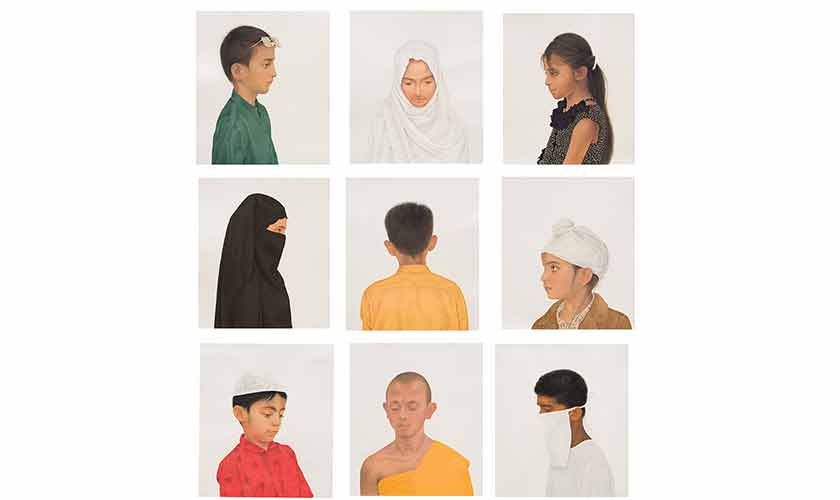
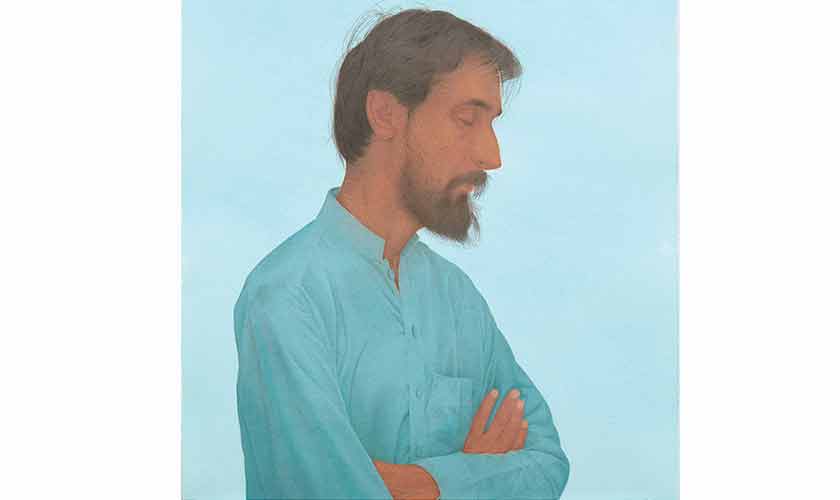
In Kazim’s watercolour paintings, however, one observes a similar strength of rendering, particularly in his two portrait series, Men of Faith (2019) and Children of Faith (2025). Both comprise signs of identity that human beings carry, whether as religious duty, cultural habit or ritual attire. The latter series features children wearing hijabs, veils, monks’ robes, Sikh turbans and prayer caps. The works may be read as a commentary on a fractured world that conditions children, accidentally born into various religions, to become parts of walled communities and warring identities.
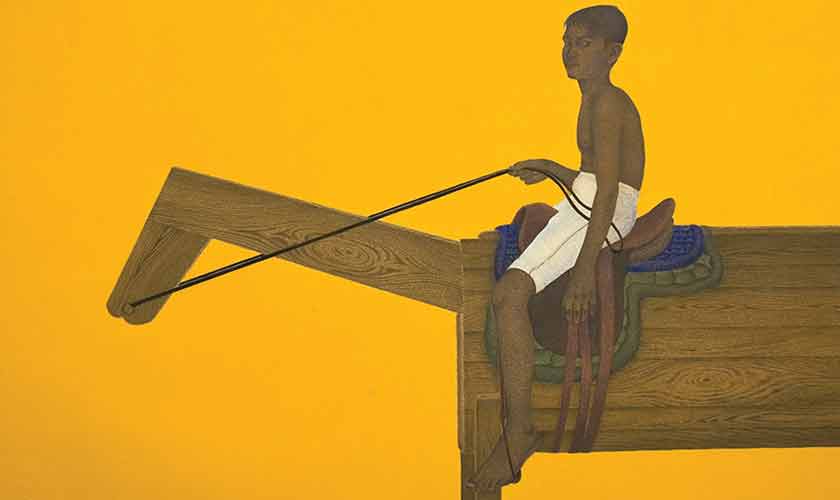
Kazim critiques that social framework by juxtaposing these images with children at play: a boy riding a wooden hobby horse (Shah Savaar, 2009), or mounted on a tiger attached to a mechanical contraption (Sher Khan, 2009). In the same group appears Aankh Micholi (Hide and Seek) (2023), showing a blindfolded girl among her peers, as if caught in a Kafkaesque sequence.
The same uncanny element in Ali Kazim’s art appears in his Hudhud (Conference of the Birds) (2022), inspired by Farid al-Din Attar’s mystical poem. His detailed rendering of flying species resurfaces in Tteela (2025), another large watercolour in pigment on paper. Kazim maps a ruinous terrain with its mounds, passages, pebbles and ridges, as if it were not a drawing made by a contemporary artist but an eternal entity that will outlive human existence.
Earthiness has been a recurring motif in Kazim’s art. His terracotta Untitled (Votive Objects) (2022) comprises a cluster of mounds that may be read as mosque domes, Buddhist stupas, or the tops of Hindu or Sikh temples. Yet their origin, history and usage are undermined, rendered unimportant, as they ultimately demonstrate mankind’s desire, and destiny, to return to dust.
A significant portion of our shared human past is preserved in fired clay objects dating back 7,000 years. Intriguingly, when a person visits a history museum, they may fail to notice the difference between a terracotta piece displayed in a cabinet and a similar object used at home, except that the museum artefact is broken and mended. Kazim creates a personal history in his series Untitled (Fallen Objects) (2014), composed of terracotta shards and epoxy resin, a combination of multiple pots fixed together in a disjointed form. The work recalls his 2017 watercolour Theekrian, comprising fragments of fallen pitchers scattered across a pale surface. The image suggests how a post-colonial society’s history is dismantled, tradition remains in transit, and the future lies spread on the floor.
The work, like language itself, is born of a particular soil, the motherland, with all its shades, textures and nuances embedded in the home. It is a place where one can converse in one’s mother tongue, even while commanding many languages of the world.
The writer is a visual artist, an art critic, a curator and a professor at the School of Visual Arts and Design, Beaconhouse National University, Lahore. He can be contacted at [email protected]