Print Story
X




Muhammad Ali Afzal’s untitled canvases at Ocean Art Galleries reject art-world jargon and market expectations
| T |
he fact that 37 paintings in Muhammad Ali Afzal’s solo exhibition at Ocean Art Galleries, Lahore, are without titles, not even labelled ‘Untitled,’ is a notable detail. It indicates a contrast between mainstream art and practice from the periphery. It has become common to encounter tortuously impenetrable titles, accompanied by labyrinthine descriptions and convoluted statements. The same can be observed in curatorial notes, art criticism and, last but not least, academic discourse on art.
Why, then, was Afzal not smitten by the glaring light of words when dealing with his visuals? An artist who studied at the National College of Arts before acquiring his MFA from the Pratt Institute, New York, and who has several solo and group exhibitions to his credit, he is no stranger to the art world. The answer lies in the life and aesthetics of an individual who has spent most of his career away from the power centres of art, such as Lahore and Karachi, pursuing his vision and producing his imagery. The resulting body of work is clearly different from that of his peers and significantly unexpected from someone with years of experience.
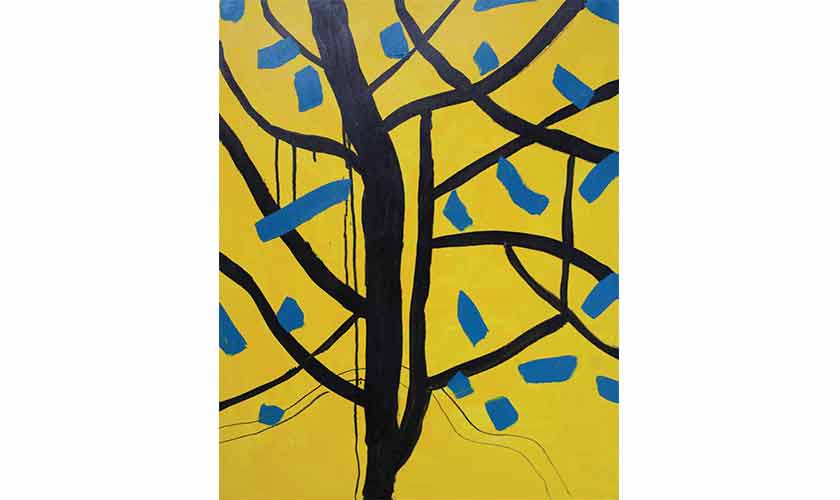
His paintings, most of them made recently, are vibrant, lucid and free. Following his mood, or the spur of the moment, they are liberated from classification. Neither landscapes nor representational, stylised or abstract, Afzal’s pictorial language reflects an urge to express, almost to explode, without being literal. Looking at his work in oil on canvas, board or aluminium, the viewer dips into the artist’s mind, which appears unconcerned with the outcome of his creations. Perhaps instinct, or the instant, determines the course of his brush and the choice of his palette.
In truth, ragged terms such as course and choice fail to lead us into his art. The imagery seems to occur as suddenly, naturally and uncontrollably as the emergence of flowers on a stem one fine morning. We may understand the botany, the geological composition of a particular soil, the cycle of seasons, yet remain uncertain about the shape, colour, size, scent or the hour at which a flower begins to bloom. The Israeli novelist Amos Oz elaborates on this phenomenon in his book of interviews: “Take an apple. What makes an apple? Water, earth, sun, an apple tree and a bit of fertiliser. But it doesn’t look like any of those things. It’s made of them but it is not like them.”
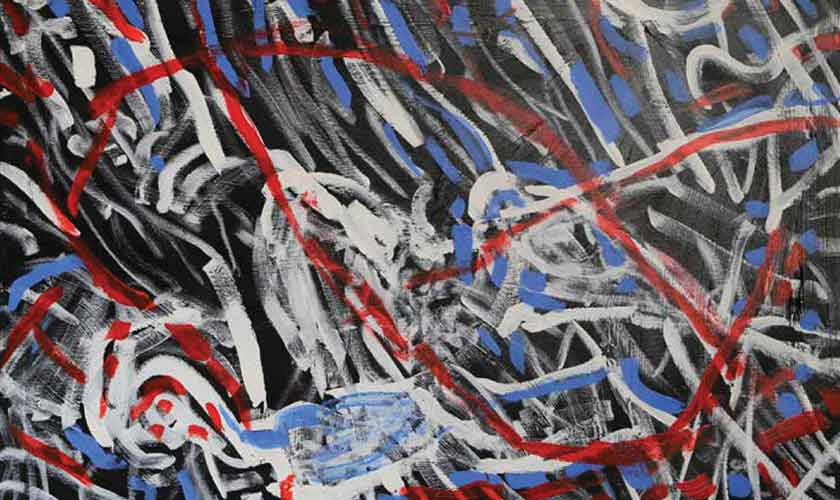
A survey of Afzal’s work from his solo show Unspoken Echoes reveals subtle yet diverse directions, largely intertwined. Architectural views featuring trees, fields, stretches of sky and sunrises in disarray are not dissimilar to canvases marked by winding circles and wandering lines. In the category of landscape, if one dares to classify, there is a striking painting of a lone, barren tree amid green vegetation, with a white car (crumbling, hesitating, strutting?) on a dirt track. The work may be read as a self-portrait: a solitary soul situated within a vast, enriching external environment; a man of few words and a select circle of contacts. As the background of both tree and vehicle suggests, the painter seems content to remain apart, absorbed in his studio and producing a distinct vision. Another artist of related imagery, freedom and setting was the late Shahbaz Malik, his distant kinsman and townsman.
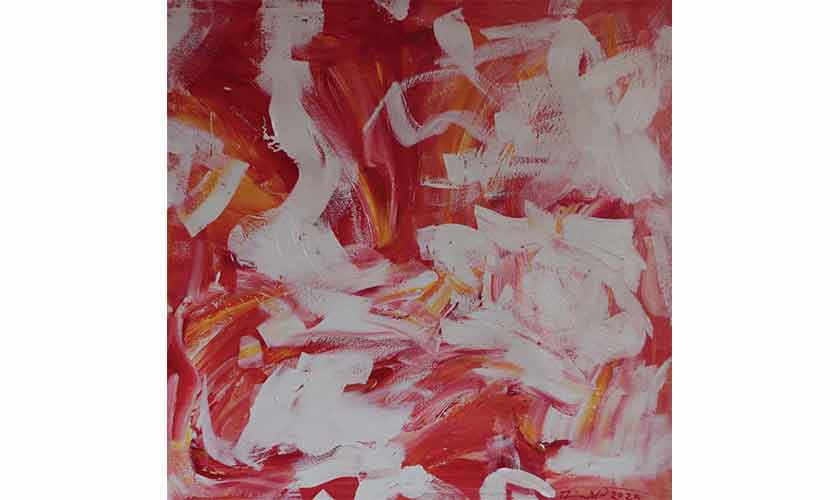
In the exhibition, one encounters layers of vivid colour, stray strokes and luminous hues without the need, or compulsion, to identify a tangible reality or a transmissible concept.
Echoes of other presences can also be discerned, such as a large jacaranda with purple blossoms hovering over a row of low residential structures. The shift in proportion between tree and walls is as striking as the force of nature embodied in the tree itself. Through a multiplication of spotty brushstrokes, mauve marks set against green patches beneath the bright blue sky of Bahawalpur, Muhammad Ali Afzal renders not an external scene but the memory of many encounters.
Some of his surfaces evoke specific, though simplified, associations: female faces in two paintings and a canvas composed of floating eyes. His brush, whether shaping a subject rooted in distant observation, stored in imagination or drawn from a familiar location, does not rely on description or context. In this, the hand of the painter (born in 1948) resembles the celebratory abandon of children as they fiddle with their materials and tools.
The freedom Afzal affords himself is the result of years of study, dedication and focus. In the exhibition, one encounters layers of vivid colour, stray strokes and luminous hues without the need, or compulsion, to identify a tangible reality or a transmissible concept.
Muhammad Ali Afzal’s canvases pose another question: how many artists around us have the privilege of discarding imposed ideas, expected themes, intellectual posturing, social responsibilities or pictorial riddles, all that is demanded by patrons, gallerists and fellow artists? The power of mark-making, the approach to form and the lyricism of shapes found in his imagery do not respond to any preconceived template of art. In that journey, it is irrelevant whether some of Afzal’s canvases appear more effective than others, or more accomplished, because that is neither his desire nor his strategy.
This should not be mistaken for a lack of discernment in the making of his work. Afzal cannot be associated with the naïvety often attributed to children’s drawings. The rawness in his imagery is a blend of natural expression and disciplined training. In this pursuit of pleasure, Muhammad Ali Afzal communicates directly with his viewers. That is one reason his paintings lack titles, though they are accompanied by the necessary details of medium, scale and year.
Another, perhaps more substantial, reason for the absence of titles is his location, or dislocation. He does not belong to the cohort of artists who orbit mentors and buyers, reside in cities known for major art schools, aggressively brand their creations or join a bandwagon early in their careers. Afzal is at peace with his tools and surfaces. Undistracted by the commotion of the art world, he has established a private abode where he lives and paints for himself, much like his work, which unfolds a range of realms seen simply for what they are.
The writer is a visual artist, an art critic, a curator and a professor at the School of Visual Arts and Design, Beaconhouse National University, Lahore. He can be contacted at [email protected]