Print Story
X

| A |
t one on the dot on February 12, a group of students started gathering next to a truck parked outside the imposing building of the Government College University. The environment was charged, yet somber as instances of suicides on campuses were still fresh in the minds of most students. The organisers wore black to symbolise mourning.
The students were soon joined by some lawyers, rights activists and members of the civil society. On the back of the truck hung a poster, with a quotation from Ghassan Kanafani, a Palestinian writer and activist. It read: “The Palestinian cause is not a cause for Palestinians only, but a cause for every revolutionary, wherever he is, as a cause of exploited and oppressed masses in our era.”
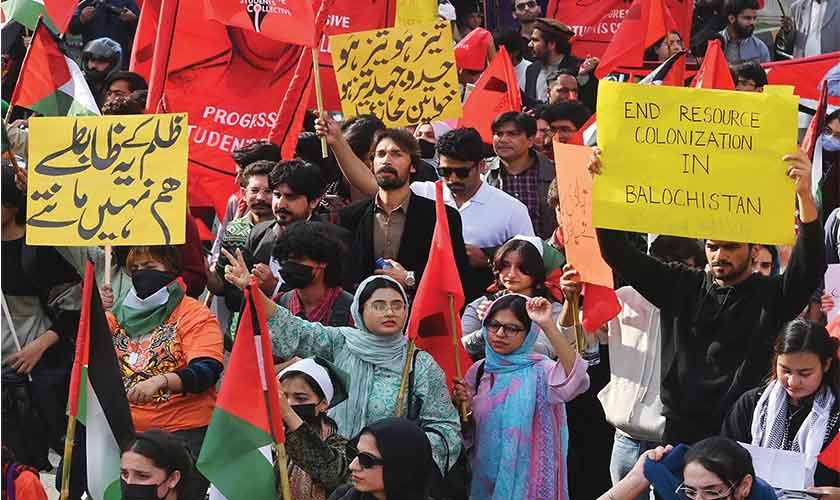
The Student Solidarity March 2026 felt refreshing and alive. Students organised themselves into marching columns, guided by volunteers on the side, their voices rising in a chorus as they yelled, “Azadi,” in response to “Toh hum kya chahtay hain?” Others held up placards.
The students, who had come to attend the march from universities from all over Lahore, walked with a sense of discipline and civic responsibility, keeping the left-most lane open for traffic and cooperating with the traffic wardens.
As the march made its way from GCU to the Punjab Assembly, curious onlookers stood on the sides. Beaming, the students explained why they were marching. Water bottles were passed around. The organisers kept the crowd alive by leading chants and slogans.
A poster read, “Inclusive student unions, now.” Another said, “End fee hikes.” Yet another declared: “If your presence unsettles the oppressor, you are my comrade.” Emblazoned on others, in bold letters, were the words “End privatisation,” “End resource exploitation in Balochistan,” and “Aurat Ittehad Zindabad.”
The heterogeneity of the slogans underscored the ethos of inclusion and highlighted the multi-faceted nature of students’ demands.
When the march spilled onto The Mall, Frazey Ali, a student at GCU told TNS, “If I could describe the experience of marching for our rights in one word, it would be empowering.”
Iconography and art
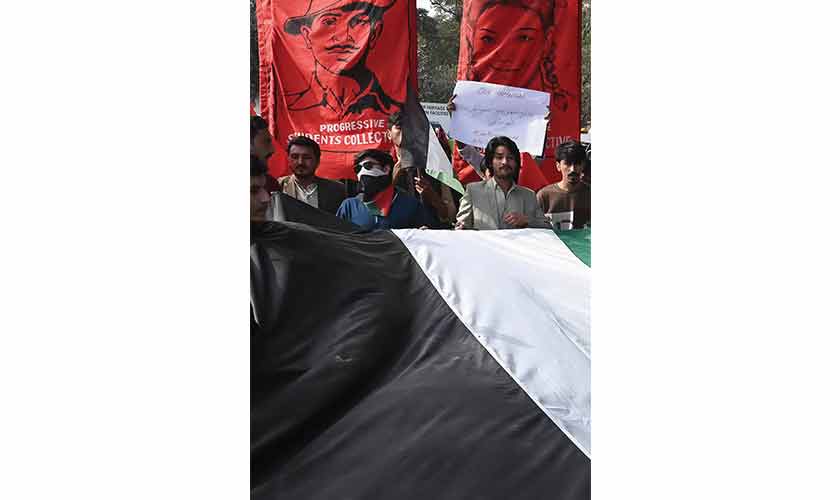
Before the students started walking, they unfurled four red sigils with close-ups of different people stamped on them.
“Today, as we march, we carry sigils, each one honouring a revolutionist; Bhagat Singh, the Punjabi anti-colonial revolutionary; Hasan Nasir, the student activist tortured to death; Che Guevara, an Argentine Marxist revolutionary; and Hind Rajab, the five-year-old Palestinian girl murdered by the IDF,” blared the voice of Eqbal Khan, the general secretary of Progressive Student’s Collective that had organised the march.
The students also carried small red flags with PSC written on it, a red banner calling for lifting the ban on student unions and Palestinian flags. Some of the organisers wore keffiyehs to signal solidarity with the Palestinians.
During the walk, the students also unfolded a huge flag of Palestine, forming groups on each of its four corners and gripping it as they marched to the assembly.
Mobilisation
Ahsan Javed, a student of University of Lahore and the central organiser of PSC, said that the march was a result of year-round mobilization. “We hold study circles throughout the year and support students across Pakistan. This year, we visited various institutions in Lahore, private as well as public, and engaged with students on the basis of the problems that they face on a day-to-day basis. The response was overwhelming. Students are tired of not being represented.”
Javed added, “Our politics is issue-based. That’s why the crowd you see is so diverse; there are students from all institutions in Lahore.”
Demands
“40 years ago, a military dictator decided to ban student unions. We have been stripped of representation ever since,” said Ali Abdullah Khan, the central president of PSC.
“The situation has deteriorated to the point that students are committing suicide under administrative stress.”
Sara Ali, the PSC spokesperson, said there were no institutional mechanisms in place to deal with harassment on campus. She said that as long as female students remained underrepresented in the decision-making bodies, harassment would persist.
Aiysha, a student, had listed down some of the problems students endure: “Fee hikes, no female representation in anti-harassment committees, no transparency about the allocation of funds and impossibly high fees for higher education.”
Hanan*, a student from Forman Christian University said, “As a student in today’s political climate, I often feel hopeless, but seeing so many people coming together for a common cause gives me hope to keep going.
“My placard demands to centre the discussion of student unions being inclusive of class, religion, ethnicity, gender and disability status. It is only then that the unions can work effectively and for everyone on campus,” he added.
Former PSC vice president Hammad Kakkar said that students from FATA and Balochistan in particular were facing double oppression: first, the absence of quality educational institutions; and second, frequent arrests and enforced disappearances of students. He demanded immediate release of all arrested students and the recovery of abducted students.
The students also demanded the restoration of student unions, addressing the institutional causes behind rising cases of student suicides, the establishment of anti-harassment committees on campuses, withdrawal from the so-called Gaza Peace Board and the release of all political prisoners across the country.
The students also demanded a reversal of fee hikes, a 50 percent subsidy on transportation and health, de-securitisation of campuses and an end to restrictive measures imposed in hostels.
Yeh Kissa Badlay Ga
As the participants settled down and speeches commenced, a troupe of students stood in one corner. They were members of the Artist Assembly, the cultural wing of the PSC, awaiting their cue.
Laiba Imran, their head, effortlessly glided through the crowd in a black shalwar kamees. She said, “The theatre performance we’ve planned is student-centric. We wanted to address the state of depression students are in due to various administrative policies. We also wanted to cover other problems that students face through the modality of street theatre.”
The play, titled Yeh Kissa Badlay Ga, is inspired by veteran lyricist Piyush Mishra’s Suno Ray Kissa. It began with students sitting in a semi-circle and narrating their problems, one by one. “My mother is sick,” said a girl in a plaintive voice, “Please try to understand and accommodate me.”
A robotic character representing the university administration stepped forward. In a halting voice, punctuated by pauses, she said, “Your attendance has been interred in the automated system. No changes can be made now. You’ll have to take the semester again.”
The play ended with a student committing suicide due to attendance issues.
Talking to TNS, Imran said that her group had come together organically: “We come together and practice and find ways to get our message across, within our limited means.”
Aamna Shahid is a staff member