Print Story
X




Recalibrating strategies to win the hearts and minds of the people might serve well in the long run
| T |
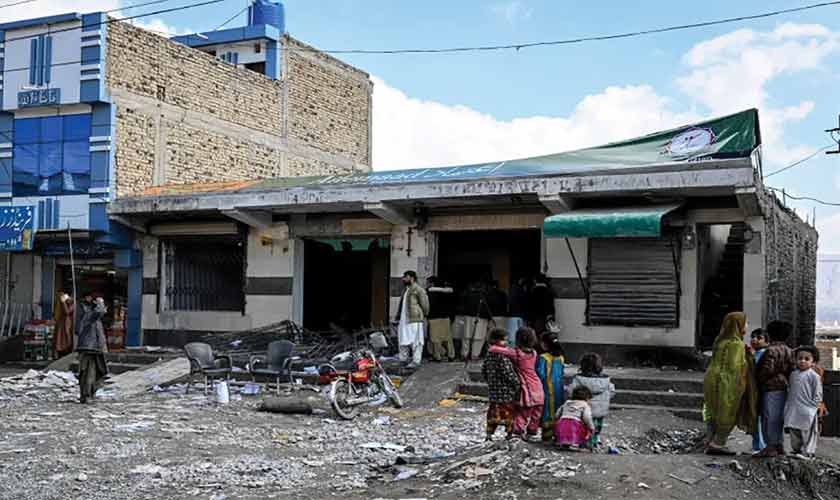
he recent coordinated attacks in 12 areas in Balochistan, including Quetta, the provincial capital, show the strength of terrorists compared to the police and security forces. The outlaws, who looked well equipped and well trained, started early morning attacks on security forces’ compounds, police stations, prisons, offices and residences of deputy commissions and district police chiefs. So much so, they reached the gate of Red Zone in Quetta, just 300 yards away from the Governor and the Chief Minister Secretariats, and residences of judges, ministers and inspector general of police.
The government claims to have killed 216 terrorists. Besides, 36 civilians and 22 security forces and law enforcing agencies’ personnel were martyred. The banned Baloch Liberation Army, which launched these attacks through its suicide wing Majeed Brigade, claimed that they had lost 96, including 50 suicide attackers.
Herof Phase I was launched on August, 26, 2024 (on the death anniversary of Nawab Akbar Bugti). These attacks had targeted a few towns and highways, killing a number of civilians and security forces and police personnel.
This was the first time the terrorists undertook simultaneous attacks on such a scale. These attacks were meant apparently to demoralise the government and foreign businesses. Some of the videos uploaded on social media showed terrorists surrounded by cheering supporters.
In the wake of these attacks Canadian copper giant Barrick Gold, which runs Reko Diq Copper-Gold project, announced a review of its security structure.
The Balochistan government announced to raise a third force of Frontier Corps to provide security to mineral-rich areas as well as borders with Iran and Afghanistan. Rs 113 billion was earmarked for law and order in the 2025-2026 annual budget besides another Rs 6 billion for internal security (a special duty in which army and paramilitary force are deployed).
The recent terrorist attacks point to a shift away from hit and run tactics and occasional ambush of security forces. This time dozens of armed men stormed compounds of security forces and law enforcing agencies. It now looks like a full-blown insurgency and cannot be countered through kinetic actions only.
Some observers say the government needs to change its policy of sidelining the main stakeholders. They point to allegations of massive rigging in the 2024 general elections, ignoring the youth and the failure to engage nationalist parties.
Certain elements in the establishment consider these nationalist groups as the soft face of separatist groups, promoting and supporting their narrative. The government has treated the raising of the issue of missing persons as promotion of the banned organisations’ narrative.
Sardar Akhtar Mengal, head of the Balochistan National Party, resigned in September 2024 from the National Assembly to protest government policies in Balochistan. His resignation has finally been accepted by the speaker. Some people will inevitably link the timing to his speech at the recent Asma Jahangir Conference in Lahore. He is barred from organising rallies and holding public meetings against what he calls illegal detention of the Baloch Yakjehti Committee’s head Dr Mahrang Baloch and others since March 2024.
Dr Malik, another former chief minister, has argued for a political dialogue with separatists, has also been protesting rigging of the 2024 election results in favour of the “favourites.” Nawab Akbar Bugti’s grandsons, who were part of the 2018 parliament, have apparently been dropped from the list of ‘favourites.’
The question then is: is it wise to sideline stakeholders of the Baloch society or force them to quit parliamentary politics, when the Baloch youth feel alienated; where a non-representative parliament and government exist? The youth currently have no tangible stakes in the current setup.
Chief Minister Mir Sarfaraz Bugti is opposed to a political dialogue and has been pursuing a hard-state policy towards separatists as well as nationalists and the BYC. He and his colleagues are alleged to have benefited from the current system.
The opposition says if a truly representative leadership is allowed to take over through free and fair elections, they will lose their relevance. Instead of improving the condition of public hospitals and educational institutions, they say, the chief minister is creating more administrative districts and divisions. The creation of each new district costs Rs 20 to Rs 30 billion initially and nearly Rs 1 billion annually. The chief minister is now planning to create another district of Dera Bugti.
Foreign support for secessionist terrorism cannot be denied. However, it is the responsibility of the government and the establishment to look into factors that alienate the youth and the Baloch population, and to engage with them.
The situation has worsened in recent months. The failure to win public support in war against separatists has contributed to the deterioration. There is a need to win the hearts and minds of the people. Serious efforts must be made to bridge the gap between the government and the people of Balochistan.
The writer is a Quetta-based media practitioner. He can be reached at [email protected]