Print Story
X




The PML-N government appears to have established control over the past two years. But with the challenges of inflation, unemployment and terrorism, can it win the battle of narratives?
| I |
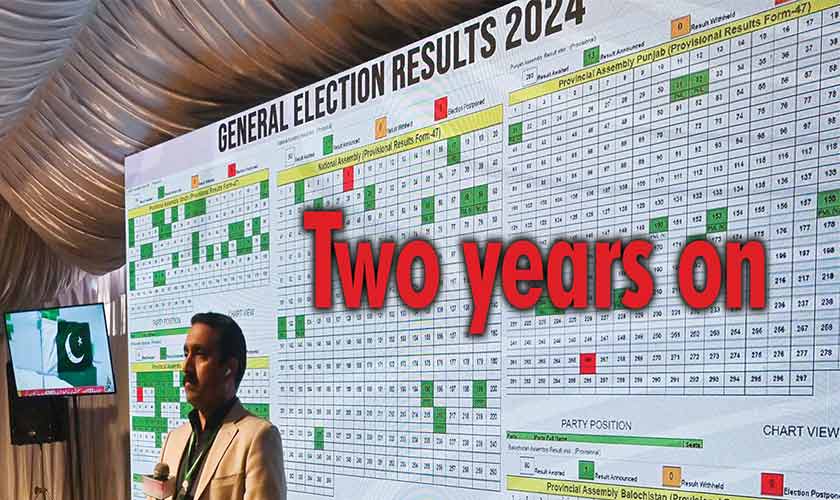
n 2026, political landscape in Pakistan depicts an uneasy stability. As the Pakistan Muslim League-Nawaz-led government enters third year in power, its track record presents a mixed picture.
Two years ago, the Shahbaz Sharif government was haunted by the challenge of legitimacy after the February 2024 elections. The last 24 months have increasingly seen it take control of the parliament. Does this mean a deepening of Pakistan’s fragile democracy? The answer is not as clear as the government might claim.
In Imran Khan’s lexicon, the PML-N’s ‘one-page’ arrangement with the establishment remains intact. With the passage of the 26th and 27th Amendments, the Judiciary is in a much less confrontational mode. The hybridisation of Pakistan’s political system has certainly gained strength since 2024. The PTI-led opposition alliance has been consistently engaged in an effort to stir up the political space for itself but with apparently limited gains.
A look back at the post-2024 election landscape in Pakistan reminds us of the initial challenges faced by the PML-N government in establishing its control over the system. Various issues pertaining to the deficit of fairness in the electoral process cast a shadow over the new state managers.
During the first year after the polls, the PTI was able to organise several rallies to put pressure on the government. The government was uneasy with several verdicts of the superior courts in cases such as the reserved seats allocation.
In some sense, the dilemmas faced by the PML-N government after the 2024 elections are similar to those faced by the Imran Khan government after the 2018 elections. Those elections were also tainted by serious questions about fairness. Like the PTI in 2018, the PML-N was at the receiving end of the wrath of powers that be. However, the one-page arrangement of the PTI government was able to ride over the opposition with great control, till its showdown with the establishment.
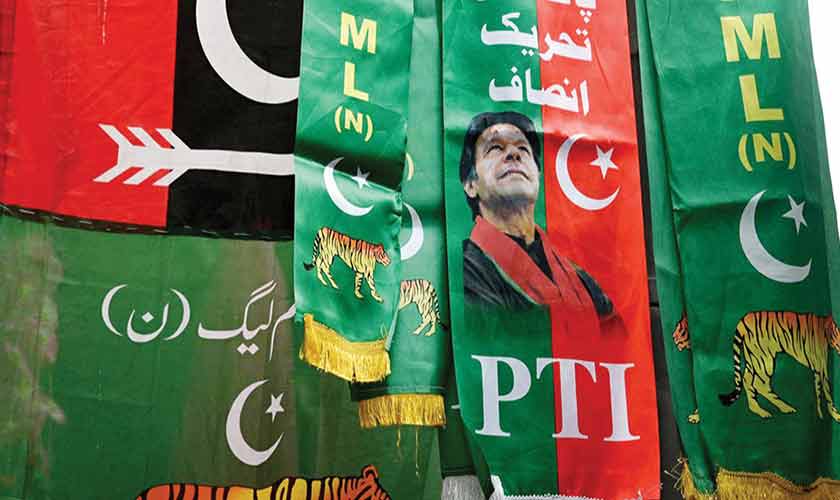
In the political arena, the PTI has been a far more successful opposition actor than the PML-N or the PPP were post-2018 elections. The PTI’s populist politics and Imran Khan’s charisma certainly made them effective opposition actors. Much like their populist counterparts in various parts of the world, the PTI has mastered the art of opposition politics through creating and recreating the narrative of resistance. However, the incarceration of Imran Khan and other top leaders of the party, has weakened the party’s ability to create problems for the government. A change of guards in Khyber Pakhtunkhwa signifies the party’s quest to refurbish its challenge to Shahbaz Sharif’s coalition government.
Will Pakistan’s Gen Z reproduce the mobilisation witnessed in some other South Asian countries? In Sri Lanka, Bangladesh and Nepal, contentious mass movements led by Gen Z have toppled governments. Will a similar script follow in Pakistan? So far, there appears little evidence to this effect. Despite the mass discontent among the ranks of Pakistan’s Gen Z, the streets in certain areas of the country present an eerily quiet picture in mainstream politics.
Will the PML-N government face a challenge in the coming months and years? Of course, Pakistan’s youth are deeply disillusioned on various counts, including unemployment. However, the tools and mechanisms of contentious mobilisation appear to be severely weak in terms of organisation of dissent at the mass level. The establishment appears to have the upper hand. Expression of dissent—already difficult in a hybrid setup—has become very challenging. The recent sentencing of prominent human rights lawyers Imaan Mazari and Hadi Ali Chattha has further affected aspirations for expression of resistance at the cost of mobilisation for resistance at the national level.
The strict implementation of PECA in various cases against the media and human rights activists appears to show the government’s unease in navigating criticism in the digital sphere and building a credible narrative about its legitimacy.
The ruling dispensation in Pakistan appears to be enjoying what looks like a unique—though short term—bonhomie in the international arena. While relations with two key neighbours, India and Afghanistan, remain deeply contentious, there are more welcoming regimes at the regional and international levels. Pakistan and the US appear to be enjoying a new phase of cordial relations under the Trump administration. Within the Middle East, Pakistan and Saudi Arabia have entered a defence alliance in 2025. Pakistan has recently joined President Trump’s Board of Peace. Pakistan appears to be a more visible international actor at the moment. This moment of international visibility has surely provided a reprieve to the government from the international criticism of its democratic credentials.
As the PML-N government inches towards the midway point of its tenure, it faces a multi-pronged challenge. Pakistan’s economic woes are far from over. While the IMF continues to pour money into Pakistan’s economy, the micro-economic picture remains grim. The government has so far failed to control inflation and unemployment. A 2025 World Bank report painted a bleak picture of Pakistan’s economy with 45 percent of the population estimated to live below the poverty line.
Security, too, remains a big challenge for the government with the rise in ethnic and religious militancy. The recent coordinated attacks at twelve sites in Balochistan reflect a dangerous upturn in Baloch insurgency. Without a massive change in the government’s approach—which appears unlikely—no short-term prospects for improvement in the situation are on the horizon in the restive province of Balochistan.
The Islamabad-Peshawar battle of narratives over the proposed military operation in Tirah Valley has once again highlighted the difficulty of managing the threat emerging from various off-shoots of the TTP. Whether the state will be able to take a decisive action against radical Islamic militants in Khyber Pakhtunkhwa remains to be seen.
Can the government win the battle of narratives? What was once described as the ‘fifth generation warfare’ has turned out to be a difficult terrain for the ruling clique. The PML-N government has struggled to keep pace with the social media blitzkrieg of the PTI. The strict implementation of PECA in various cases against the media and human rights activists appears to show the government’s unease in navigating criticism in the digital sphere and building a credible narrative about its legitimacy.
At one end, the PTI has displayed some potential for public mobilisation against the perceived democratic backsliding in the country. At the other, the party’s one-point agenda of demanding the release of its leader grossly bypasses the larger demand for opening the political system to public aspirations for equity, social welfare and redistribution of resources.
The writer is the director of the political science programme at the Lahore University of Management Sciences. She is the author of In Search of Lost Glory: Sindhi Nationalism in Pakistan (Hurst Publishers, 2021).