Print Story
X




Kazakhstan’s largest city reveals itself through quiet rituals and gentle contrasts
| T |
he aircraft touched down at Almaty International Airport just after half past midnight. Inside the terminal, a red signboard in English immediately signalled Kazakhstan’s international outlook. Kazakh-language signage was also prominently displayed, underlining the equal status of the local language. What surprised us was the absence of Russian, still widely spoken and officially recognised in the country.
Check-out was swift. We were out of the airport lounge within minutes, picked by a vehicle arranged by a friend on whose recommendation my wife and I had decided to visit the world’s ninth-largest country by land area.
We had booked a studio apartment in the city centre, informed the owner of our late arrival and paid an additional fee. As soon as we stepped outside the airport, we began calling the number provided to coordinate our check-in. After nearly 20 minutes of trying, we finally reached the owner, who introduced herself as Carla. She asked us to come to the location and wait ten minutes for her to arrive with the keys.
It was around 1.30am. The weather was pleasant, with a faint chill in the air. We stood by the roadside, cars parked neatly in a row. Carla arrived dressed in jogging clothes. She led us upstairs to the apartment, a single-room studio with a small, almost extra-small bathroom. Without fuss, she unfolded the sofa-cum-bed along one wall, quickly turning it into a bed with pillows and fresh sheets.
The room felt warm, so she opened a window to let in some air. “In July, temperatures in Almaty can go up to 35 degrees Celsius, so it gets hot inside,” she said. Pointing towards the kitchenette, she added, firmly, “The crockery is there for you to use, just make sure you clean it afterwards.” She appeared to be in her forties and had an athletic, well-maintained build.
It was getting late, and we wanted her to leave as quickly as possible. We had travelled all day from Turkistan and were desperate to collapse into the bed. We slept like babies and woke around 10.30am. When I checked the time on my phone, I felt a jolt.
“We’ve lost precious time in Almaty. Time to get up and go,” I announced.
My wife looked alarmed. She asked if I was feeling all right. When she realised the cause of my panic, she shot me an irritated glance. “Don’t worry,” she said. “Almaty isn’t going anywhere.”
“But we are,” I replied.
That did it. She understood and climbed out of bed, ready to explore the city.
Almaty is the largest city in Kazakhstan, with a metropolitan population of more than two million. It served as the country’s capital from 1991 to 1997, before Astana took over that role. The moment we stepped out of our apartment that morning, the city felt assured and modern. The roads were clean. Young people zipped past on electric scooters scattered across the city, run by two companies and easily recognisable by their yellow-and-blue paint.
The first task, one I assigned myself, was to exchange money for the local currency, the oddly named Kazakhstani tenge. We could not find an ATM nearby that would convert US dollars, so I approached a man smoking under a tree outside a building. To our surprise, he spoke fluent English and promptly gave us directions to a bank that handled currency exchange.
On the way, we passed a striking mosque crowned with a golden dome and four minarets. It was Friday. “Let’s come back at prayer time,” I suggested to my wife, who was already keen to see it up close. Google Maps showed the bank to be about 700 metres away, so I asked her to wait on a bench beneath a roadside tree while I went ahead to exchange the money. She agreed, and I hurried off.
Finding the bank was easier than changing the money. The place was almost empty, with a young boy standing near the counter to guide customers. Speaking a little English, he led me to the ticket machine and handed me token number 606. I had not realised the bank enforced a strict token system even when you were the only customer present. There were no other people in sight, and the waiting area was wrapped in silence.
After about ten minutes, the screen flickered and my number appeared. I stood up immediately and asked the boy which counter to approach. He pointed me towards one at the far end of the lobby, where a robust young Kazakh woman sat behind a glass partition. She spoke through a microphone fixed to the glass. She did not understand English and signalled for the boy to assist.

I asked to exchange 100 US dollars into tenge. After listening to the translation, she fell silent, as if thinking deeply, before beginning to tap at her keyboard. I could not tell what the delay was about. Eventually, the boy handed me a form to complete, which I filled out as best I could. The woman then asked for the exact apartment number where we were staying, information I did not have. I showed her the address on Google Maps, but she remained unconvinced.
She suddenly asked for my passport. I handed her my phone with a photograph of it.
“She wants to see your original passport,” the boy translated.
“I don’t have it with me,” I said. “It’s with my wife, about 700 metres away.”
“You may go and get it,” he replied politely.
I stood up, walked back into the main hall and called my wife to explain the situation. She understood immediately and began walking towards the bank with the passport. In the meantime, a couple entered, took a token and, after a short wait, were directed to the same counter. By the time my wife arrived, about 15 minutes later, a new token had been issued and we were back in the queue.
The couple ahead of us seemed to take an inordinate amount of time. Now I understood why. “Here, the bank staff are never in a hurry,” I murmured to my wife. “They want to make sure every customer has a proper encounter.”
After nearly half an hour, we managed to exchange our 100 US dollars into tenge. Task accomplished. We stepped out of the bank at last.
Friday prayers were scheduled for 1.15pm. Glancing at the time, we hurried towards the golden-domed mosque we had spotted earlier, the Central Mosque of Almaty, one of the largest mosques in Almaty. Built to accommodate up to 7,000 worshippers, it stands on the site of an older mosque dating back to 1890, which was destroyed by fire in 1987. Its foundation stone was laid in 1993; construction was completed in 1999.
While the building is impressive as a whole, the interior gained its distinctive character in 2000, when Quranic verses were added inside the great dome. Turkish calligraphers had clearly poured care and devotion into the work. The hall was simple yet striking. The mihrab wall was adorned with glazed blue and green tiles. A grand chandelier hung overhead, lending the space both warmth and quiet grandeur.
After prayers, we stepped outside to see rows of worshippers along the roadside, praying on their mats. It felt welcoming, almost communal. Hunger soon set in. We decided on Turkish doner. With a Turkish population of around 45,000, Almaty has no shortage of Turkish eateries. The one we chose was small but neat, with customers queuing up at the counter, trays in hand, choosing and paying for their meals. We took our doners and ate them on the move, ready to continue exploring the city.
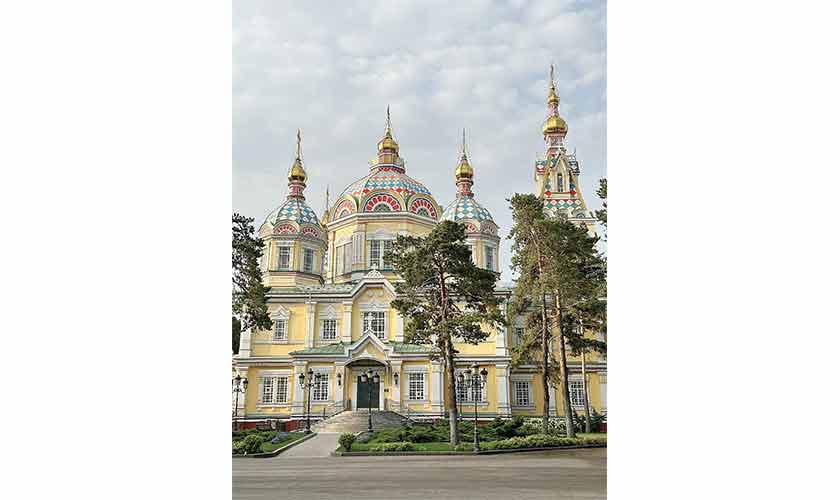
It was time to visit the Ascension Cathedral, not far from where we were staying. Completed in 1907, the cathedral is remarkable in that its main structure is made entirely of wood and assembled without the use of nails. The road leading up to it was green and immaculately kept. After undergoing extensive restoration between 2017 and 2020, the cathedral has emerged as one of Almaty’s most visited landmarks.
Painted in soft shades of yellow and white, the building is crowned by a vividly coloured cupola in red, blue and green, topped with a golden cross glinting in the afternoon sun. Set against a clear blue sky, the cathedral looked almost luminous. A large garden surrounds the church, where vendors had set up stalls selling toys and small swings for children. A dense flock of pigeons had gathered on the path, and children ran through them, laughing as the birds scattered and regrouped.
As we packed our bags and prepared to leave for the next destination, it felt as though Almaty had quietly inscribed itself into us, a reminder that some cities are not simply visited, but slowly absorbed, settling somewhere deeper than memory.
After walking around the building, we stepped inside. As expected, the interior held icons, figurines and stained glass. Natural light filtered through the coloured panels, illuminating corners of the space in soft hues. Although Almaty is predominantly Muslim, around 70 per cent, it has a sizeable Christian population, largely Orthodox, alongside smaller Buddhist and Jewish communities and a notable number of people who identify as non-religious.
Despite the presence of tourists and worshippers, the hall was completely silent. A woman was quietly scraping wax from the candle stands. We sat on a bench for a while, taking in the architecture. I took a few photographs of the stained-glass windows. The low light in the main hall lent the space a dramatic stillness.
“Let’s go outside,” my wife said gently.
We stepped back into the bright sunlight and sat on a bench in the nearby park. A squirrel darted towards us and eagerly accepted the red berries my wife had bought from a small shop on the way to the cathedral. “We came all this way to feed this squirrel,” she remarked, amused by its enthusiasm.
After a while, we moved on, heading west. At the end of a grassy stretch, we noticed a large building with a star mounted on its façade. As we drew closer, it became clear that we had reached a military memorial, a site dedicated to the World Wars I and II. Sculptures surrounded the area, with a central podium bearing an eternal flame. The two flanking walls commemorated fallen soldiers from the two wars.
The weather was perfect. A small crowd had gathered nearby, surrounding a young woman in bridal dress and a young man in formal black attire. “Looks like they’re getting married here,” my wife said. I agreed, it felt too crowded and purposeful to be just a photo shoot.
We continued walking through the memorial and set our next destination: the Green Bazaar. As we entered it, we were surprised to find an entire section devoted to horse meat. Every cut imaginable was on display. I slowed down, curious to look more closely, but my wife pulled me away. For me, as a Pakistani, it was an unusual sight. We knew horse meat was a staple of Kazakh cuisine, but seeing it laid out so openly was quite an experience.
By now, we had spent most of the day moving through the city, and one thing had become clear: Almaty dresses the modern way. Women often wore knee-length skirts with sleeveless or short-sleeved tops. Men favoured light-coloured trousers or shorts paired with trainers. People were fair-skinned, with distinctive, sharp facial features. Women, in particular, appeared well put together, confident in how they carried themselves. “Almaty feels like a Scandinavian city,” I remarked to my wife, drawing on my earlier travels in the region.
As the sun began to dip, we decided to catch the sunset from a higher vantage point. We booked a taxi through the Yandex app. It arrived quickly. We asked the driver to take us to the highest point in Almaty. He was young and clearly enthusiastic about driving. Sensing our excitement, he marked a location on Google Maps and headed towards Kök Töbe.
Rising about 1,100 metres above sea level, Kök Töbe is one of Almaty’s most recognisable landmarks. The hill is home to a recreational area with amusement rides, restaurants and viewing platforms. It is accessible by road as well as cable car, with the lower station near Hotel Kazakhstan. The Almaty Tower, a 372-metre-tall television tower, stands nearby and is visible from much of the city.
After roughly 20 minutes of driving, we reached the amusement park entrance. Still eager for height, we asked the driver to go further. He admitted that he was unfamiliar with this stretch of road. As the tarmac gave way to a dirt track, his concern became visible. Yet curiosity seemed to outweigh caution. We passed a handful of modest houses, but there were no other vehicles in sight. After several sharp, uneasy turns, the road simply ended. We were at a dead end.
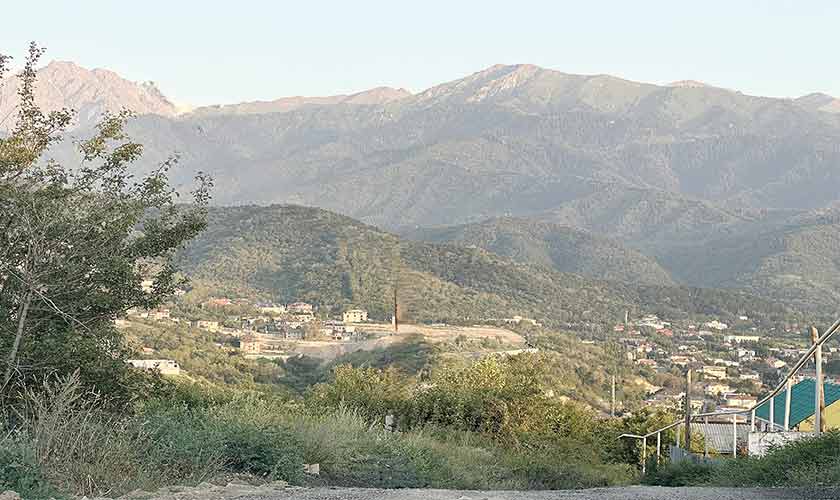
“This is the highest point near the city,” the driver said, pointing towards the distant mountain range. “To go higher, you’d have to head into those mountains.”
From there, the view opened up beautifully. Almaty stretched out below us, framed by a dramatic ring of sunlit peaks. The sun was nearly gone. We decided that it was time to return to the city. The ride may have ended, but our only way back was the same car. To make sure we were matched with the same driver, we rebooked the trip, this time selecting the option that allows pets.
We took a few photographs, thanked the driver for venturing into what felt like uncharted territory and began our descent back into the city.
We asked the driver to drop us off on Arbat Street, a popular thoroughfare where nightlife had already taken hold. Young people strolled in groups, lingering and laughing. Street musicians, magicians and dancers performed for passing crowds, drawing small circles of onlookers. Soaking in the energy, we realised that we were back in our own neighbourhood. We returned to the Turkish restaurant where we had eaten lunch and settled in for dinner.
By then, it was time to head back to the apartment. The day had been long, full and demanding in the best way possible.
I woke up early the next morning, determined not to miss a final walk before leaving the city. An hour on foot through Almaty’s quiet streets was enough to recharge me. I enjoyed the greenery around the church and the grey clouds hanging low above the city. On my way back, I came across a farmers’ market just outside the green bazaar. Fresh produce straight from the fields was being sold at modest prices. The crowd was mostly middle-aged and elderly, unsurprising at that hour. Youth, everywhere, keeps its own schedule.
It was time to awaken my wife and set out on our last walk together before moving on. We returned to Arbat Street to see what it felt like at noon. The contrast was striking. The street was calm, almost empty. At this hour, Almaty felt unhurried and gentle, a city at ease with itself.
As we packed our bags and prepared to leave for the next destination, it felt as though Almaty had quietly inscribed itself into us, a reminder that some cities are not simply visited, but slowly absorbed, settling somewhere deeper than memory.
The writer is a professor at the National University of Sciences and Technology.