Print Story
X




As the collection unfolded in Milan, it became clear that this was not just about how clothes are worn but about where they come from, what they carry and how they exist.

| A |
s co-creative directors of Prada, Miuccia Prada and Raf Simons had no interest in a neat seasonal update. Instead, they offered a way of thinking about dressing that embraced imperfection and uneasy beauty for uneasy times. Staged at Fondazione Prada’s Deposito space in Milan, the setting established the intellectual core of the collection.
“This is not nostalgia for the past but the careful reworking of it, what should be preserved and what must be remade. It’s a kind of archaeology,” Simons said.
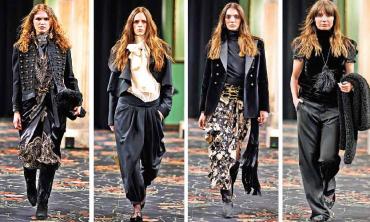
Strip away the layers, he suggested, and beauty will eventually reveal itself. That notion translated into clothes that felt discovered rather than newly produced. Coats arrived with intentional creases and folds, while leather looked softened by time and use rather than polished to perfection.
Layers peeled back to show tweed beneath, a metaphor for wallpaper removed to expose earlier lives. These clothes wore time, peeling and softly frayed, their veneer pushing back against the pristine finish that so often defines modern luxury. Soft-shouldered, narrowly cut overcoats, both single and double breasted, nodded to Prada’s familiar lean silhouette but were worn with instinctive ease. Restraint, clarity and precision did the work instead of spectacle.
Layering became the predominant language of the collection. Long shirt cuffs featured as if they were worn and thin underneath slim coats. Double cuffs, typically associated with formality, were relaxed and reinterpreted. Low-cut top vests, square tanks and unexpected necklines subtly disrupted the order of base and outer layers.
Silhouettes were slender, almost strict, marking the end of oversized comfort. Although this may represent a return to masculine codes, Prada and Simons made it clear that this was a rein on excess. The slender line was not about fragility but about paring back and highlighting the body.
Colour challenged expectations too. The designers opted for rose, deep purple, green and mauve. These emotive shades provided relief in an otherwise sombre palette, carrying an optimistic message in a heavy political climate. The imperfection trend was a consistent seam of thought. Worn cuffs, frayed seams, puckered leathers and raw edges were incorporated as deliberate details. By wearing away the concept of traditional elegance, Prada and Simons conveyed that perfection and elegance are not synonymous. The clothes reflected the world they were made for: careful, considered and visibly marked by wear.
However, moments of quiet eccentricity did find its way now and then. Colourful laces added personality to subdued footwear, while hats, ranging from crumpled caps to bucket hats, were pressed flat against the backs of jackets. This reminded the audience of the personal experiences that garments undergo after they leave the runway.
Rather than drawing conclusive transformational ideas, the collection encouraged the audience to remain in a state of discontent. Ambiguity was portrayed as a quality of modern sophistication.

Miuccia Prada described “uncomfortable” as the most apt description for the psychology of this moment in which certainty is in short supply. This contrast between beauty and destruction remained evident throughout. Prada and Simons did not claim fashion to be a solution to world problems. However, they asserted the need to tell the truth. Beauty is not irrelevant in times of crisis but it should be linked to reality. Ultimately, Prada’s F/W ‘26 menswear collection proves there is no point in idealised escapism. –Photo Courtesy: Giovanni Giannoni/WWD