Print Story
X




Series loss marks a significant moment providing India with important lessons on combination, stability and execution under pressure.

Last week, New Zealand’s men’s cricket team created history by clinching their first-ever bilateral One Day International (ODI) series on Indian soil.
Arriving with a depleted squad, that lacked several first-choice players - including Kane Williamson, Mitchell Santner, Tom Latham, Rachin Ravindra and Jacob Duffy - the visitors rebounded from a 1-0 deficit to secure a memorable 2-1 series victory.
New Zealand’s bowling attack also entered the series with limited experience, with none of the bowlers possessing 50 or more ODI wickets. Michael Bracewell was the most seasoned campaigner, with just 37 wickets to his name before the series began.
The triumph ended a long and frustrating run for the Black Caps, who had lost all seven of their previous ODI series in India, a streak stretching back to 1988. Prior to this contest, New Zealand
had managed only eight wins in 39 completed ODI matches against India on Indian soil. Among visiting teams with at least 20 matches in India, they held the poorest win-loss record.
The series victory followed another historic achievement earlier this season, when New Zealand recorded their first-ever Test series win in India with a stunning 3-0 sweep in October 2024, further underlining their growing success in sub-continental conditions.
For India, the defeat marked only their third bilateral ODI series loss at home in the last decade, having previously lost to Australia in 2019 and 2023. It was also India’s first home ODI series defeat after winning the toss since October 2022, snapping a streak of 13 consecutive such victories.
Despite Kohli’s brilliance, India suffered their first-ever bilateral ODI series defeat to New Zealand at home - a result that surprised fans but stemmed from multiple cricketing factors rather than a single lapse. Foremost among them was New Zealand’s superior adaptability to Indian conditions. Traditionally considered vulnerable in the subcontinent, the visitors executed their plans astutely, using spin effectively and varying pace with impressive discipline.
India’s batting, usually their strongest asset at home, lacked consistency. While the top-order showed occasional flashes of form, meaningful partnerships were scarce. The middle-order struggled against New Zealand’s disciplined bowling and sharp field placements, often losing wickets in clusters during key phases of the innings.
India’s bowling also failed to apply sustained pressure. The inability to strike early with the new ball allowed New Zealand’s openers to settle, while a lack of penetration in the middle overs enabled the visitors to control the tempo of the game.
Another decisive factor was New Zealand’s composure in critical moments. They executed their strategies better under pressure, while India appeared slightly complacent, possibly underestimating a side with a proven record in limited-overs cricket. The series loss underlined the reality that home advantage alone is insufficient in modern ODI cricket, where adaptability, execution and mental sharpness are paramount.
Former players and critics have pointed to frequent changes in India’s playing XI as a contributing factor, disrupting team balance ahead of the T20 World Cup. In contrast, New Zealand relied on a settled and cohesive unit, embodying their collective “Kiwi way” and highlighting the value of role clarity and team unity.
Daryl Mitchell was named Player of the Series after another outstanding performance against India. His last seven ODI innings versus India now read: 130, 134, 17, 63, 84, 131* and 137.
Remarkably, all four of Mitchell’s ODI centuries against India have been scored in India, with only AB de Villiers (five) having more ODI hundreds against India on Indian soil. Those four centuries have come in Mitchell’s last five ODI innings in the country.
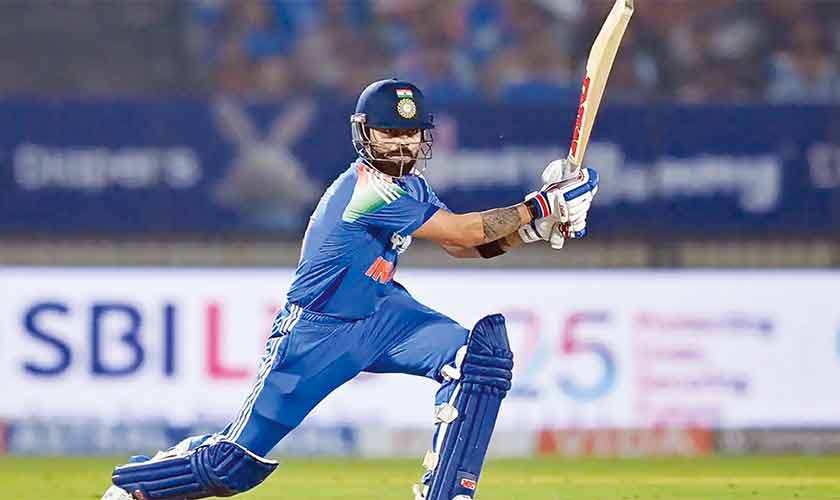
In the final ODI at Indore, Indian batting maestro Virat Kohli produced a sublime innings of 124 to register his 54th ODI century. During the knock, Kohli also surpassed Ricky Ponting to become the highest run-scorer at No. 3 in ODI history, moving to 12,676 runs, ahead of Ponting’s 12,655.
Kohli, scored his seventh ODI century against New Zealand, further enhancing his extraordinary record. The knock was his 85th international hundred, including 54 in ODIs, and his 41st century on home soil across formats. Overall, it marked Kohli’s 10th international hundred against New
Zealand - the most by any batter - surpassing the nine centuries each scored by Jacques Kallis, Joe Root and Sachin Tendulkar.
After winning the 2024 T20 World Cup and winning the Player of the Match award in the final, Kohli retired from T20Is. On 12 May 2025, he also announced his retirement from the Test format.
Kohli, 37, now has seven or more international hundreds against five different opponents: 10 against Sri Lanka, nine versus West Indies, eight against Australia and seven each against South Africa and New Zealand. His 124-run innings in Indore also took his tally of List A hundreds to 59 in 334 innings, with only Tendulkar ahead, having scored 60 centuries in 538 innings. At home Kohli has registered 41 international hundreds in 259 innings, again second only to Tendulkar, who scored 42 in 538 innings on Indian soil.
Man of the Series Daryl Mitchell was the standout performer, amassing 352 runs at a
remarkable average of 176, including two centuries and a half-century. It was the highest aggregate by a New Zealand batter in a three-match bilateral ODI series. Mitchell registered back-to-back centuries (131* and 137) and now holds four ODI hundreds in India - the joint- most by a Kiwi, alongside Nathan Astle.
Mitchell’s 352 runs are the third-highest by any batter in a three-match ODI series, behind the 360 runs scored by Babar Azam against West Indies in 2016 and Shubman Gill against New Zealand in 2023.
For India, Kohli was the leading run-scorer with 240 runs, including a century and a half-century.
In the bowling department, New Zealand’s Kristian Clarke claimed the most wickets in the series with seven at an average of 26.14. India’s Jamieson and Harshit Rana shared six wickets apiece, averaging 28.16 and 33.50 respectively.