Print Story
X




PFF Chief Mohsen Gilani meets US Chargé d’Affaires Ms. Natalie Baker, pledges strategic support for USA’s FIFA World Cup 2026 campaign
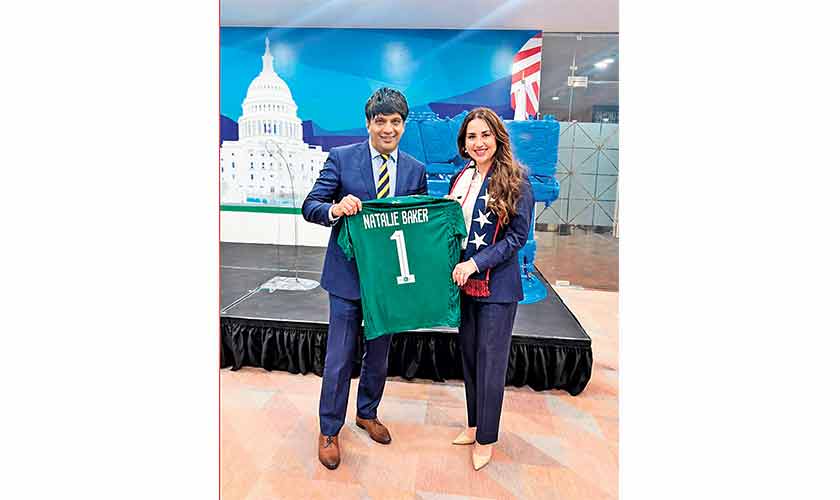
Football has always been more than a game. In the modern world, it is diplomacy, identity, youth empowerment, and international perception rolled into one. The recent high-level engagement between Pakistan Football Federation (PFF) President Syed Mohsen Gilani and the United States Chargé d’Affaires, Ms. Natalie A. Baker, is a timely reminder that sport, when guided by vision and intent, can quietly achieve what formal diplomacy often struggles to deliver.
Held at the Freedom 260 Liberty Bell Initiative under the evocative theme “Let Freedom Ring,” launched by the US Mission in Pakistan, the meeting was symbolic in both setting and substance. It marked not just a routine courtesy call but a strategic dialogue that could shape how Pakistan presents itself to the world through football in the coming years, particularly as the United States prepares to co-host the FIFA World Cup 2026.
From an observer’s standpoint, what stood out most was the clarity of purpose exhibited by the PFF’s current leadership. President Mohsen Gilani has inherited an institution that, for years, remained trapped in administrative paralysis and global isolation. In less than six months, however, there is visible momentum, both internally within the federation and externally in how international stakeholders are beginning to re-engage with Pakistani football.
During his interaction with US Ambassador Ms. Baker, PFF President Gilani outlined a renewed vision for the Pakistan Football Federation, one that positions football not merely as a competitive sport but as a national development tool. He emphasized that football’s reach into communities, schools, and marginalized spaces makes it uniquely suited to promote unity, discipline, and a positive international narrative for Pakistan. This is an important distinction. Countries no longer rely solely on economic or political indicators to shape perception; cultural influence, especially through sport, now plays a decisive role.
Equally significant was Gilani’s acknowledgment of institutional support from within Pakistan. His briefing to the US envoy highlighted the backing of the Prime Minister’s Office and the Ministry of Sports, particularly in relation to grassroots and youth-centric initiatives. This alignment between the federation and the state is critical. Football ecosystems do not flourish in isolation; they require political will, administrative stability, and long-term policy continuity, elements that have historically been missing in Pakistan’s football journey.
In a direct remark during the discussions, Gilani noted that the federation’s collaboration with the Prime Minister’s Office was about far more than sport. He framed it as a mission to empower youth and align Pakistan’s football structures with global best practices. That statement carries weight. For decades, Pakistan’s young footballers have suffered not due to lack of talent, but due to lack of structure. If this alignment holds, it could finally address that foundational gap.
US Ambassador Ms. Natalie A. Baker, for her part, was reportedly appreciative of the pace of reform under the current PFF leadership. Her acknowledgment of increased fan engagement and government support over a short span signals growing international confidence. From a diplomatic perspective, such validation matters. It opens doors for technical assistance, developmental partnerships, and exposure that Pakistani football has long been deprived of.
The conversation naturally gravitated toward the FIFA World Cup 2026, a tournament of unprecedented scale, to be co-hosted by the United States, Canada, and Mexico. President Gilani’s pledge of support for the US campaign was not merely ceremonial. It reflected an understanding that Pakistan, despite not being a participant on the pitch, can still play a meaningful role off it, through cultural exchange, fan engagement, diaspora mobilization, and football diplomacy.
Gilani’s assertion that Pakistan intends to leverage the World Cup as a platform to project a positive national image is both ambitious and pragmatic. Major tournaments shape global narratives, and Pakistan’s association with the event, through institutional cooperation and symbolic alignment, can help counter long-standing stereotypes by showcasing its youthful, passionate, and sporting side.
Another critical pillar of the discussion was women’s football. The PFF President made it clear that women’s football is no longer a peripheral concern but a central component of the federation’s modernization strategy. This is a welcome shift. Globally, women’s football is the fastest-growing segment of the sport, and Pakistan cannot afford to remain on the sidelines. Gilani’s acknowledgment of government support as an “administrative backbone” underscores that meaningful progress is finally being backed by action rather than rhetoric.
From an expert’s lens, the true value of this meeting lies not in its optics but in its intent. Football, when used strategically, becomes a vehicle for governance reform, youth engagement, gender inclusion, and international cooperation. The PFF-US Embassy dialogue reflects an understanding of that broader canvas.
As the meeting concluded, both sides reportedly agreed that this partnership must extend beyond symbolic gestures. The emphasis on long-term institutional governance and cultural exchange suggests a desire to ensure that Pakistani football never slips back into the cycles of stagnation and isolation that defined its recent past.
For Pakistan, this moment represents opportunity. For the PFF, it represents responsibility. And for football lovers across the country, it offers cautious optimism that the world’s most popular sport may finally reclaim its rightful place in Pakistan, not just on the field, but in how the nation engages with the world.