Print Story
X




In Ferdowsnama, Shandana Minhas crafts a subtle meditation on the art of recording history
| S |
handana Minhas’ Ferdowsnama stands apart within her oeuvre, which spans novels across different genres with a distinctly contemporary focus. Her fifth and latest novel appears to be moulded from a different clay, not only because it is set in the 16th-Century Mughal India, but also due to its conceptual and thematic boldness. In this terse but deeply rewarding novel, the award-winning author of Survival Tips for Lunatics examines the beguiling ways in which myth-making and narrative-building shape the fates of empires. Storytelling, as readers will discover within these pages, has the potential to become an instrument through which power is gained and consolidated.
At the heart of Minhas’ new novel is the eponymous yet enigmatic Ferdows, a flame-scarred scholar who finds refuge in the Great Moghul’s Kitabkhana – a space she describes as “the largest house of books in the world.” When the sovereign orders her to document the imperial hunt, she escapes the comforts of her sanctuary and adopts the guise of the reluctant yet obedient chronicler. Ferdows traverses the vast stretches of the Mughal empire with a warrior, Amar Singh; an artist, Qamar-uz Zaman; and a tracker, Jingu.
From the outset, she is bound by an unyielding allegiance to the emperor. “To question the Great Moghul,” Ferdows states, “is to question why the sun rises in the east, why a lion hunts, why a daughter of Iblis cannot be trusted.” At the same time, she harbours no delusions about the fact that she is little more than a cipher, existing only at the periphery of the narrative. “If [the Great Moghul] notices this lowly one at all in the pages, may he notice it as one notices the stirring of grain in a sack when a mouse passes,” Ferdows states.
The protagonist downplays all detail about her own life, revealing only the choicest of insights with an almost unsettling restraint. She discloses this information as a measured reaction to the urgency of a particular moment instead of a desire for self-expression.
Marked by dissociation, Ferdows carries echoes of Ayesha from Minhas’s debut novel Tunnel Vision. Ayesha’s consciousness was strikingly active even when her body lay inert in a hospital bed. Ferdows’s loyalty remains indissolubly chained to the emperor insofar that she stands the danger of receding into the shadows. This imposed invisibility adds to the mystique of Ferdowsnama. The narrator’s self-effacement allows her to emerge – at least initially – as an observer rather than an eager participant. Occupying a liminal space between insider and outsider, Ferdows is well-placed to comment on the events and machinations involved in the imperial missions.
Above all, Ferdows’ chronicles bear subtle hints of subversion as it confers agency to a female narrator. Her account is a counter to the stereotypical, male-dominated accounts of valour and feigned glory. Narrated through a distinctly female gaze, Ferdowsnama will remind readers of Gulbaddan Begum’s Humayun-Nama. Much like Gulbaddan Begum’s official biography of her father’s life, Ferdows’s account also begins with the customary invocation “In the name of God, the Merciful, the Compassionate.”
Bound by the established norms of record-keeping, the narrator tells more than she shows. The narrative retains a distinct freshness of perspective – a quality often lacking in fact-driven biographies. That’s because Ferdows isn’t attempting to produce a biography of the Great Moghul. Her words will be read by the sovereign’s grand vizier, who determines “what is written, what is read [and] what is forgotten” in the imperial memoir. Like the Humayun-Nama, ‘Ferdowsnama’ is, at best, destined to become source material for the official court chronicler.
Storytelling… has the potential to become an instrument through which power is gained and consolidated.
The narrator’s obsequiousness towards the imperial sovereign is a telltale sign of blind devotion rather than a blatant attempt to curry favour through flattery. Ferdows seems to be cognizant of the fact that her observations may be dismissed by a gatekeeper who lacks the gift of discernment or relegated to a mere footnote in the official memoir. She doesn’t consciously seek to cultivate a space for herself in historical records in an effort to be immortalised. Even then, the narrator quietly exposes the intricacies and deceptions involved in the history-writing process.
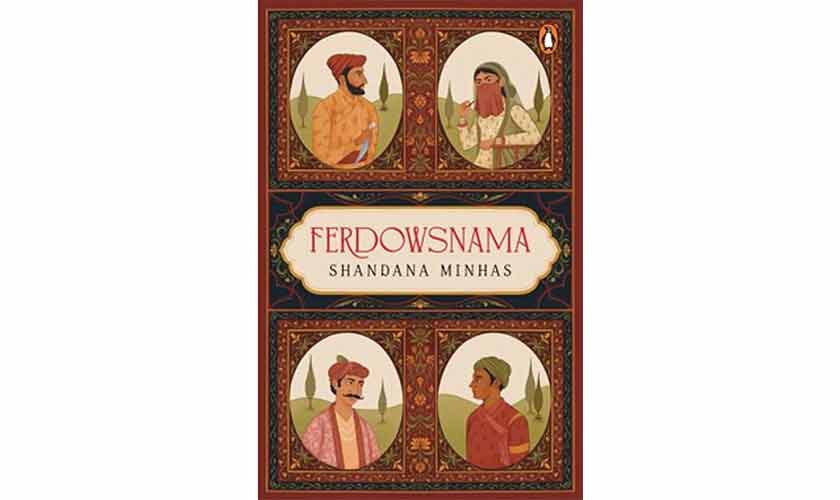
Beyond its rich thematic focus, Minhas’s fifth novel benefits from an intriguing structure. Eschewing a linear narrative, Ferdowsnama is composed as four vignettes. Framing the novel into episodic sections rather than a sequential flow of events doesn’t compromise on the cohesiveness of the text. Instead, each vignette becomes a self-contained snapshot that is refreshing in its completeness. Minhas also avoids chapter numbers or headings, preferring instead to structure the sections in the form of hastily scrawled dispatches carried by winged messengers.
Each vignette reveals how the Great Moghul’s ‘fantastic four’ venture into the farthest reaches of the sprawling empire to tackle an assortment of challenges posing a threat to the sovereign’s dominance. In one section, Ferdows and her companions must reckon with the havoc wreaked by Maya, the emperor’s bereaved elephant, who grows exceedingly destructive after her calf is taken by a crocodile. Once a formidable part of the sovereign’s battalion whose needs were actively catered to, the elephant steadily became a liability for the Great Moghul. Unfortunately, affection and past loyalties carry scant weight in matters of power.
Other vignettes feature more fantastic – if occasionally inbred – beasts. Demons linger like curses through these pages while the curious disappearances of a minor ruler open the portals to secrets buried within the sands of time. All of these episodes have direct consequences for the Great Moghul’s absolute dominion. The sovereign’s team of ‘special agents’ manages to proactively stave off any crises and help the Great Moghal maintain his control over the empire.
Throughout the narrative, Ferdows seems to display an unflinching loyalty to the monarch. However, the allegiances of the other members of the Great Moghul’s imperial mission do tend to waver. The final vignette, which is centred around the death of a chieftain, reveals the fragility of the group’s allegiances to their ‘master’ and the repercussions they must face for daring to pursue a selfish instinct.
“[Qamar-uz Zaman] caught himself quickly, and said he did not mean to imply this was punishment,” Ferdows writes. “To serve the Great Moghul in the way we did was a privilege, not a penance.” These conflicting loyalties steer readers towards a stunning denouement that reveals how the pursuit of power can produce drastic consequences.
Animals aren’t just plot devices in Ferdowsnama; they form the emotional centre of the novel. This motif instantly calls to mind the emotional fervour with which Minhas depicted a variety of sentient creatures in her second novel Survival Tips for Lunatics.
Compelling, stimulating and boldly inventive, Ferdowsnama is a long-awaited novel from a Pakistani author whose work defies easy categorisation. Minhas’s latest work is a powerful indictment of power, loyalty and the spurious craft of chronicling the past.
Ferdowsnama
Author: Shandana Minhas
Publisher: Vintage Books, 2025
Pages: 184
The reviewer is a freelance journalist and the author of No Funeral for Nazia.