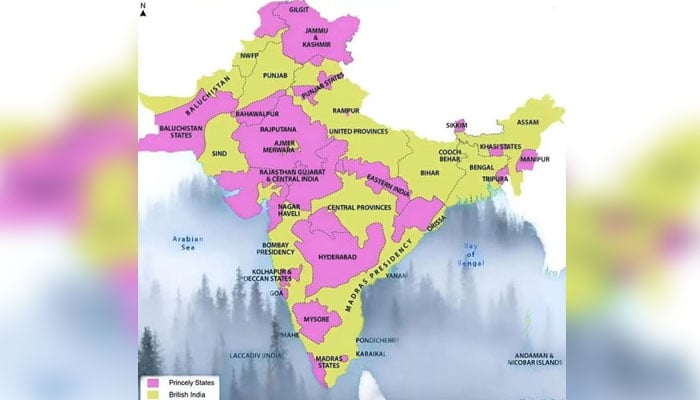
The partition of India occurred in a distinct manner for territories forming ‘British India’ and those forming ‘princely states’. While the former is well documented and understood, the latter is less so.
Describing the demographics of the Indian subcontinent, Caroline Keen in ‘Princely India and the British’, writes “Before 1947, two-fifths of the Indian subcontinent was not British territory, and two-ninths of its inhabitants were not British subjects. This territory was divided into over 600 individual states which were governed by hereditary princes of varying rank, owing allegiance to the British Crown.
“The states displayed a great diversity in terms of size, population and revenue. Collectively they covered an area of nearly 600,000 square miles with a population of just over 80 million. Individually they ranged from Hyderabad, the principal state, with an area of 82,698 square miles and a population of over 14 million, to the tiny Kathiawar state of Veja-no-Ness with an area of about three-tenths of a square mile and a population of 184”.
The UK’s general elections of 1945 brought the Labour Party, led by Clement Attlee, to power on the promise to begin the dismemberment of the British Empire. The British Empire consisted of India, Burma, Ceylon, Malaya, Cyprus, Hong Kong, the West Indies, Gibraltar, the Falklands and large tracts of Africa.
The ultimate instrument that incorporated the ‘June 3rd Plan’ and contained the scheme for Partition was the Indian Independence Act, 1947, which envisaged the setting up of two independent ‘dominions’ by the names of ‘India’ and ‘Pakistan’ on August 15,1947.
These two dominions would comprise territories which, under Section 311 of the Government of India Act, 1935, were included in ‘British India’, thereby excluding princely states, whose relationship with the British Crown was based on treaties or customs.
The unique position of princely states was addressed by Section 7 of the Indian Independence Act, 1947, in a manner consistent with the ‘memorandum on the states’ submitted to the Chamber of Princes by the Cabinet Mission Plan. Accordingly, on August 15, 1947, the suzerainty of His Majesty the King Emperor over princely states in India would lapse, and with it all treaties and agreements executed between the British Crown and princely states would also lapse.
Thereafter, the princely states would resume their status as totally independent and sovereign polities, which could, in theory, negotiate their foreign relations with foreign powers afresh, a process well explained by Lawrence James in ‘Raj: The Making of British India’ and by Larry Collins and Dominique Lapierre in ‘Freedom at Midnight’.
This lack of regulation by the Indian Independence Act, 1947 explains why Hyderabad and Junagadh could not join Pakistan despite the earnest desire of their rulers, though much to the aversion of their population, and why the Maharaja of Kashmir’s decision to join India, despite the aversion of the local population, effectively prevailed.
Quaid-e-Azam had a strictly constitutional view of the accession of princely states and deemed it the prerogative of the respective ruler to decide. However, the palpable truth is that the accession of princely states was not subject to any enforceable law or principle such as ‘accession or division along religious lines’.
Following Partition, the Government of India Act, 1935 was to become the constitution of both the dominion of India and Pakistan until a regular constitution was framed by their respective constituent assemblies. The Act provided a mechanism for the accession of ‘princely states’ as ‘federated states’ of the dominions.
Although legally independent, there is considerable evidence to show that Lord Mountbatten used his position to persuade princely states which were contiguous to the dominion of India to accede thereto, impressing upon them the impracticality of remaining independent or joining Pakistan.
In the days leading up to Partition, Sardar Vallabhbhai Patel and Vappala Pangunni Menon had worked out an ‘attractive’ draft ‘stand-still agreement’, assuring collaboration, the continuation of grants and non-interference, which could be used to lure the rulers of princely states to accede to the dominion of India. Save for a handful, the vast majority of rulers of princely states executed stand-still agreements prior to the momentous day of Partition. Pakistan also employed the model agreements, styled as ‘instruments of accession’, and executed the same with rulers of princely states.
The ‘salute states’ – four big princely states which acceded to Pakistan – were Kalat, Bahawalpur, Chitral and Khairpur. Other smaller states which acceded to Pakistan were Hunza, Nagar, Dir, Swat, Amb, Phulra, Las Bela, Kharan and Makran.
Accession did not amount to a merger, and all of the above states remained internally autonomous regions ruled by their respective rulers. By the early 1970s, all princely states were fully merged into Pakistan.
The writer is a practising barrister. He can be reached at: