The question of identity has sparked passionate debate in Pakistan and around the world for a long time. While some see identity as rigid and unchanging, this view often misses its natural fluidity and adaptability.
Identity is far more than a simple label; it is a living, shifting landscape shaped by history, culture, power and personal experience. It is both deeply personal and profoundly political. People discover who they are through identity, but this journey is guided by the forces of language, institutions, ideology, and the weight of history. Identity is not something we simply have; it is something we forge, often through struggle and transformation.
At a foundational level, identity provides a sense of belonging by anchoring individuals within categories such as nation, religion, ethnicity, language, and class. However, Stuart Hall, in his essay ‘Who Needs Identity?’ (1996), contends that identity is not an essence but a continuous process of becoming. He asserts, “actually identities are about questions of using the resources of history, language and culture in the process of becoming rather than being: not ‘who we are’ or ‘where we came from’, so much as what we might become, how we have been represented and how that bears on how we might represent ourselves.”
Consequently, identity is constructed through representation, including stories, images and discourses that describe, factually or imaginarily, who individuals are and who they are not. This perspective challenges essentialist notions of identity as fixed or natural, situating it within historical and cultural production.
Identity is inherently relational, emerging through difference, particularly the distinction between the ‘self’ and the ‘other’. Edward Said, in ‘Orientalism’, (1978), demonstrates how Western identity was constructed by producing the Orient’ as its inferior counterpart. This process was not neutral but deeply intertwined with colonial power. Thus, identity is inseparable from politics and is shaped by those who possess the authority to represent and define.
The role of power in identity formation is central to Michel Foucault’s work, ‘The History of Sexuality’ (Vol 1, 1978). Foucault argues that identities are produced through discourses embedded in institutions such as schools, prisons, and religious systems. These discourses classify individuals, normalise behaviour and create categories through which people understand themselves. In this sense, identity is an effect of power. However, individuals do not remain entirely passive; they internalise and sometimes resist these classifications.
From a Marxist perspective, identity is inseparable from material conditions and class relations. Karl Marx and Friedrich Engels, in ‘The German Ideology’ (1846), conceptualised social identity as rooted in economic structures, with class identity arising from one’s position within relations of production. This view was later expanded by Antonio Gramsci, who introduced the concept of ‘cultural hegemony’ in his ‘Prison Notebooks’. Gramsci argued that ruling classes maintain dominance not only through force but also through consent, shaping cultural norms, values and beliefs so that their worldview appears natural. Consequently, under hegemony, identity is indirectly moulded and individuals come to accept dominant ideologies as common sense.
Building on these ideas, Terry Eagleton in ‘Ideology: An Introduction’ (1991) examines how ideology operates within culture to produce subjectivity. For Eagleton, identity is not external to ideology but is one of its effects. Individuals are shaped by ideological structures that determine how they perceive the world and themselves. Thus, identity becomes a site where power and meaning intersect.
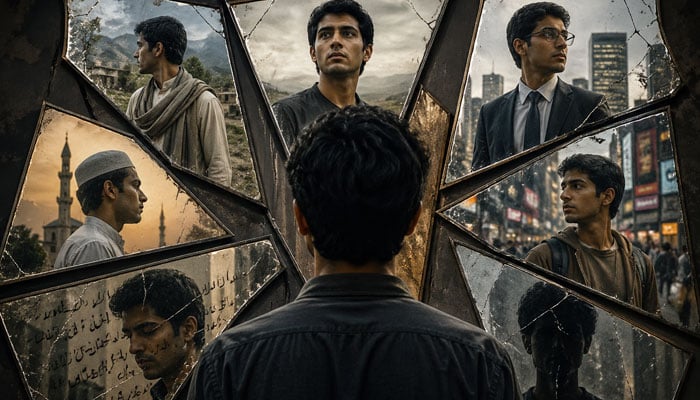
While Marxist thinkers emphasise structure and ideology, psychoanalytic theory provides additional insight into the internal formation of identity. Jacques Lacan, for instance, introduced the concept of the ‘mirror stage’ in his 1949 lecture, ‘The mirror stage as formative of the function of the I as revealed in Psychoanalytic Experience’. Lacan argues that identity is formed through a moment of recognition and misrecognition, as the child, upon seeing its reflection, identifies with an image that appears whole and coherent despite internal fragmentation. This creates a fundamental tension: identity is always, to some extent, an illusion. For Lacan, the self is never fully stable; it is shaped by the ‘symbolic order’, language, rules and laws and society – the ‘big other’. This perspective reveals identity as inherently incomplete, always seeking coherence but never fully achieving it.
In contrast to these critical perspectives, conservative or communitarian thinkers emphasise the significance of shared values and traditions in identity formation. Charles Taylor, in ‘The Politics of Recognition’ (1992), argues that identity is shaped through ‘recognition’, defined as the acknowledgement of one’s worth by others. Misrecognition or non-recognition, according to Taylor, can cause significant harm by distorting individuals’ sense of self. He maintains that cultural and communal structures are essential for meaningful identity and that modern societies must recognise diversity while upholding shared moral horizons.
Anthropological perspectives further enrich the understanding of identity by emphasising its cultural aspects. Anthropologists argue that identity is shaped through everyday practices, rituals and symbols. Culture provides the window through which individuals interpret and see their world and their place within it. Therefore, identity is lived as much as it is conceptualised. It is enacted in language, dress, customs and social interactions.
Language, in particular, plays a decisive role in identity formation. It functions not only as a tool of communication but also as a carrier of a worldview. Ngugi wa Thiong’o, in ‘Decolonizing the Mind’ (1986), asserts that colonial domination operates through language by displacing indigenous modes of thought. Reclaiming native languages thus becomes an act of reclaiming identity.
In multilingual societies like Pakistan, the hierarchy of languages reveals deeper power dynamics, often pushing local identities to the margins while elevating dominant communities and languages.
The formation of national identity exemplifies the intersection of imagination, power and culture. Benedict Anderson, in ‘Imagined Communities’ (1983), describes the nation as a socially constructed community, imagined through shared narratives, media and institutions. National identity is therefore not a natural fact but a political and cultural project. In postcolonial contexts, this project is often fraught with tension as diverse identities are subsumed under a singular national narrative.
Colonialism represents a disruption of identity. Frantz Fanon, in ‘Black Skin, White Masks’ (1952), examines how colonial subjects internalise the inferiority imposed upon them, resulting in alienation and self-division. Under colonialism, identity becomes fractured, caught between imposed and inherited worlds. This legacy continues to shape postcolonial societies, where struggles over culture, language and history remain unresolved.
Today, globalisation has further complicated trends in identity, continuing the legacy of disruption. As ideas, people, and media flow across borders, hybrid identities emerge, woven from many sources. This blending can generate creativity and openness, but it also stirs anxiety and resistance. The rise of nationalism and religious fundamentalism often reflects a longing for stability that seems to be slipping away.
In Pakistan, identity is a battleground of competing voices. Ethnic, linguistic, sectarian and regional identities weave together with national identity in intricate patterns. State efforts to enforce uniformity have often met with resistance from powerful ethnic groups and marginalised communities striving for recognition and autonomy. The struggle between unity and diversity remains at the heart of the nation’s story.
Education stands at a crossroads in shaping identity. It can reinforce dominant ideologies and identities, yet it can also produce critical reflection and transformation. Through independent reading, encountering diverse ideas and engaging with different intellectual traditions, individuals can move beyond inherited identities and cultivate a more thoughtful sense of self.
In the end, identity is not a destination but a journey in motion. It is shaped and molded by power but always open to new meanings. It is anchored in history yet ever adapting. Identity lives in the tension between self and other, structure and freedom, tradition and transformation.
Instead of chasing a single and pure identity, it is far richer to welcome multiplicity and change. As Hall observes, identities are always in flux. They are mere points of temporary attachment. Embracing this reality can open the door to more inclusive, open-hearted, and dialogical ways of belonging.
The writer heads an independent organisation dealing with education and development in Swat. He can be reached at: [email protected]