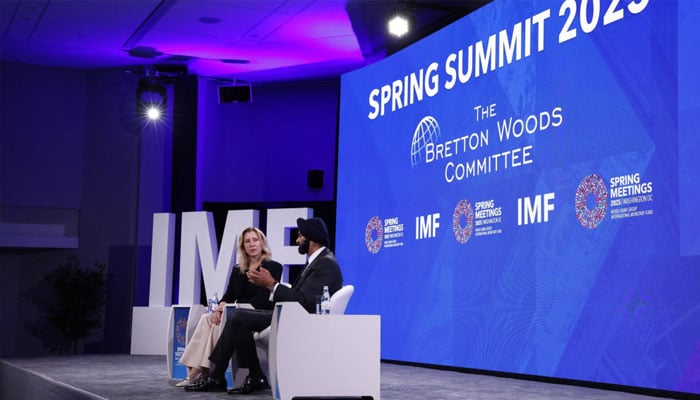
The spring meetings of the Bretton Woods Committee in Washington brought together three of the most consequential figures in global economic governance: Kristalina Georgieva of the International Monetary Fund, Ajay Banga of the World Bank and Christine Lagarde of the European Central Bank.
Their message, though delivered from very different vantage points, converged on a single warning: the world is absorbing another major shock from the conflict in the Middle East and the resulting disruption in energy markets, and countries that have not built resilience will pay the steepest price.
Georgieva set the tone with a frank account of how quickly the outlook has deteriorated. Before the latest escalation, the Fund had been preparing to raise its global growth projections. Instead, it revised them downward. Around one-fifth of global oil and gas supply is effectively out of the market, pushing prices higher and slowing activity across economies large and small.
The Fund is no longer working from a single forecast but from a range of scenarios stretching from a short disruption with a rapid recovery to a prolonged shock that could push several economies into recession. By the time of the annual IMF and World Bank meetings in Thailand, she warned, the world could be debating a far deeper crisis.
The burden of this shock will fall unevenly. Poor countries and vulnerable middle-income energy importers are least equipped to absorb it. They have already depleted their fiscal buffers during the pandemic and the recent inflation wave, leaving them with little room to protect their populations. The Fund estimates possible additional financing needs in the range of $20-50 billion for the most exposed economies, a sum that is manageable for the institution but could determine whether affected governments stabilise or collapse.
On policy, Georgieva urged central banks to stay alert without panicking. If the price shock proves brief, premature tightening could choke fragile growth. If wage and price pressures broaden, decisive action will be unavoidable. On the fiscal side, her message was blunter: there is no painless adjustment when supply and demand are so far out of balance. The task is to protect the most vulnerable through strictly targeted, temporary support, not through broad subsidies or price controls that drain public resources and complicate the work of monetary authorities.
Banga approached the same crisis as a lender to nearly every developing country. He expects energy markets to remain tight for months even if a ceasefire holds, because restarting wells and restoring shipping takes time. The World Bank has assembled a tiered response: an initial crisis window could unlock roughly $20-$25 billion quickly; repurposing existing projects could raise the total to $60 billion; and over 15 months, the institution could mobilise $80 to $100 billion in support above its normal lending levels. Yet Banga was candid about the gap between good advice and political reality. Governments facing elections often choose popular, broad measures over targeted ones, and the Bank cannot guarantee otherwise.
He also linked the present crisis to a structural challenge that will outlast it: generating jobs for the 1.2 billion young people who will enter the workforce in developing countries over the next 15 years. Public finance alone will never be sufficient. Unlocking private capital at scale requires sustained reforms in the business climate, stronger guarantee platforms and new instruments that package development lending into asset classes accessible to global pension funds and insurers.
Lagarde brought the perspective of a central bank navigating the same shock in a region that remains deeply exposed to energy price volatility. She declined to label the disruption as clearly transitory, noting that it combines direct fuel price effects, indirect cost pressures across industry, and the risk of second-round impacts on wages and inflation expectations.
The ECB now publishes three scenarios, baseline, adverse and severe, and will act to defend its two per cent inflation objective if required. She also spoke of the erosion of trust in multilateral institutions, rejecting the argument that organisations born at Bretton Woods have become obsolete. The answer, she argued, is reform and demonstrated results, not abandonment.
For Pakistan, a country that imports energy, faces acute demographic pressure and depends on multilateral support, these messages carry particular weight. Pakistan sits at the intersection of every vulnerability these three leaders described: fiscal constraints, exposure to commodity price swings, a young population requiring productive employment and an economy that has repeatedly sought emergency assistance without consolidating the reforms that would reduce its need for it.
There was no false comfort in Washington and no promise of quick fixes. What emerged instead was a clear consensus: resilience begins at home but cannot be secured without cooperation abroad. Pakistan has heard versions of this lesson before. The test, as always, is whether it is absorbed before the next shock arrives or only after.
The writer attended the Bretton Woods Committee spring meetings in Washington in 2026 and is a postgraduate student at Harvard University.