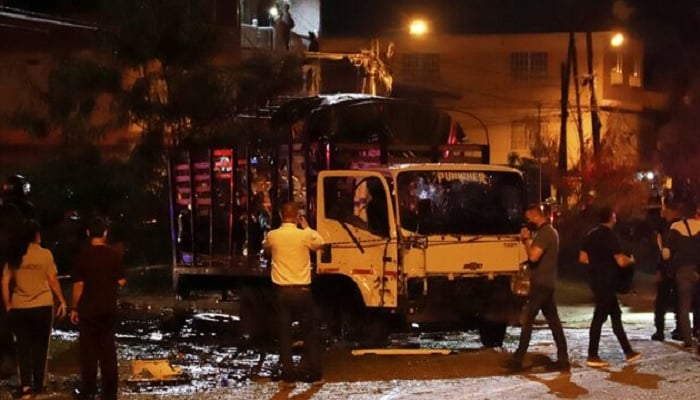
At least 13 people were killed and 17 wounded in an explosives attack in western Colombia on Saturday, a police source told Reuters, in violence authorities have blamed on dissidents of the FARC guerrilla group.
Authorities blamed the attack in the Cauca department -- a conflict-ridden, coca-growing region -- on dissidents of the now-disbanded FARC guerrilla army, who have been sowing violence across the country.
"Those who carried out this attack... are terrorists, fascists and drug traffickers," President Gustavo Petro said on X.
"I want our very best soldiers to confront them," he added.
The leftist leader blamed the bombing on Ivan Mordisco, the South American country's most-wanted criminal, whom he has compared to late cocaine kingpin Pablo Escobar.
The explosion Saturday left "10 dead and 12 seriously injured. However, the toll is expected to rise significantly," a local fire department official told AFP, while Reuters reported the death toll at 13, citing sources.
A police source said rescuers were searching for several missing people.
Cauca Governor Octavio Guzman shared a video on social media that showed victims on the ground and destroyed vehicles in the aftermath of the bombing.
Other social media posts detailed extensive damage and craters in the roadway, with witnesses claiming the blast was so strong that they were knocked back several meters.
The violence came after a bomb attack on Friday on a military base in Cali, Colombia's third-largest city, which injured two people and set off a string of attacks in the Valle del Cauca and Cauca departments.
According to military chief Hugo Lopez, 26 attacks have been recorded in the two departments over the past two days.
Authorities have boosted the military and police presence in the areas, Defence Minister Pedro Sanchez said Saturday.
Colombia has a history of armed groups -- which finance their operations through drug trafficking, illegal mining and extortion -- attempting to influence elections through violence.
FARC remnants who rejected a 2016 peace deal with the government have been actively trying to disrupt stalled peace talks with Petro.
Security is one of the central issues of the May 31 presidential election. Political violence was brought into sharp focus last June, when young conservative presidential frontrunner Miguel Uribe Turbay was shot in broad daylight while campaigning in the capital, Bogota.
Leftist Senator Ivan Cepeda, an architect of Petro's controversial policy of negotiating with armed groups, is ahead in polls, trailed by right-wing candidates Abelardo de la Espriella and Paloma Valencia.
All three have reported receiving death threats and are campaigning under heavy security.