_akhbar.jpg)
WASHINGTON/ TURKIYE/TEHRAN/ISLAMABAD: President Donald Trump Thursday hinted at visiting Pakistan if a peace deal is signed between Iran and the United States, reports RT.
‘I might go to Pakistan, Islamabad, if the deal is signed there, I’ll go’. Pakistan’s been great, they want me’.
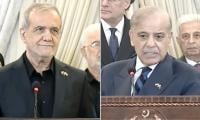
Meanwhile, at the height of Pakistan’s intense diplomatic efforts for a détente between Iran and the US in the larger interest of the Middle East and beyond, Prime Minister Shehbaz Sharif landed in Antalya, Türkiye, on Thursday. The prime minister arrived in Antalya to a rousing welcome after concluding his visits to Saudi Arabia and Qatar.
Antalya Governor Hulusi Sahin received Shehbaz at the airport, reports Geo News quoting the Prime Minister’s Office (PMO). Pakistan’s Ambassador to Turkiye Yousuf Junaid and other senior officials were also present on the occasion. Shehbaz is scheduled to attend the 5th Antalya Diplomacy Forum, where he is expected to engage with global leaders. He is also expected to hold a meeting with Turkish President Recep Tayyip Erdogan.
Senior members of the Pakistani delegation accompanying the prime minister included Deputy Prime Minister/Foreign Minister Ishaq Dar, Minister for Information and Broadcasting Attaullah Tarar, Special Assistant to the Prime Minister Tariq Fatemi and the prime minister’s spokesperson for international media Mosharraf Zaidi.
Later in the evening, Foreign Minister Hakan Fidan paid a courtesy call on Shehbaz and thanked him for his participation in the upcoming Antalya Diplomacy Forum. Deputy Prime Minister Ishaq Dar and SAPM Syed Tariq Fatemi were also present, the PMO said in a statement. He told Shehbaz that President Recep Tayyip Erdogan was looking forward to meeting with him on the sidelines of Antalya Diplomacy Forum.
Shehbaz thanked the Turkish foreign minister for the warm welcome and traditional hospitality and said it was a pleasure for him to visit Turkiye, his second home. The prime minister said he was looking forward to the opportunity to participate in the Antalya Diplomacy Forum and meeting President Tayyip Erdogan.
Earlier in the day, Shehbaz held a warm and cordial meeting with Qatar’s Emir Sheikh Tamim bin Hamad Al Thani in Doha in which the latest regional and international developments, particularly in the Middle East came under discussion.
Sheikh Tamim welcomed the prime minister and his delegation, and expressed his deep appreciation for Pakistan’s pivotal role in supporting efforts to de-escalate tensions in the region and promote diplomatic dialogue in a manner that serves regional security and stability, the press release stated. Shehbaz renewed his condemnation of the attacks on Qatar and other Gulf countries, while reaffirming Pakistan’s full solidarity and support for the leadership and the people of Qatar.
Both leaders underscored the importance of supporting de-escalation efforts and enhancing international coordination to ensure the security and stability of the region, particularly ensuring the maintenance of smooth flow of energy supply chains.
The two leaders also reviewed bilateral relations and ways to further develop them, especially in the fields of security, defence and energy, in a manner that strengthened the partnership and opened new avenues for bilateral cooperation.
Both the leaders also held a one-on-one meeting, during which they exchanged views on current developments of mutual interest and emphasised the importance of continued coordination and consultation between the two countries, particularly in the light of ongoing events and their implications for regional security and stability.
In a closely related development, Chief of the Defence Forces (CDF) Field Marshal Asim Munir met with Iran´s parliament speaker in Tehran on Thursday, Iranian state television said, after Pakistani mediators travelled to Iran to press efforts to end the war, reports AFP.
“Field Marshal Asim Munir, Commander of the Pakistan Army, who travelled to our country yesterday, met and held talks with Mohammad Bagher Ghalibaf... this Thursday morning, April 16,” the report said.
There were no further details on the contents of the latest meeting, which came a day after the field marshal arrived in Tehran with his delegation, bringing what Iranian state television described as a message from the United States.
The field marshal wore military fatigues in the meeting and Ghalibaf, a veteran of Iran’s Revolutionary Guards ideological army, a dark suit and white shirt without a tie as is customary for Iranian officials, pictures broadcast by state media showed.
According to the Press TV, Field Marshal Asim Munir met the Commander of Iran’s Khatam Al-Anbiya Central Headquarters, Major General Ali Abdollahi, in Tehran.
Meanwhile, Iran’s Ambassador Reza Amiri Moghadam Thursday said his country wanted Pakistan to host the next round of peace talks, citing Tehran’s strong trust in Islamabad’s role as a neutral and credible mediator in its talks with Washington, Jamila Achakzai adds.
During a policy dialogue at the Institute of Regional Studies in Islamabad, Amiri said negotiations would take place in Pakistan “and nowhere else”.
He voiced a lack of trust in the United States and said Iran had conveyed it to Pakistan.
He praised Pakistan’s leadership, calling the mediation efforts of the prime minister and army chief “commendable,” highlighting Islamabad’s growing diplomatic role in facilitating dialogue between the two sides.
He said Iran considered Pakistan a reliable partner for dialogue and mediation and expressed gratitude to the Pakistani government for its efforts in facilitating talks and promoting de-escalation, noting that Islamabad’s engagement had been viewed positively in Tehran.
Highlighting Iran’s geopolitical position, the envoy said the country had faced sustained pressure for over four decades following its 1979 revolution. “For 47 years, we have been under pressure and excesses from the United States and Zionist forces, but they have not succeeded,” he said, adding that conflicts in the region had only deepened over time.
Amiri maintained that Iran did not seek aggression or regional dominance, rejecting claims that Tehran aimed to establish hegemony in the Middle East. Instead, he described Iran as a country in a “sensitive position” striving to protect its sovereignty without allowing foreign interference in its internal affairs.
On the longstanding nuclear dispute, the ambassador said Iran’s programme was solely for peaceful purposes, insisting that no country had been able to prove otherwise. He added that the International Atomic Energy Agency (IAEA) had repeatedly confirmed that Iran was not developing nuclear weapons.
Amiri accused Israel of seeking dominance in the Middle East with consistent backing from the United States, alleging that both worked against Iran’s interests. He also referenced the past conflicts, including support for Iraq under Saddam Hussein, and described the nuclear issue as an artificially created dispute that continues to fuel tensions.
The envoy said the previous rounds of US-Iran negotiations had made progress, with five rounds of talks held and some points of agreement reached. He, however, said that the United States launched attacks on Iran during the negotiation process without prior notice, derailing diplomatic momentum.
Despite suffering significant human and financial losses in recent conflicts, including the deaths of military leaders, scientists and civilians, Amiri said Iran remained united and resilient. He said the country’s system was built on institutional strength rather than individuals.
The ambassador said Pakistan, as a responsible country committed to peace and stability in the region, had initiated an unparalleled effort to mediate between Iran and the United States. He said Iran highly respected those efforts and hoped that the other party would assist Pakistan in that important mission of establishing regional and international peace and security.
Amiri said his country had entered into negotiations with determination and resolve to achieve results. “Our negotiation team is designated based on who the other party appoints, and we will dispatch our team accordingly.” The envoy said Iran was ready for negotiation and dialogue at any level the other party was prepared for.
Meanwhile, the federal capital has transformed into a high-security fortress to facilitate the second round of high-stake peace talks between Iran and the United States, reports Shakeel Anjum. With the world eyes focused on the Red Zone, the government has finalised an exhaustive security framework designed to provide a foolproof environment for the high-stakes negotiations. Under the direct supervision of the interior ministry and the capital administration, Islamabad has implemented a Multi-Tiered Protection Strategy to ensure absolute safety of the visiting dignitaries.
“The strictest security arrangements are also being prioritised and deemed essential, considering the possibility that President Donald Trump might unexpectedly arrive in Pakistan; however, Pakistan is fully prepared in any case,” a relevant officer said.
The government has finalised an exhaustive, multi-tiered security apparatus to safeguard the proceedings in Islamabad. The master plan outlines the strategic deployment and operational protocols designed to ensure a secure environment for this critical diplomatic mission.
Given the extraordinary sensitivity of the dialogue, security operations have been elevated to a wartime level of vigilance under the Blue Book VVIP protocol. In a departure from the routine administrative policing, the Pakistan Army has been entrusted with the direct security of Red Zone and sensitive installations. The military will maintain overall command, providing a centralised monitoring umbrella over all auxiliary forces.
A formidable contingent of approximately 10,000 personnel has been requisitioned. This force includes elite units from the Frontier Constabulary (FC), Pakistan Rangers and regional police departments. To ensure a robust presence without depleting local precincts, manpower has been drawn from across the federation, including Punjab, Sindh, Azad Kashmir and Gilgit-Baltistan.
The security perimeter is organised into specialized tiers to address diverse threats. The Anti-Terrorism Force (ATF) and Anti-Riot Force will manage the immediate perimeter as frontline response. The Bomb Disposal Squad (BDS) will conduct continuous sweeps of all venues and transit paths. Specialised units from the National Highways and Motorway Police (NH&MP) will coordinate with the local traffic police to ensure seamless movement of foreign delegations.
The capital has been transformed into a high-security enclave with a focus on “impenetrable perimeters.” The number of active checkpoints in Islamabad has been increased nearly threefold, rising from 22 to 60. These stations are equipped for thorough biometric and physical screening of all individuals entering the city limits. Unconventional entry points, including the Margalla Hills and various mule tracks on the outskirts of the capital, are now under 24/7 surveillance.
Rangers and police units have been stationed at these high-ground locations to prevent any breach from the northern ridges.
Authorities have emphasized that the current deployment of 10,000 personnel is an initial baseline. Should the regional threat matrix shift or the talks be extended, the Ministry of Interior remains prepared to scale the force further to maintain “foolproof” security.