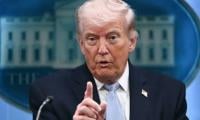
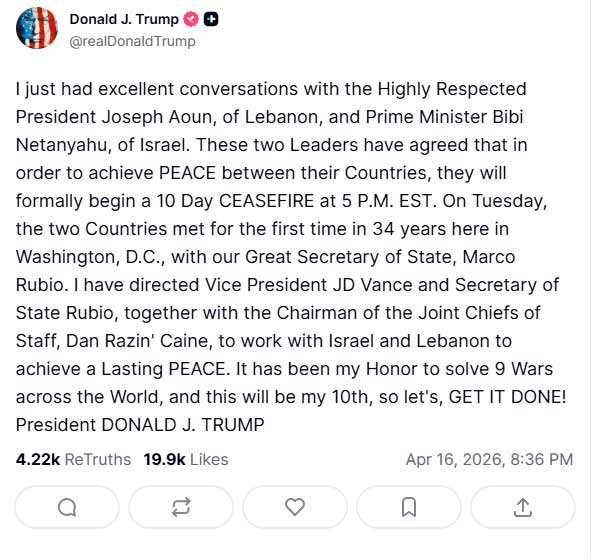
US President Donald Trump said on Thursday that Israel and Lebanon had agreed to begin a 10-day ceasefire at 5pm EST (2100 GMT), signalling a pause in Israel's conflict with Iran-backed Hezbollah that has raged in parallel to the war with Iran.
A US official said the ceasefire would start on Thursday.
Israel's campaign in Lebanon has emerged as a major obstacle to securing a peace deal sought by Trump to end the war on Iran he launched with Israel in late February, which has disrupted the global energy trade, spiking oil prices and risking further economic fallout.
US and Iranian officials are weighing a second round of in-person talks in Islamabad in the coming days and a cessation of fighting in Lebanon could clear the way for an agreement on other tricky issues including Tehran's nuclear ambitions.
Pakistan's Foreign Ministry earlier said that peace in Lebanon was essential for talks it is mediating.
Trump said he had held excellent conversations with both Lebanese President Joseph Aoun and Israeli Prime Minister Benjamin Netanyahu.
Netanyahu said in a video statement he had agreed to the 10-day pause and that there was an opportunity to make an historic deal with Lebanon.
But there was uncertainty over whether a truce could hold between bitter enemies Israel and Hezbollah. Netanyahu said in his video message he had not agreed to Hezbollah's demand to withdraw forces deployed in southern Lebanon back to the international border between the two countries and would maintain an extensive "security zone" up to the border with Syria.
Israel's main demand remained that Hezbollah must be dismantled, he added.
In its first comment after Trump's announcement, Hezbollah said any ceasefire must not allow Israel freedom of movement within Lebanon. In a statement issued by its media office, the group said the presence of Israeli troops on Lebanese territory granted Lebanon and its people the "right to resist".
Lebanon was dragged into the war in the Middle East on March 2, when Hezbollah opened fire in support of Tehran, prompting an Israeli offensive in Lebanon just 15 months after the last major conflict between the group and Israel.
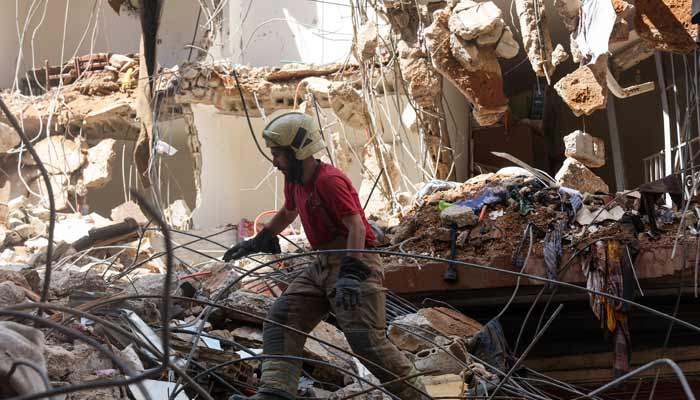
Israeli attacks have killed more than 2,100 people in Lebanon since March 2 and forced more than 1.2 million to flee, said Lebanese authorities.
However, Israel said that Hezbollah attacks have killed two Israeli civilians, while 13 Israeli soldiers have died in Lebanon since March 2.
Israeli forces have invaded areas of southern Lebanon, and vowed to maintain control over territory extending all the way to the Litani River, which meets the Mediterranean some 30km (20 miles) north of Israel's border. Israel ordered residents out of the area south of the Litani during the war.
Israeli troops have since destroyed Lebanese villages in the area, saying their aim is to create a "buffer zone" to protect northern Israeli towns from Hezbollah attacks.
In Beirut, Lebanese doctor Fadi Sharara told Reuters he wasn't optimistic about the ceasefire's prospects. "I don't think it will succeed because it's impossible for Hezbollah to surrender its weapons and (Hezbollah) doesn't have trust in that," Sharara told Reuters.
Senior Hezbollah lawmaker Hassan Fadlallah, speaking to Reuters minutes before Trump's announcement, said the group had been informed by Iran's ambassador to Lebanon that a ceasefire could begin on Thursday evening. After the announcement, he said it would be for 10 days.
Asked if Hezbollah would commit to the truce, Fadlallah said everything depended on Israel halting all forms of hostilities, and credited Iran's diplomatic efforts for the possible ceasefire.