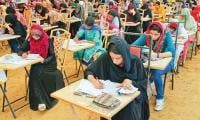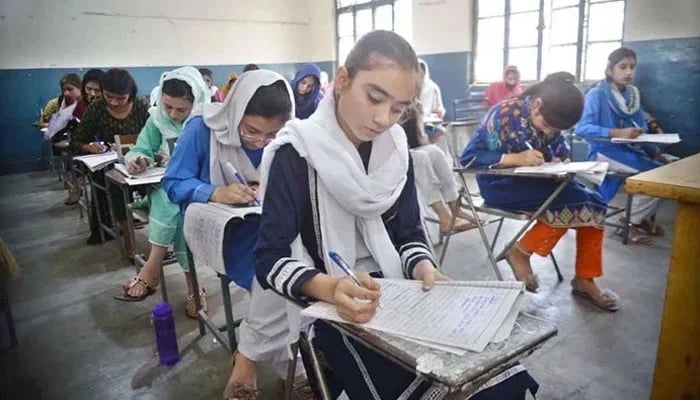
PESHAWAR: Journalists were urged to incorporate a gender-sensitive perspective in reporting on the upcoming budget for the fiscal year 2026-27, with the objective of highlighting key challenges hindering the promotion of female literacy in Khyber Pakhtunkhwa.
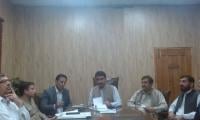
The issue was raised during a training workshop on the education budget organised by Blue Veins, a non-governmental organisation, in collaboration with the Malala Fund, said a press release on Sunday.
“Titled “Education Budget: Understanding, Analysis, Tracking and Reporting,” the workshop aimed to apprise media persons of their role in holding the government accountable for education budgeting”, said Yumna Aftab, Project Manager at Blue Veins.
She added that multiple barriers, including structural, socio-cultural and economic factors, impede girls’ access to learning and completion of quality education in Khyber Pakhtunkhwa, limiting the province’s progress towards achieving equitable and inclusive educational outcomes.
Yumna highlighted that nearly 4.9 million children in Khyber Pakhtunkhwa are not attending school, with girls making up a disproportionate share of around 2.9 million, or 60 per cent of the total.
Among these out-of-school children, the highest number is in Peshawar district - more than 500,000 (approximately 519,928), including 200,142 boys and 319,767 girls.Access to education in Khyber Pakhtunkhwa remains unequal across gender lines, driven by numerous challenges.
“The gross enrolment ratio for girls at the secondary school level stands at 34.25 per cent compared to 55.78 per cent for boys, indicating that a substantial proportion of school-age girls remain out of formal education,” she added.
In recent years, Yumna continued, the Khyber Pakhtunkhwa government has taken steps to improve girls’ access to education through policy reforms, targeted programmes and strategic investments, including allocating 70 per cent of the development budget to girls’ education.
While these efforts have yielded tangible progress, numerous challenges still persist, and girls continue to face barriers to enrolling in school and completing their education.Muhammad Ejaz Khalil, in his presentation on the education budget, shared comprehensive information on the allocation and disbursement of funds for literacy.
He said that the KP government has increased the education budget by 11 per cent, from Rs326 billion in 2024-25 to Rs363 billion in 2025-26.However, he noted that out of the total budget of Rs363 billion, only Rs18 billion is allocated for development, while a staggering Rs344 billion is spent on salaries and other expenditures of the education department.
“The share of the education sector in the provincial annual budget is around 17 per cent, with about 29 new development projects for the current fiscal year,” he added.Programme Manager at Blue Veins, Qamar Naseem, spoke on gender-responsive reporting and highlighted its importance in bringing to light challenges in increasing the literacy rate in the province, particularly among females.
He said there are three types of reporting: gender-responsive, gender-neutral and gender-negative.“Journalists should focus on gender-responsive reporting to ensure equal opportunities for both boys and girls in accessing education,” he said.
Journalist Lihaz Ali shared tips with his colleagues for reporting on the education sector, with a focus on loopholes in the proper disbursement of funds and the lack of facilities for girls’ education.
He said that around five districts in KP - Upper Kohistan, Shangla, Kolai-Palas, Dir and Torghar - do not have a single college for girls, depriving thousands of female students of higher education opportunities.
“The role of the media is to serve as a watchdog, and reporters should produce investigative stories on the implementation of development schemes while ensuring transparency in the distribution of funds,” Lihaz observed.
He suggested that journalists utilise the KP Right to Information Act 2013 to obtain information on various education schemes, as well as budgetary figures and fund allocations from official websites, to make their stories data-driven and impactful.