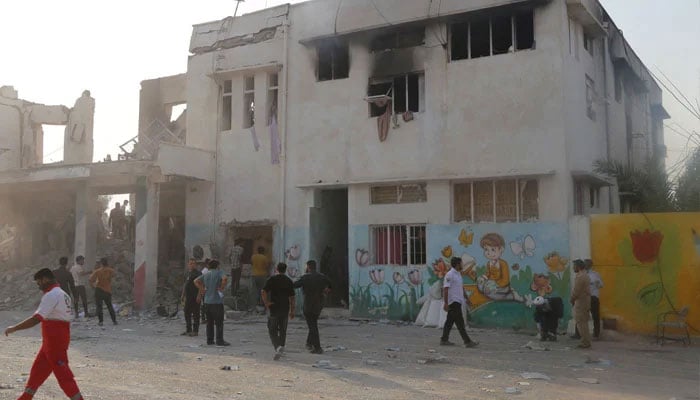
Iranian families have buried children who had nothing to do with nuclear negotiations, missile doctrine or ideological rivalry, and entire neighbourhoods have been reduced to rubble in strikes described in distant capitals as strategic operations.
Parents have waited in hospital corridors for news that never came, and in Minab one of the deadliest attacks destroyed a girls’ elementary school, killing well over a hundred people, most of them students who had been in class when the missiles struck.
The unprovoked US and Israeli strikes on Iran did not simply target infrastructure or military installations. It also assassinated Iran’s Supreme Leader, Ayatollah Ali Khamenei, along with other senior figures in the Iranian leadership. Whatever one thinks of his politics or the nature of the Iranian state, eliminating the political and religious head of a sovereign country through external force signals a willingness by Washington and Tel Aviv to remove foreign leadership when they conclude the moment demands it.
Western governments frequently invoke sovereignty and international law when condemning similar behaviour by their adversaries. That is precisely why actions like this resonate so differently outside Western capitals. The issue is not whether Iran’s system is controversial or whether its leadership has critics inside the country, because those debates have existed within Iranian society for decades. The issue is that the decision to remove the country’s highest authority was taken not in Tehran but in Washington and Tel Aviv, and that decision carries consequences that extend far beyond a single operation.
Iran retaliated quickly with missile and drone strikes across the region, targeting Israeli territory and US installations in the Gulf. In the days since, more than a thousand people have been reported killed inside Iran, including large numbers of civilians and well over a hundred children, while the ripple effects have begun spreading outward through energy markets, regional security arrangements etc.
Iranian families are burying children who were never part of this conflict, and the destruction of civilian neighbourhoods has already begun shaping the way this war will be remembered across the region. At the same time, the retaliation that followed has also taken American lives. Several US servicemen have now been killed in attacks linked to the widening confrontation.
Those soldiers were not the ones designing strategy from offices in Washington or Tel Aviv. The escalation that placed them in harm’s way was the result of political choices made by Benjamin Netanyahu, who is already facing an international arrest warrant for the genocide in Gaza, and supported by Donald Trump in Washington.
For Trump voters, the past year increasingly feels like a departure from the promise that helped propel him into office. Trump rose to prominence by attacking the foreign-policy establishment and condemning endless wars that consumed American lives and resources. Yet the last year has included strikes on Iranian nuclear facilities, expanded military operations in Syria and Iraq, escalating confrontation across the region, and now participation in the killing of Iran’s Supreme Leader.
The contrast is especially stark when viewed alongside conditions inside the US itself. Rising healthcare costs, ageing infrastructure, economic pressure on working-class communities and deep political division have left many Americans expecting a renewed focus on domestic priorities. Instead, American power is once again being projected into one of the world’s most combustible regions, where the long-term consequences of intervention have repeatedly proven far more complex than the arguments used to justify them.
In Pakistan, the reaction has been immediate because Iran is not a distant theatre of conflict, but a neighbour connected through geography, sectarian realities and long historical ties. When civilians are killed there, it resonates here in ways that are both emotional and political. At the same time, Pakistan operates within severe economic constraints and maintains critical financial relationships with the Gulf states while managing a sensitive relationship with Washington, realities that inevitably limit how far public outrage can translate into state policy.
That tension has been visible in the protests that erupted across Pakistani cities. When images of destroyed homes and dead children circulate, public reaction is inevitable. Those protests must remain peaceful, but any excessive use of force against demonstrators deserves scrutiny because suppressing grief rarely resolves the anger behind it.
When powerful states normalise the elimination of sovereign leadership as a policy instrument, other governments inevitably adjust their security calculations – and prepare for the possibility that the same logic could one day be applied to them.
Iraq in 2003 was introduced as a decisive intervention that would remove a threat and stabilise the region. Libya in 2011 was framed as a limited operation designed to prevent catastrophe while avoiding long-term entanglement. Afghanistan was presented as a campaign that would dismantle terrorism and eventually produce a stable political order. Each intervention began with assurances that escalation would remain contained and that military force would deliver clarity.
Instead, each opened the door to years of instability, regional spillover and consequences that outlived the leaders who authorised them. Iraq reshaped the balance of power across the Middle East and ignited conflicts that continue today. Libya collapsed into fragmentation that destabilised North Africa and the Mediterranean. Afghanistan consumed two decades before ending almost exactly where it began.
What is unfolding now follows the same familiar sequence: an intervention justified as necessary, an escalation presented as controlled, and a promise that the consequences will remain manageable. Yet, the costs are already visible. Civilians in Iran have been killed, children among them. American soldiers are dead as the retaliation spreads. Shipping through the Strait of Hormuz is again under threat.
This is how wars of choice begin, and also, increasingly, how they unfold.
The writer is a non-resident fellow at the Consortium for Asia Pacific & Eurasian Studies. He tweets/posts @umarwrites