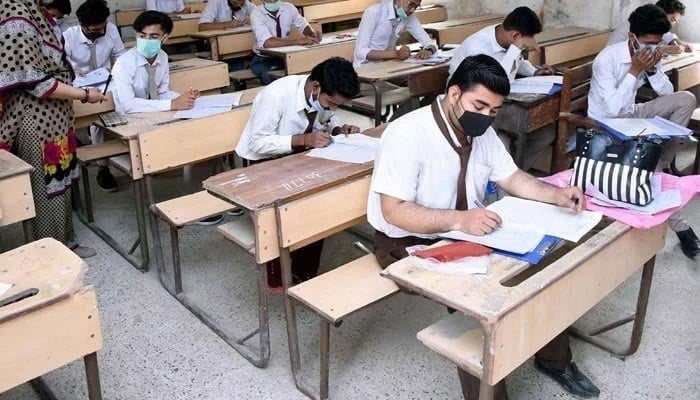
For several decades, Pakistan’s education system has been closely aligned with the British Cambridge curriculum for O and A Levels, a system that has increasingly catered to the elite segment of society.
Today, more than 270 schools across the country are registered as Cambridge education centres, with over 100,000 O-Level exam entries recorded each year. This steady growth is largely driven by students’ aspirations to gain admission to international universities, secure high-value careers, and develop advanced academic and professional skills. Karachi, Lahore, and Islamabad remain the primary hubs with the highest demand for O-Level education.
The Cambridge system, particularly the Ordinary Level (O Level), has gained a strong foothold in Pakistan due to its perceived academic and career advantages. Initially offered only by private international schools, the system expanded in April 2025 with the introduction of four public-sector schools. The education minister has stated that Cambridge education will play a significant role in improving the quality of learning for the country’s youth.
However, a major concern is the substantial foreign exchange outflow, as tens of billions of rupees are remitted abroad each year for Cambridge examinations. These payments are processed through British Council centres, which register students and transfer exam fees to Cambridge Assessment International Education and other UK-based examination boards.
According to the British Council, more than 100,000 students from Pakistan sit for O-level examinations annually. With the fee for eight O Level subjects set at Rs211,000, Cambridge boards are likely to receive over Rs21 billion from Pakistan in a single examination session alone. In comparison, the government allocated Rs66.3 billion for development projects in the higher education sector in the outgoing fiscal year, but for 2025–26, this amount has been reduced to Rs39.4 billion to cover both ongoing initiatives and 12 new schemes.
Education experts widely argue that international examination boards are capitalising on structural weaknesses in Pakistan’s education system and drawing significant financial resources out of the country. This makes it imperative for Pakistan to reform its school, college and university frameworks to reduce this outflow and redirect funds toward national development.
The local board and examination structure must also be modernised. Currently, it is heavily focused on rote memorisation, whereas systems such as Cambridge and the International Baccalaureate emphasise analytical thinking, problem-solving, and conceptual understanding. These are the skills that Pakistan urgently needs to cultivate in its youth.
At present, the large sums transferred annually from Pakistan to the UK for Cambridge O and A Levels and related programmes remain largely untaxed under existing policies. In addition to examination fees, families also bear the burden of high school tuition, books, laboratory charges, extra coaching and other academic expenses.
Collectively, these costs place Cambridge education beyond the reach of most households, making it accessible primarily to affluent families. Despite this, these parents continue to prefer Cambridge qualifications because of their global recognition and the perception that they offer better access to top universities abroad and higher-ranking institutions within Pakistan. However, the underlying concern remains that these fees are charged in foreign currency and the resulting revenue is largely sent back to the UK rather than being reinvested locally.
Given these realities, strengthening Pakistan’s education and examination system is critical. The country already has established boards and institutions that could be upgraded to achieve international equivalence. A modern national board should be developed with strong quality assurance, transparent assessment practices and globally aligned curricula. This would help attract more students to the local system while ensuring that Pakistani qualifications gain international acceptance. Such recognition could be achieved through curriculum alignment with global competency standards, participation in international verification frameworks, partnerships with foreign universities and collaboration with international qualification authorities.
In parallel, the government must significantly increase investment in examination infrastructure, professional examiner training and targeted subsidies for low and middle-income families. These measures would not only improve access and quality but also help retain financial resources within the country. Pakistan should also pursue agreements with foreign universities and governments to ensure automatic or preferential recognition of selected local qualifications, similar to the recognition currently afforded to Cambridge and other international boards.
It is also important to acknowledge the broader challenges facing Pakistan’s education system. Large numbers of children remain out of school, many teachers are undertrained and underpaid and public schools struggle with quality and resources. These weaknesses push middle- and upper-income families toward international systems while lower-income students remain confined to underperforming public institutions, which deepens social inequality and limits national potential.
Regional comparisons offer valuable lessons. India, Bangladesh and Vietnam have all made significant investments in education reform. India’s 2020 National Education Policy introduced a 5 3 3 4 structure, emphasising creativity, coding and critical thinking, contributing to the country’s strong presence in global technology and professional sectors.
Bangladesh has also expanded digital and inclusive education programmes, including its 2023 Digital Education Strategy, which increased the use of tablets, online learning, and mobile applications in schools. While Pakistan has one of the largest Cambridge student populations in the region, its overall education system has not kept pace with these reforms.
Pakistan also has a large pool of qualified tutors and educators who could play a valuable role in strengthening learning outcomes if properly integrated into national policy. The Cambridge system has helped many Pakistani students access international education pathways but its high cost and the outflow of foreign currency place a heavy burden on the country.
By modernising its own examination boards and investing in local capacity, Pakistan can retain resources, expand opportunity and secure a stronger future for its youth.
The writer is the author of ‘Digital Pakistan’ and holds the position of chief digital officer and director at the Centre for Information and Communication Technology at IoBM.
He tweets/posts @imranbatada and can be reached at: [email protected]