Print Story
X




Chinji’s rich cultural heritage embodies theessence of its identity

| I |
have been documenting the cultural heritage and oral history of various villages in Talagang. Chinji is a historic village noted for its cultural heritage. It is situated about 25 kilometres south of Talagang on the Talagang-Sargodha Road. Bhatti Rajputs are the main caste in the village. Although people from some other castes also reside there, the Bhatti Rajputs constitute a majority of the population. Tariq Mehmood Malik (2025) states in his book, Talagang Kay Dehat, that Sikhs and Hindus also lived in the pre-Partition Chinji. Notable families included those of Vesraj, Ronaqrai, Samdas, Lakhmichand and Ratna.
I have been interested in studying the funerary monuments in Talagang. This village is noted not only for stone-carved graves, historic mosques and the shrine of Pir Phul Badshah, but also for its religious figures.
According to Anis Ahmad Khan, a notable of the village, Chinji has a long and complex history of settlement, having been founded and re-established four times over the centuries. The earliest settlement lay about one kilometre west of present-day Chinji National Park and dates to the pre-Islamic period. A second settlement later emerged at Tharoti, also in the pre-Islamic era, to the north of the first site.

After the abandonment of the second settlement, a third phase of habitation developed in the foothills of Kharpa, known locally as Chinji Namal. The present village represents the fourth foundation, likely established in the 14th Century. Traces of earlier settlements remain visible in the landscape around modern Chinji.
The first settlement is tentatively linked to the Kushan period and the second is associated with the Hindu Shahi era (822-1026 CE). Coins from the Kushan period have been found at former habitation sites along the Gabhir nullah and the ancient Chinji-Kallar Kahar route.
Remains of earlier pre-Islamic settlements lie near several present-day villages along this route, including Bhilomar, Qadirpur, Thirchak and Bharpur. The discovery of Buddhist relics and Hindu icons points to the region’s religious diversity, suggesting a time when multiple belief systems coexisted and interacted. Chinji appears to have occupied a key position in a wide network of settlements linked to Buddhist communities and other groups during the Hindu Shahi period.
Today, when one visits Chinji, one finds the remains of earlier settlements, a historic mosque, graves and shrines within the village.
During my visit, I was struck by the beauty of the stone-carved graves in the village’s central graveyard, situated near the shrine of Pir Phul Badshah. Before studying these graves, I visited the shrine of Pir Phul Badshah, one of the most popular shrines in Chinji.

Pir Phul Badshah was not only an eminent mystic of the village but also renowned for his skill at tent pegging. According to Syed Muhammad Zaheer Abbas Gilani, son of Haji Pir Syed Tasawar Hussain Shah Gilani and the present custodian of the shrine, Pir Phul Badshah won a cup at a tent pegging tournament held in Delhi in 1925. Tent pegging was, and remains, one of the important sports in Pothohar and the Salt Range.
Pir Phul Badshah was a descendant of Syed Bahauddin Gilani, also known as Bahawal Sher Qalandar, a 16th-Century Qadiri Sufi whose shrine is located in Okara’s Hujra Shah Muqeem. He was the son of Syed Sakhi Shah Shahabal Qalandar.
According to Syed Muhammad Zaheer Abbas Gilani, Syed Sakhi Shah Shahabal Qalandar was the first person from Anga village in Soon Sakesar to settle in Chinji, around 1860. He was known in the village for his piety. His father, Syed Shah Sharaf, was also regarded as a righteous and devout man. His shrine is located in Anga village.
The lineage extends further back to Syed Abdullah Shah, the grandfather of Syed Sakhi Shah Shahabal Qalandar, whose shrine lies in Gheela Parial village near Chakri in Rawalpindi district. He, too, was an eminent mystic from the Gilani family of Bahawal Sher Qalandar. Originally from Bhera, Syed Abdullah Shah preached the Qadiriyya practices in Chakri and the surrounding areas. He was buried in Gheela Parial village.

Pir Phul Badshah passed away in 1975. Following his death, an impressive tomb was constructed over his and his father’s graves. The tomb of Pir Phul Badshah is a beautiful square structure with a hemispherical dome, visible from a distance. It is believed to have been built in the 1980s. Muhammad Atta, a famous mason from Khabeki village in Soon valley, constructed the tomb. The tomb is adorned with paintings. It is rare to see a tomb adorned with paintings in Talagang; if there were any, they have now been either renovated or rebuilt. One such beautiful tomb belongs to Pir Ghulam Murshid in Chowkhandi village in Talagang.
The walls and ceiling of the tomb of Pir Phul Badshah are adorned with floral paintings.
Chinji has a long and complex history of settlement, having been founded and re-established four times over the centuries.
There are five graves in the tomb. The central grave belongs to Pir Phul Badshah. On the right is the grave of Syed Sakhi Shah Shahabal Qalandar, the father of Pir Phul Badshah. On the left is the grave of Pir Aurangzeb Badshah, a brother of Pir Phul Badshah. Two other graves belong to the sons of Pir Phul Badshah.
To the left of the main entrance to the tomb of Pir Phul Badshah is another tomb containing the graves of Pir Syed Abdullah Shah Gilani and Pir Syed Aurangzeb Shah Gilani.
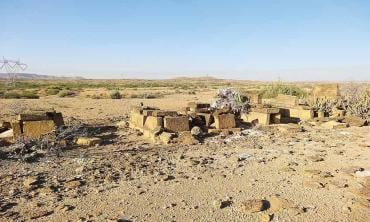
In front of the tomb of Pir Phul Badshah is the grave of Fateh Khan, who was a deputy (khalifa) of Pir Phul Badshah. A little walk east of the tomb leads to the grave of Hafiz Allah Razi, who used to teach at a mosque in a mohalla of the Chinji village. According to the inscription on his grave, Hafiz Allah Razi died on Ramazan 23, 1369, corresponding to July 8, 1950. The gravestone is noted for its floral pattern. Adjacent to his grave, there is another grave bearing the name Nek Bakhat. Both are stone graves. Chinji is home to some of the most magnificent stone-carved gravestones, noted for their remarkable depiction of floral and geometric designs. Some gravestones bear the names of the deceased. There are a few historical graveyards in the village, including the markazi (central) cemetery (also known as Janaza Gah), Nakar-wala Qabristan, Thati-wala Qabristan and Baba Muniyan-wala Qabristan. The earliest is Nakar-wala Qabristan. The second-oldest cemetery in Chinji village is the Markazi Qabristan, which dates back to the 14th Century. This necropolis lies east and north of the shrine of Pir Phul Badshah.
The earliest graves have disappeared now. Some of the most notable cenotaphs belong to the Bhatti Rajput community, which is the main and largest clan in Chinji village. The stone-carved graves in the central graveyard are noted for their intricate carvings. These are multi-tiered graves, with some having 4 tiers. Some of the tiers are undecorated. Typically, both sides - northern and southern - are marked by decorative gravestones. There are several one-chambered graves with undecorated covering slabs and some decorative gravestones bearing the names of the deceased. One of the graves with a single casket or chamber is marked with the name Khan Muhammad. A few gravestones depict a musalla (prayer rug). These graves are constructed of soft sandstone and date back to the 18th, 19th, and 20th Centuries. However, a majority of stone-carved graves date back to the 19th and 20th centuries. Some of the graves date back to the 14th century, when Chinji was founded for the fourth time.

Apart from the shrine of Pir Phul Badshah and stone-carved graves, the village has the historical Jamia Masjid, which has been renovated and extended. According to Anis Ahmad Khan, the mosque was once noted for its painted wooden ceiling and wooden door. Both these were removed during the renovation and extension of the mosque. It is said that two brothers, one of them Sher Muhammad of Bhilomar village, carved the door and the wooden ceiling of the mosque. They stayed in Chinji for several months, engraving both the door and the ceiling of the Jamia Masjid.
An eminent religious scholar, Maulana Abdul Hadi, once served here as pesh-imam. Maulana Abdul Hadi was probably the first person from Chinji village to graduate from Darul Uloom Deoband. According to Maulana Tahir Mehmood Azhar, the author of Tarikhi Shahi Masjid Khichi Wa Asar-e-Salheen (2011), Maulana Abdul Hadi graduated from Darul Uloom Deoband in 1900. After completing his education at Darul Uloom Deoband. He returned to Chinji and continued teaching at the Jamia Masjid. According to Anis Ahmad Khan, Hafiz Ghulam Nabi, the father of Maulana Abdul Hadi, had also served as the pesh-imam of the mosque and was a religious scholar well-versed in Arabic and Persian. Hafiz Ghluam Nabi, son of Sohrab Khan, passed away in 1907 and was buried in the Markazi Qabristan.
Maulana Abdul Hadi was also an expert in Arabic and Persian. He was an erudite scholar of fiqh and hadith. He was known for his religious teaching in Talagang. He was a contemporary of Maulana Muhammad Imam Ghazali (d 1960) of Tamman and Qazi Ahmad Din (d 1973) of Jasial village. I have written about both these religious scholars of Talagang. Maulana Abdul Hadi passed away in 1954 and was buried in Chinji village. After his death, his son, Maulana Hafiz Riazuddin, became the pesh-imam at the Jamia Masjid. Maulana Hafiz Riazuddin passed away on November 25, 2000. Qari Abdul Hameed, son of Maulana Hafiz Riazuddin, currently serves as the pesh-imam at the mosque.
Chinji’s rich cultural heritage embodies the essence of its identity.
The writer is an associate professor and anthropologist at the Pakistan Institute of Development Economics, Islamabad. He has authored 18 books on Pakistan’s cultural heritage and anthropology. He tweets @kalhorozulfiqar. He may be contacted at [email protected]