Print Story
X




Zubair Shah has built a fashion brand on empathy, education and the simple yet radical notion that the ramp belongs to everyone.

| F |
rom accounting to avant-garde fashion, Zubair Shah has emerged as a formidable force in Pakistan’s fashion industry.
Since his debut in 2021, he has redefined the runway by blending wild-at-heart aesthetics with social responsibility, fre-quently partnering with ins-titutions such as National Textile University (NTU), Indus Uni-versity and the Millennium Institute of Technology and Entrepreneurship (MiTE) to give students a professional platform. Through his work with the Depilex Smileagain Foundation, he has brought cancer and acid burn survivors to the ramp, transforming the spotlight into a space for resilience and rehab-ilitation. In an interview with Instep, he talks about his career and the broader fashion scene.
Instep: How is your brand contributing to the develop-ment of fashion students in Pakistan?
Zubair Shah (ZS): A desi-gner’s legacy isn’t just in the clothes they create, but in the doors they open. In every showcase I organise, I dedicate a platform to a selected university, allowing their brightest students to step onto the professional stage. We curate the top 15 student ensembles and give them the opportunity to see their work worn by Pakistan’s top models on the ramp. We have done this for NTU, Indus University and MiTE, with Iqra University next in line. It is about giving them a sense of the industry’s rigour while celebrating their raw talent.
Instep: How deeply have we explored our cultural heritage within local fashion?
ZS: Honestly, we have barely scratched the surface. Pakistan has several provinces, each with a distinct cultural identity, yet less than 20 per cent of this richness has made it to the runway. We romanticise Egyptian culture while neglecting our own Indus Civilisation, which predates it. Even with Sindhi culture, we get stuck in a loop of Ajrak and Topi, forgetting the embroidery tech-niques and silhouettes waiting to be reimagined for a modern audience. We need to move beyond the cliches.
Instep: Your Summer Bloom showcase with acid burn survivors was a water-shed moment. What was the thinking behind it?
ZS: In collaboration with Masarrat Misbah and the Smileagain Foundation, we brought three men, two children and 10 women to the stage. The challenge was to merge high fashion with genuine funct-ionality. We wanted them to feel empowered as well as comf-ortable, so we used lightweight fabrics such as soft net and chiffon, engineering every seam to ensure the garments caused no pain or irritation to sensitive skin. It was fashion designed with empathy at its core.
Instep: Where do you find your creative inspiration?
ZS: I have always admired Hasan Sheheryar Yasin (HSY) for his mastery of heritage and
the way he weaves Mughal-
era opulence into a cohesive collection. More recently, Rizwan Beyg’s collection at Bridal Couture Week (BCW) moved me deeply.
The quality of craftsmanship and attention to detail was a reminder of what we should all strive for. That balance between old-world soul and technical perfection keeps me inspired.
“The golden era, Iraj Manzoor, Iffat Omar, Vaneeza Ahmed and Gia Ali, produced professionals who were passionate architects of the ramp. They studied the theme, understood the designer’s vision and rehearsed with an almost religious discipline. By the time they hit the runway, it was a performance, not just a walk. Iraj is perhaps the best example of this. Her presence was so commanding she often risked overshadowing the outfits themselves. People did not come just to see the clothes, they came to see the aura she projected. She could command an entire room with a single look. Many models today have the look but lack that depth. The
approach can feel transactional: arrive, walk and leave, without that same hunger to understand the artistic intent behind what they are wearing.” – Zubair Shah
Instep: Why do designers put seemingly unwearable outfits on the ramp?
ZS: The ramp is a designer’s canvas, not a retail catalogue. An unusual outfit is there to show-case versatility and technical imagination, a declaration of what is possible when you are not bound by commercial wear-ability. It is art pushing against convention.
Instep: Where is your brand finding its international foot-ing?
ZS: We have developed a particularly strong and loyal client base in Norway. It is rewarding to see the fusion of avant-garde structures with Pakistani craftsmanship being appreciated by an audience that values uniqueness over mass-produced trends.
Instep: Why is altruism and advocacy so central to your brand?
ZS: A fashion show is a high-visibility platform with a responsibility to speak for those who are often ignored. When we align with a cause, we are not just looking for a theme. We are looking to spark a conversation.
The most profound example was offering our platform to Angeline Malik during her battle with cancer. She walked the ramp when she was undergoing chemotherapy. It meant walking the ramp bald. She did it with grace and poise that left the audience breathless. She also showcased her own jewellery line that day. Seeing her reclaim her confidence through our platform was incredibly moving. A woman fighting for her life with a smile is more fashionable than any outfit I could ever stitch.
Instep: How do you com-pare the legendary models of the past with today’s gener-ation?
ZS: The difference is stark. The golden era featuring Iraj Manzoor, Iffat Omar, Vaneeza Ahmed and Gia Ali, produced professionals who were passi-onate architects of the ramp.
They studied the theme, understood the designer’s vision and rehearsed with an almost religious discipline. By the time they hit the runway, it was a performance, not just a walk. Iraj is perhaps the best example of this.
Her presence was comman-ding so much so that she often risked overshadowing the outfits themselves. People did not come just to see the clothes, they came to see the aura she projected. She could command an entire room with a single look.
Many models today have the look but lack that depth. The approach can feel transactional: arrive, walk and leave, without that same hunger to understand the artistic intent behind what they are wearing.
Instep: What inspired your move towards gender-fluid fashion?
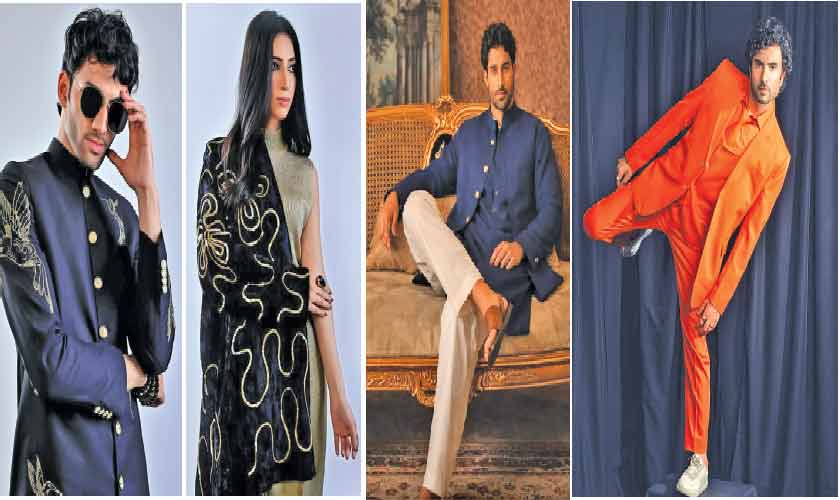
ZS: It was a realisation that fashion is a language and lang-uage should not be segregated. Women, who are my clients, gravitated towards structured menswear blazers while men wanted intricate embellished textures. Gen Z is tired of being told which side of the store they belong to. They want an identity, not a category. I focus on the silhouette and the soul of the garment, creating something that empowers the wearer, regardless of gender.
Instep: You are moving from a digital boutique to a physical flagship store on Tariq Road. How are you preparing?
ZS: The energy is electric. Moving from a digital screen to a physical space is like going from a sketch to a finished piece; you finally see the texture come alive. We open right after Eid and I want it to be far more than a ribbon-cutting ceremony. The launch will reflect the full DNA of the brand. Details are a surprise for now.
Instep: What is your preference: safe lawn coll-ection or loss-making avant-garde masterpieces?
ZS: The avant-garde master-piece. Lawn is business, avant-garde is soul.
Instep: What is the biggest lie about Pakistani fashion?
ZS: That it is an exclusive playground for the elite.
Instep: What should a newcomer be aware of when entering a fashion house?
ZS: Look for a house with a soul, not just a factory.
Instep: Best ramp walk, past or present?
ZS: Iraj Manzoor. She did not just walk, she commanded the atmosphere.
Instep: Minimalism or maximalism?
ZS: A seamless blend of both.
Instep: One international celebrity you’d like to dress?
ZS: Shah Rukh Khan. A black-and-gold ensemble to match his timeless aura would be the ultimate creative milestone.
Instep: Karachi’s grit or Lahore’s glamour?
ZS: Why choose? Karachi gives me the edge to experiment, Lahore gives me the heritage to ground my craft.
Instep: One trend you hope never returns?
ZS: I don’t believe in never. A mistake from 10 years ago is often the innovation of tomorrow.
Instep: Pakistani fashion in 2026 in one word?
ZS: Ascendant.