Print Story
X




If the modern Oscars run on the simple idea of not just what film and performances win but why they do, then the 2026 ceremony was unusually strange, but still one small step in the right direction.
Will the real winner please stand up?
| L |
Let’s be honest: most awards seasons are almost always messy. Frontrunners collapse and dark horses emerge as the favourite(s) by the time the Oscars ceremony rolls around. This year was different and not so different.
For months, it seemed that the battle for major Academy Awards was between Paul Thomas Anderson’s One Battle After Another and Ryan Coogler’s Sinners. It was the establishment versus a genre ignored for far too long, one battle after another, in more ways than one.
True to form, the Academy refused to snub its high-profile heavyweights, and so, what we got instead was a strange concoction of winners. While some were deserving, others simply hadn’t brought their best to the table. It was a night that felt less like a coronation and more like an unresolved argument. And somewhere in the middle of it all, looking increasingly uncom-fortable, was Timothée Chalamet.

The expected wins
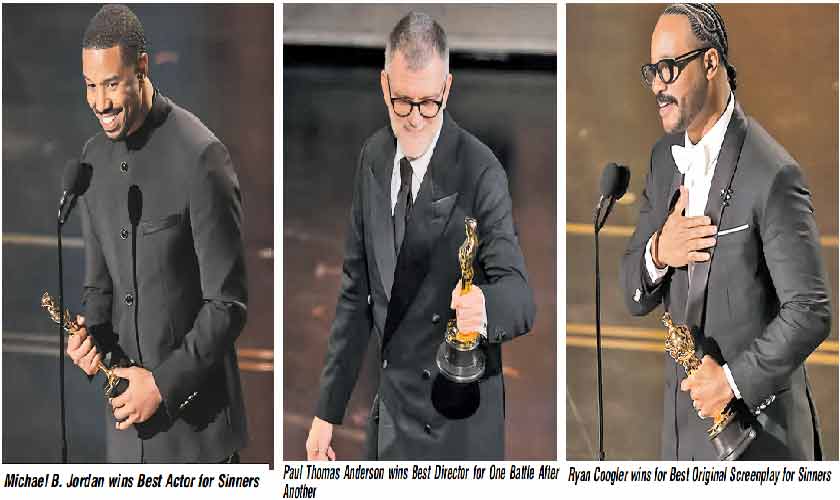
Nobody was shocked when One Battle After Another took home the trophies for Best Picture, Best Director, Best Supporting Actor, Best Adapted Screenplay and Casting. Ander-son’s film had ‘Oscar’ written all over it from the moment it was conceived, irrespective of what the creators claim. It is a serious political thriller about idealism and its consequences, made by one of America’s most respected directors. The Academy loves this kind of thing, especially given the current political upheavel in the United States and so, they voted accordingly.
Should it have won? That’s a much more trickier question. Running over 2 hours and 42 minutes and packed with A-list celebrities, One Battle After Another was not necessarily the best film on the nominees list. That honour should have gone to Sinners. Ryan Coogler’s film wasn’t a ‘timely’ political thriller; it was a powerful, original exploration of horror, vampires and the soul of blues music, the kind that you remember for years to come. However, while one film had some of Hollywood’s biggest names like Leonardo DiCaprio, Sean Penn, Benicio del Toro and Regina Hall, the other featured a mostly Black cast led by the formidable Michael B. Jordan in a double role.

Ultimately, One Battle After Another beat Sinners in major categories whereas it should’ve been the other way around. For instance, Sean Penn’s perfor-mance as Colonel Steven J. Lockjaw was impressive, but it lacked the magic of Delroy Lindo’s performance in Sinners or Jacob Elordi’s haunting performance as the creature in Frankenstein. Penn now has three Oscars, but this win felt safe. While three Oscars isn’t inherently a problem, it becomes one when the Academy chooses the familiar over ‘risky’ nominees with less star power.
Another case in point is the Best Director category. One Battle After Another’s director, Paul Thomas Anderson is a respected filmmaker and his nomination made sense. With an extensive body of work including There Will Be Blood and The Master, he had never won an Oscar. Was the Academy finally correcting the mistake of not rewarding him sooner. That’s a rhethorical question, because I certainly think so. In no other cinematic universe does his direction surpass what Ryan Coogler achieved in Sinners. Daring, original and frankly more difficult to pull off, Coogler’s work was sidelined because Anderson felt like the safer choice. Ditto for Best Picture.

There were some victorious moments for the film, though. Sinners came in with 16 nominations, which is a remark-able number for a film rooted in horror and it made its presence felt throughout the night. Genre cinema has been knocking on the Oscar door for years. On Sunday, it crossed the rubicon.
While on the subject of directors, leaving Guillermo del Toro out of the nominations after his genius work on Frankenstein was a huge snub. Had del Toro been nominated, it might have turned the category into a three-way race. Alas, it was not to be.
Michael B.
Jordan’s moment
There are wins that feel procedural and wins that feel like the room exhaling. Michael B. Jordan winning Best Actor was the second kind. He has been one of the best actors working in Hollywood for the better part of a decade.
Long before his collaborations with Ryan Coogler, Jordan starred in one of the best shows in the history of modern tele-vision: The Wire. For years, the Academy had overlooked his astounding talent. It is one of those institutional blind spots that everyone sees except the institution itself and when his name was finally called on Sunday, the applause said everything: warmer than usual, longer than usual and carrying the particular quality of an industry finally catching up with itself.

The performance deserved it. Playing twin brothers in Sinners is not just a technical challenge, it is an acting one and Jordan solved it without showing off. Smoke and Stack share the same face in the film, but nothing else. The way Jordan sets them apart is a thing of beauty. From posture to stillness, it is the kind of performance you fully appreciate the second or third time you watch. Some voters probably needed those extra viewings.
He and Coogler have been at this since Fruitvale Station. With Creed and Black Panther, they have quietly built one of the most interesting partnerships in contemporary American cinema. Sunday night felt like the Academy finally acknowledging the whole of it, not just this film. A career award in disguise. Jordan’s speech was short and genuinely moved. He didn’t perform gratitude as an art form, he meant every word and it showed. The best kind of speech.
The Chalamet
subplot
Then there is the Timothée Chalamet situation, which deserves its own section because it was, in its way, the most entertaining thing that happened all night. He came in as the frontrunner for Marty Supreme. The campaign had been enor-mous: serious, sustained and somewhat over-the-top. As the industry’s ‘boy wonder’, this was supposed to be his moment following films like A Complete Unknown, Call Me By Your Name, Dune, Beautiful Boy and Hot Summer Nights. Everyone expected him to win until a town hall interview with Matthew McConaughey. In the interview, he said he would not want to work in an art form “where it’s like, keep this thing alive, even though no one cares about this anymore,” and used ballet and opera as his examples. The backlash was swift and the frontrunner narrative began to quietly disintegrate.
Conan O’Brien, hosting with evident relish, made Chalamet a recurring theme. Every time the camera cut to him, O’Brien was there with another gentle dismantling of the campaign mythology. The internet supplied the rest. Someone coined the term “method campaigning” and it spread instantly. It wasn’t cruel. Oscars humour rarely is, but it was pointed.
By the end of the night, the season’s most anticipated winner and Hollywood’s ‘future super-star’ had become its most prominent also-ran. Somehow this only made him more talked about, which is either very funny or very 2026, possibly both.
Underneath it all was the realisation that positioning Chal-amet as the ‘next Leonardo DiCaprio’ had been a mistake. While a great actor prioritises craft over awards, Timothée Chalamet emerged as an actor thinking about fame and Oscar glory first.
To understand this fully, you only need to compare their filmographies at the same age. Watch Chalamet’s performances again; the words ‘soft’ and ‘vulnerable’ come to mind again and again. Even his voice remains so consistent that it’s hard to distinguish his character in Beautiful Boy from the one in Hot Summer Nights. DiCaprio, on the other hand, picked scripts that challenged himself and the audience.

Among his brilliant perfor-mances early on in his career included films like What’s Eating Gilbert Grape, The Basketball Diaries, Romeo and Juliet, Total Eclipse and Catch Me if You Can.
Later works like Shutter Island, Django Unchained and The Wolf of Wall Street showcase a diversity that simply doesn’t exist in Chalamet’s portfolio. While he is younger, an honest look at A Complete Unknown reveals a performance that pales in comparison to Todd Haynes’ I’m Not There, where actors like Cate Blanchett and the late Heath Ledger delivered truly brilliant iterations of Bob Dylan. Need I say more?
Coogler’s
screenplay win
Michael B. Jordan’s win carried the emotional weight, but Ryan Coogler’s victory for Best Original Screenplay was more significant because of what it represented. Think about what it means for a horror-inflected genre film to win an original screenplay award at the Oscars.
10 years ago, this simply would not have been possible. The assumption, unstated but widely held, was that genre films could be entertaining and even excellent, but not quite ‘serious’ enough for the top table. That assumption has been crumbling for a while. Coogler’s win acted as a confirmation that such prejudices have been dismantled.
His speech was exactly what you would expect from him: generous, low-key and mostly spent on his collaborators rather than himself, particularly his wife and producing partner. It was the speech of someone who knows that a film this ambitious doesn’t happen through individual will alone. It was also an important win because Coogler didn’t win the other major award he deserved: Best Director.
The nostalgia reel
The ceremony leaned hard into nostalgia this year, with mixed but mostly enjoyable results. The Bridesmaids reunion was the highlight. Kristen Wiig, Maya Rudolph, Rose Byrne, Melissa McCarthy and Ellie Kemper were there to present Best Score and instead delivered what was essentially a ten-minute comedy sketch involving fake celebrity letters, increasingly elaborate digressions and a running joke about the fact that they had not yet mentioned the actual award. One fictional correspondent complained, in character, that the bit had gone on far too long. The audience disagreed. It was confident and genuinely funny, the kind of chemistry you cannot manu-facture.
Nicole Kidman and Ewan McGregor’s Moulin Rouge reun-ion was quieter and landed in a completely different way. No bit, no sketch, just the two of them onstage together and the warmth between them was immediate and unforced. Sometimes that is enough.
Anne Hathaway and Anna Wintour presenting Costume Design together was the evening’s most knowing moment. Hath-away played it with just enough Andrea Sachs energy to land the joke without overplaying it. The most powerful figure in fashion, onstage at a ceremony honouring costumes, next to the woman who played a fictionalised version of her employee. The Academy knew exactly what they were doing and they did it so well that it will be remembered as one of the most brilliant bits from the Academy Awards. Meryl Streep and Emily Blunt, both absent, were missed.
In memoriam
The In Memoriam segment is always difficult, but this year it hit harder than usual. Catherine O’Hara and Diane Keaton, two performers so distinctive that their absence felt like a specific kind of loss rather than a general one.
O’Hara could find the humanity buried inside the most absurd character, while Keaton had that rare quality of fragility and precision existing simultaneously, never tipping too far into one or the other. What they did on screen cannot be taught and will not be replicated. The industry is mourning more than just careers, they are mourning a particular kind of presence and presence cannot be replaced.
The bigger picture
The 2026 Oscars will be remembered as the year genre cinema stopped being the Academy’s guilty pleasure and became the main event. Anderson made the prestige film and took home most of the major trophies. Coogler, however, made the more interesting film and made the case for out-of-the-box ideas. The Academy found room for both, which is about as good as these nights get. I do think that Sinners deserved to win Best Director and Best Film, but change comes slowly.
Timothée Chalamet went home without the statue, which, in the end, felt just about right. What the evening added up to was a genuine conversation about what cinema is, who it is for and what it could eventually be. The Oscars are at their best when they cannot quite agree on what they are celebrating. This year, they could not and ultimately, it made for a better show.
Paul Thomas Anderson wins Best Director for One Battle After Another
Ryan Coogler wins for Best Original Screenplay for Sinners
Timothe e Chalamet with Kylie Jenner at Oscars 2026
Autumn Durald Arkapaw poses with the Oscar for Best Cinematography for Sinners. She is the first woman to win this category
Melissa Mccarthy, Rose Byrne, Kristen Wiig, Maya Rudolph and Ellie Kemper – Bridesmaids reunion
Amy Madigan wins Best Supporting Actress for Weapons
Ewan McGregor and Nicole Kidman reunion after Moulin Rouge
Rachel McAdams honours Diane Keaton, Catherine O'Hara among others during In Memoriam section of the Academy Awards
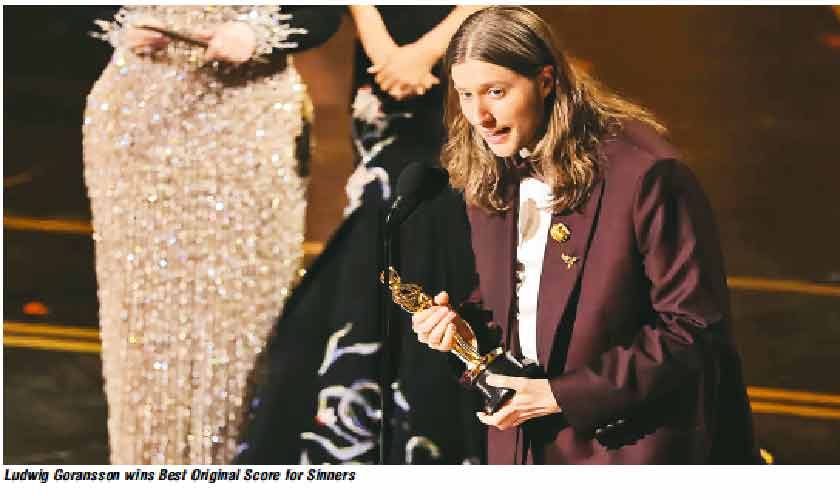
Ludwig Goransson wins Best Original Score for Sinners

Leonardo DiCaprio came to the Oscars with girlfriend Vittoria Ceretti, 27 and a moustache that has led to plenty of memes