Print Story
X




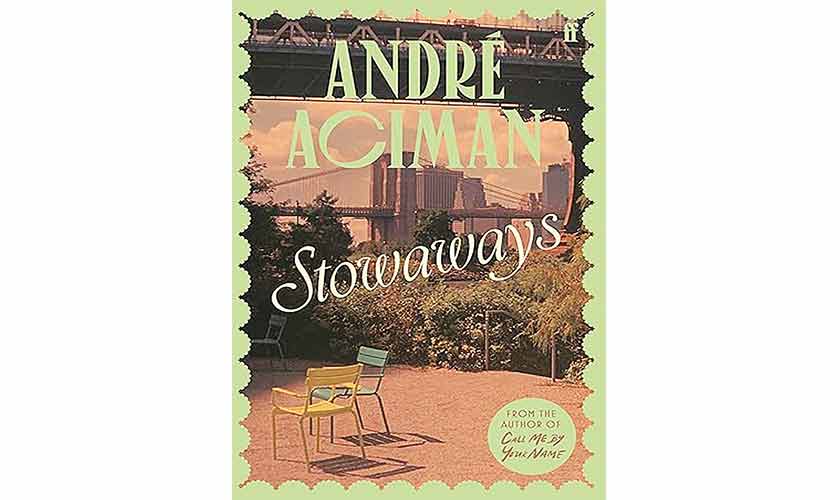
André Aciman’s Stowaways strips love of its certainties and offers a meditation on regret
| L |
Love is a dangerous pursuit contingent on risk. It demands the courage to take chances at the right moment, even when the outcome is uncertain or painful. Few among us can summon the courage to surrender completely to its dictates. Our inhibitions and doubts threaten to pull us deeper into a vortex, steering us further away from achieving any semblance of happiness.
The characters in André Aciman’s Stowaways find themselves negotiating the unpredictable terrain of love. The central force of TheNew York Times bestselling author’s new novella isn’t derived from the everyday complications and frustrations commonly associated with the phenomenon. Instead, the slim yet rewarding text draws its power from thesuspicions and anxieties many of us harbour about the choices we have to make as we navigate the shifting highs and lows of love.
At its core, the novella is a skilful reimagining of Brief Encounter, the 1945 British romantic tragedy film directed by David Lean and based on a screenplay by Noël Coward. The film depicts a doomed emotional connection between two happily married strangers and has been lauded for its measured yet sensitive portrayal of an extramarital affair. Over the decades, Brief Encounter has also come to be seen as an allegory of forbidden love.
While Aciman’s novella may draw its inspiration from the film, its narrative is far more modern, reflective and refreshingly original. The tone of Stowaways mirrors the muted melancholy of the film.
With a deceptively simple premise, the novella masks a profound emotional depth. On a “typical midweek summer evening” in Manhattan, Julian receives an email, a seemingly innocuous occurrence that threatens to disturb the quiet routine of his domestic life. The email is from Carol, a woman he has neither met nor heard of. After casting a quick glance at the subject line, Julian realises that it concerns Paul Axel, an older acquaintance who has recently died. Carol, an old friend of the deceased, writes that she has “a message from Paul…but would prefer to relay it in person.” Guided by curiosity and an unspoken devotion to his late friend, Julian agrees to meet the stranger, setting the stage for a transformative, brutally honest conversation about choice, passion and the limits of love.
Stowaways doesn’t rely on dramatic episodes or a shocking denouement. The conversation allows Julian and Carol to share memories and insights about Paul. The exchange occasionally steers them towards thought-provoking epiphanies about their friend’s life and legacy.
From the outset, little is revealed about Paul, except for the immense yet measured love he bore for the two protagonists. At different stages of his life, Paul had turned to Carol and Julian for consolation in distressed hours, offering them a love that was constant yet never demanding or calculating. In one instance, his affection was met with benign indifference; in another, it was weighed down by the ache of unrequited love. Throughout the novella, Carol and Julian confront the cold reality that, had they responded to his overtures, they might have been the anchor Paul needed all along.
These observations are, of course, rooted in conjecture and could only have been confirmed by Paul himself. Aciman’s decision to let the deceased’s presence remain a weighted silence prevents the novella from yielding easy, concrete conclusions. This technique lends a realistic touch to the narrative. If Paul had emerged as a full-blooded character, the protagonists would have arrived at convenient, airtight resolutions to their moral dilemmas. Stowaways reveals that definitive answers are an illusion. Grief resembles an unfinished puzzle.We must learn to accept its mysteries.
Stowaways reveals that definitive answers are an illusion.
The strength of Aciman’s novella lies in its portrayal of grief as a force that unites rather than divides. Carol and Julian make tentative, often clumsy, attempts to piece together their fragmented memories of Paul. This exercise is driven by a desire to not only understand the man who loved them, but also reflect on their own choices. Their long, meandering conversation serves as both a coping mechanism and a reminder that life is defined by the journey rather than by the final destination.
Stowaways depicts sexuality in fluid terms and uses it as a doorway to access Paul’s deepest vulnerabilities. Love, too, emerges as a disembodied character in the novella. It is seen as a liberating force, unconstrained by specific pronouns or circumstances. However, Aciman isn’t so naive as to assume that love can erase all traces of doubt.
In Brief Encounter, a transgressive romance drives the narrative. Viewers are led to believe that the feelings the two characters harbour for each other are pure, even if societal expectations prevent the lovers from acting upon them. Stowaways views love itself as the forbidden element that makes characters act recklessly or renders them tongue-tied.
Burdened by its intensity, Paul finds himself paralysed, trapped in a state of perpetual stasis. Paul’s hardships in love lead him to turn inwards and adopt a cynical perspective. “Which might explain why his journals number thousands of pages,” Carol tells Julian. “He was trying to figure something out that self-knowledge couldn’t uncover. Typical, typical, Paul. Was he in love with us…or was he just compulsive because compulsion was the closest thing to his heart?”
The pitfall of writing a novella is that certain narrative strands may feel disjointed or underdeveloped. Some characters in Stowaways, particularly the minor ones, fade into the background, appearing in a few passages, only to vanish entirely from the narrative. The ending may also strike some readers as inconclusive and unsatisfying. However, these elements shouldn’t be viewed as shortcomings. As a creative form, the novella thrives on, and is enriched by, its silences. Stowaways achieves a similar effect and stands out for its refreshing brevity.
Aciman is widely known for his acclaimed first novel Call Me by Your Name (2007), which was adapted into a film, with a screenplay penned by American film director and screenwriter James Ivory. Compared to his coming-of-age first novel, Stowaways might seem like a quiet performance.
Be that as it may, the novella has its own distinct charm. Unlike The Gentleman From Peru (2024), one of Aciman’s recent works, his latest offering doesn’t lean on farcical plot twists. Stowaways provides a moving meditation of modern relationships grounded in realism and enriched by the intricacies of human experience.
Stowaways
Author: André Aciman
Publisher: Faber & Faber
Pages: 112 pages
The reviewer is a freelance journalist and the author of No Funeral for Nazia