Print Story
X




A conversation with Mazhar Tirmizi
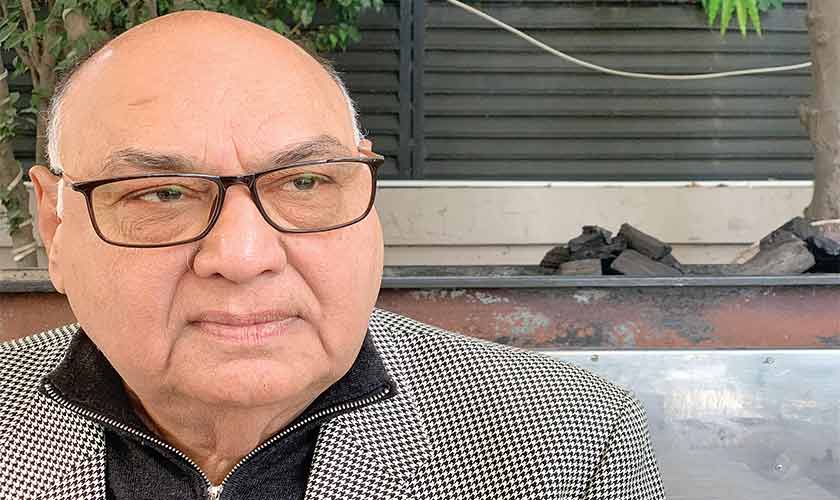
Mazhar Tirmizi shapes stories of loss and legacy in Punjabi verse. In a career spanning more than five decades, he has embroidered the circle of grief and renewal, drawing a cosmology of both loneliness and accompaniment. Living in England since the ’70s, he has never considered himself a proverbial poet in exile. His elegant, playful poems offer insight into the troubled moment through an exhumation of the past, while giving the reader depth and beauty.
Author of more than five collections of poetry, Thandi Bhubhul, Jaag da Sufna, Kaya Kagad, Adh, Dooja Hath Sawali and Ism Hawa Vich, in the interview below, he talks to Aasim Akhtar about patterns of immigration, his passion for the Punjabi language and his life, inspired in part by other lives. Excerpts:
The News on Sunday: Tell us about your family background. What does your surname, Tirmizi, refer to?
Mazhar Tirmizi: My maternal family belonged to Sarhal Qazian, a village in Jalandhar district in East Punjab. The nearest railway station, some 20 kilometres away, was Behram. Investigation into the genealogy led me to discover that my ancestors had immigrated from Termez in Central Asia to the Punjab. My nana (maternal grandfather) was also linked with the raja of Faridkot.
I was told that my father got married on the condition that the star singer of those times, Tamancha Jan, would perform at his wedding. Tamancha Jan (mentioned by Pran Neville in one of his books) would actually carry a pistol known as tamancha. Her most famous song was Sohna chhadd gaya la kay yari, ni mera yar Punjabi. When I heard about the performance from my mother, I used to imagine what it must have been like, attaching a certain romance to it.
My mother was unschooled, but she was a woman of immense wisdom and a magnificent householder. She would speak Punjabi beautifully. The romance I associate with the language comes from her.
TNS: How did the family move to West Punjab before Partition?
MT: Dr Varyam Singh, a family friend, admonished my nana to leave Sarhal Qazian for a safer place because of the growing political turmoil. Finally convinced, my father brought the family to Behram at night to the waiting room at the station to leave for Jalandhar by the early morning train. He ventured out to get some food for the family, but upon his return, he found the waiting room locked up. He had been recently recruited to the local police, so he dared to break the lock to rescue the family.
The family took refuge at Varyam Singh’s house for the night. Early in the morning, they left for Lahore. My paternal uncle was already in Sahiwal, so they all arrived there. My father eventually became incharge of Sahiwal city. One of our relatives, AG Raza, who later took charge as the IG, permitted my father to resume his earlier job in Sahiwal. Three of our families settled in houses located on the road that linked Chichawatni to Burewala. My own family decided to stay in Sahiwal. I joined the school in Okara, where my father had been posted. After the seventh grade, I moved to another school in Sahiwal my father had matriculated from.
TNS: How did your literary journey begin?
MT: I owe my initial exposure to literature to the ‘comrades’ in Okara. They were a group of intellectuals, writers and Trade Unionists with leftist leanings. There used to be a Venus Cinema there, and adjacent to it the Grand Hotel. I used to frequent the hotel to read books, to enjoy a cup of tea while overhearing the arguments. I had also become a member of the American Mobile Library. Among those revolutionary-spirited comrades was one Salim Baghi. (Mohammad Hanif has modelled the main character of his new novel, Rebel English Academy, after him). He was a teacher in Okara. The fact that he had no degree remains unquestionable. He had company with one Rasheed Najam, whose father, Kaukab Sahab, was a headmaster. Najam was, in a way, my mentor; I used to borrow books from him and sit out on his ‘veranda-turned-baithak-turned-library’. The rule of initiation was to dole out Russian literature to the young prospective socialists by Abdus Salam, a firebrand communist of the times. The transformation would begin with Maxim Gorky’s Mother, the novel that challenges many preconceived notions.
I would often cycle my way to the Hotel. The comrades had by now nearly adopted me as a new entrant – a young man brimming with passion to learn. Around that time, my father was informed that his son was seeing some ‘dangerous’ people. I was advised that I should stop seeing the comrades at the Hotel; instead, I should invite them home. Initially, they (the comrades) refused to gather at Shora Kothi (as the house used to be called), afraid of meeting at a police officer’s residence, but later, much to my mother’s contentment, they agreed.
TNS: When did you start writing Urdu verse?
MT: I must have been in the eighth grade when I tried my hand at writing Urdu poetry. I used to meet Zafar Iqbal quite frequently in those days. I knew him as a poet, but he was a lawyer by profession and a close associate of my father’s. Afterwards, I matriculated from Sahiwal. By then, I had read a great deal of French and Russian literature in translation, and the Urdu classics. Gradually, my poetry found its way to the literary journals.
My friend, Khalid Ahmed, proposed that we should organise an open-air mushaira in a street behind Dyal Singh Library on Nisbet Road, where the likes of Zaheer Babar used to live. The event was presided over by Ahmed Nadeem Qasmi, whom I met for the first time there. I read out one of my ghazals. Qasmi Sahab was so overwhelmed that he embraced me and asked me to have it published in Funoon:
Dil ki khwahish hai keh woh zehr phir ek bar peeyoon
Raat ka karb sahoon, din ki tamazat mein jaloon
Aisi hulchul mein sukoon ka bhi koi lamha ho
Kaanptey aks ko kuchh dair theher kar daikhoon...
My father discouraged me from joining Government College in Lahore. So, I stayed in Sahiwal until my graduation, after which I moved to Lahore.
TNS: How did you come across Majeed Amjad, the unsung Urdu poet?
MT: I had not yet finished school when I caught sight of Majeed Amjad for the first time in Okara, walking on the street near the Grand Hotel. I started following him on the bicycle. He was walking towards the railway station to catch the train to Sahiwal, where he used to live. I paced up and introduced myself to him as an ardent admirer. He invited me to Sahiwal. Once I moved there, I started seeing him almost daily, either at his place or at the Stadium Hotel. He was a benevolent soul and a kindred spirit. The letters that he wrote me have also been published. There was a mango tree in the courtyard of his house – he would bring me ripe mangoes wrapped in a newspaper. I remember borrowing Camus’sThe Outsider from him, which I could never return because he passed away shortly after, in 1974. His body was taken to his native Jhang for burial. His unpublished poems were put together by Khawaja Zakariya as Kuliyat-i- Majeed Amjad. The account of my meetings with him has appeared in a book of essays compiled in Karachi.
TNS: Tell us about your experience of migrating to the UK in the ’70s.
MT: I migrated to the UK in 1975. My maternal uncle (mamoo) used to live in London. I travelled by road in his company. We spent a night in Kabul on the way – during which I made a point to watch the movie Bobby at the cinema. It was the Zahir Shah era - the social system was liberal and gender-balanced. It was by sheer coincidence that I ran into a friend from Okara at the hotel.He was also going to England. Passing through Afghanistan, we made another nightly stopover at Herat. I sneaked out alone at night and encountered several groups of hippies, who were a common sight in the ’70s - at a local kehwa khana there. I remember befriending a French girl. We met again at the next stopover. This happenedrepeatedly for some time, leaving my mamoo utterly bewildered. We passed through Turkey. There were agents there who facilitated in human smuggling. We had to travel through Iran, but we didn’t have the transit visa. Somebody suggested that we should resort to getting fake visas stamped on our passports.
When we finally arrived at Dover, the immigration officials let my mamoothrough but I was asked to stay. South Asians did not require a visa to enter England in those days, just the ‘entry’ stamped at the immigration counter. My mamoo left me there telling me that if I get deported, I shall leave; otherwise, he’d come back to get me. I was taken to a detention centre nearby. Packed with people of various nationalities, I found it a very exciting environment – men playing guitars, exchanging views, gossiping. The next morning, an immigration officer was to decide my fate. Early morning, a police officer came into my cell while I was looking out of a small window at the white cliffs. “Young man, what are you looking for?” he asked. “I am looking for freedom,” I replied.
The immigration officer sat me down respectfully. “Unfortunately, we have to send you back,” he declared. Then, on an informal note, he asked me about my interests. When the conversation steered towards literature, TS Elliot and Yeats came up. He was so impressed that he made me a cup of coffee, left the room and returned with my passport in hand, the visa stamped on it. “Welcome to the UK – you may stay as long as you want,” he said. He offered me a pound as token money since I had no small cash and advised me to enjoy Fish ’n Chips before I left. Eventually, I got the British nationality following a long procedure through the Home Office.
TNS: How did the shift to Punjabi occur? What motivated the turnabout?
MT: When I was in Sahiwal, I came across some bilingual writers (Urdu and Punjabi), such as Ahmed Bashir. Under their influence, I started to read Punjabi literature, beginning with Shah Hussain, who truly inspired me. When I came to Lahore, I met Najam Hussain Syed, who encouraged me to write in Punjabi instead. There was no literary journal in Punjabi in those days except for Akhtar Hussein Akhtar’s Lehran. Together with my friends, I started the Punjabi magazine from Lahore, called Rut Likha. Printed at Hussain Naqi’s press, Triple Star, it did not survive beyond four issues despite the fact that it became a trendsetter. It gave the impetus to younger writers to write in Punjabi – an amalgam of philosophy, history and literature.
TNS: What is your take on the Punjabi language as a cultural shorthand?
MT: People who do not speak Punjabi while being Punjabi are a case of ‘lost identity.’ It’s a serious issue common in both East and West, especially in the West, where linguistic identity is more vulnerable because the Punjabis have disowned the language, unlike the expatriate Bengalis. The situation is a mix of complexes, status and ignorance. Unless it’s taught at an elementary level, it will not gain acceptance and appreciation. Add to that the stigma that it’s the language of the uncultured, ill-educated commoners.
There came a moment in my life when I started questioning myself about why I didn’t choose to write in my mother tongue – the language that I own. Before my departure, there was a lot of ferment in the air – activism to revive the Punjabi language and the Punjabi movement. I never quite confined myself to a particular ideology or school of thought, nor subscribed to the notion of writing revolutionary poems. To my mind, the idea of ‘revolution’ was soaked in romanticism. It did fascinate me, and I had formed a perspective, but it was primarily my love for the language that motivated me to turn to poetry. My most popular geet, Umran Langhian Pabban Bhar, was written around 1973 against the backdrop of troubled times. There was anger and frustration among the youth and drastic changes in mainstream politics. The dominant trend in poetry was led by poets like Faiz, Jalib, and Ustad Daman. That was probably the call of the times, but it was another genre which, more often than not, verged on sloganeering. The question that haunted me was: what is my voice in these troubled times? I wanted to write something that could resonate with my entire being and reflect upon the collective consciousness of society. I was proficient in Punjabi, armed with experience and vocabulary. In addition, I had a spiritual connection with the language.
My friend and fellow poet, Amarjit Chandan, had gone to see my village. He found my nana’s house lying in ruins. Amidst those ruins there was a mentally deranged woman who thought the house belonged to her. The moment she saw Amarjit, she asked: “Shah aa gaye naen?” Amarjit brought back pictures of the ruined house and memories that broke my heart.
In response, I wrote the poem Sarhal Qazian, included among my ten significant poems on Partition. It eventually turned into a play, staged in English, Punjabi and other languages. Ajoka renamed it as Surkh Gulabaan da Mausam, with Zohra Sehgal in the cast. Later on, it was staged in India as well. Menna Elfyn, the famous Welsh poet and playwright, translated it into Welsh.
TNS: How do you conceive a poem?
MT: I don’t believe in writing in an idiom that is incomprehensible or removed from the mundane and the commonplace. In other words, you cannot guard a language against incorporating new words and terms that may be foreign to it because, after all, that’s how a language modifies and transpires. It’s not a forbidden territory where no other language can trespass. I don’t allow inhibitions and prejudices to invade my thoughts. I continue to write in Punjabi with freedom and vigour.
Writing that play was a therapeutic experience. I was writing in my mother’s language, making my mother speak through me in the tone she would address me in. Conversely, I was talking to the audience in her voice. When I acted in the play, I played both the mother and the son myself in a solo performance, switching roles. It was a dialogue, but it became a monologue in essence because I characterised two voices together. I believe that if you rediscover and cultivate your mother tongue, it empowers you because, essentially, it’s embedded in you.
Poetry and the poetic muse haunt you. Pablo Neruda used to say: “Poetry looks out for me.” The poet can be touched by the slightest incident or a single moment in time. I was listening to Beethoven’s Fifth Symphony when the sound played up sensuous images in my head, which I expressed as:
Jeevain Samundar Ghummaya
Va lehran di gal chhiri
Chhupdey patalan ‘chon koi ghaibi haasa chhiraya
Raat de mukh ton chanan charhaya
Dilan luka kay kisey purani yad ta hoka bharaya
Kisey hanair sawair di gal tay suraj da munh phiraya
Anbar, dharti ik hoey, bandey, rukh tay panchhi ik doojey tay mik hoey
TNS: Tasveer and Soorat make a frequent appearance in your writings. Why is that?
MT: Images possess me. My existential being dictates every phenomenon, every event to turn ultimately into a picture – people, buildings, places, landscapes congeal into images. I have always tried to capture these images in their various guises, but often as dreams.
During the wintertime in England, afternoons are melancholic. I wrote a poem, Loadey Valey di Tasveer. The poet is sitting alone, watching clouds, houses, thinking about his family, his wife who’s gone to work:
Kammon aan kay davey bhari, mamta maari
Dukh di handi charhdi ae
Chuk changair di qatra qatra
Dukh da bhanda bhardi ae
There are many poems you’d find images in; the most powerful among them is Jadoo Nagri. That’s the title of one of my books published in India. The poet goes back to his old house and pulls out old photographs. He finds them dampened and soiled. He decides to smoulder them. His mother is sitting in a corner; the winter sun is busy creating shadows on her skin. She gets up and tries to save those photographs:
Chup hoye-aan diyan gallaan kar kar rondi ae
“Aenaan noon kyun sarna aen
Aenaan noon kuchh na juraya, kuchh na juraya”
The interviewer is an art critic based in Islamabad.