Print Story
X




A new study shows how masculinity can be shaped less by authority than by bureaucracy
| T |
he history of masculinity has rarely been written from the vantage point of those for whom power is promised yet persistently withheld. Dominant traditions in sociology and political theory have treated masculinity as either an achieved position or a coherent cultural script. There exists, however, another masculine condition: one defined by postponement rather than possession, by anticipation rather than arrival. It is a masculinity shaped in waiting rooms, probationary households and bureaucratic intervals where legitimacy is endlessly deferred.
What emerges is a conception of masculinity as administrated rather than owned. Documents, income thresholds and immigration regimes penetrate the intimate domain, producing a masculine subject whose adulthood is continually under review. Gender becomes inseparable from governance. The state appears not merely as an external regulator but as an intimate force embedded within kinship, marriage and everyday moral expectations. Masculinity, in this configuration, is best understood as a condition of suspension.
Marriage, conventionally imagined as a site of resolution, is recast here as a site of intensification. In transnational British Pakistani contexts, marriage migration is invested with hope, social mobility, respectability, masculine fulfilment. Yet ethnographic realities reveal marriage as a mechanism that redistributes vulnerability rather than alleviating it.
The migrant husband enters not simply a family but a dense apparatus of control. Fathers-in-law oversee wages and documents; employers align with kinship authority; the state remains an ever-present arbiter of legitimacy. Marriage becomes the medium through which immigration control is domesticated. Power circulates quietly, appearing familial while operating bureaucratically. Kinship emerges not as a cultural residue, but as a strategic extension of state authority.
The book’s most generative conceptual contribution is liminal masculinity. Drawing on, yet extending, anthropological theories of liminality, it asks what happens when transition never ends. The migrant husband occupies a prolonged threshold: husband without authority, adult without autonomy, provider by expectation yet dependent in practice.
This condition is structured by time. Protracted visa processes, probationary citizenship and economic precarity produce what is aptly described as wait-hood—an extended suspension of life trajectories. Masculinity becomes temporal rather than territorial, measured through endurance rather than command. Waiting disciplines aspiration, corrodes confidence and renders the future perpetually provisional. Crisis here is not episodic but structural.
One of the book’s most unsettling achievements is its reversal of the dominant figure of the Muslim patriarch. Against prevailing representations of Muslim men as unilaterally powerful, the ethnography documents men who are subject to verbal, emotional and physical abuse, often rendered silent by expectations of masculine endurance.
Marriage becomes the medium through which immigration control is domesticated.
This is not a denial of patriarchy but a re-mapping of its operation. Power within families does not align neatly with gender alone. Citizenship, education and economic security redistribute authority in ways that can subordinate men. Patriarchy appears here as fractured and situational, a resource unevenly allocated rather than a stable male possession.
Citizenship emerges as one of the book’s most incisive analytical lenses. It functions not merely as a legal status but as a form of masculine capital. Those who possess it can wait, negotiate and threaten withdrawal; those who do not are compelled to comply. Within transnational marriages, citizenship reorganises household hierarchies, subtly reproducing colonial distinctions between subject and sovereign.
This analysis complicates familiar diaspora narratives. Exploitation does not flow unidirectionally from “home” to “host” country. Instead, colonial logics are reactivated within families themselves, with citizenship acting as the contemporary idiom of domination.
The book does not confine itself to vulnerability. It traces the emergence of alternative masculine practices forged in response to precarity. Religious devotion, particularly within Sufi contexts, offers a grammar of dignity grounded in patience, moral discipline and endurance. What is termed spiritual masculinity enables men to reframe suffering as ethical labour rather than failure.
Alongside this, cultural forms such as digitally circulated “songs of sorrow” provide collective spaces for articulating grief and injustice. These affective archives expand the terrain of masculinity studies, locating theory not only in institutions but in expressive practice.
Colonialism figures here not as memory but as method. Immigration law, surveillance and economic thresholds replicate older hierarchies of suspicion and worth, now internalised within domestic life. Crucially, the book avoids romanticising precolonial masculinity. Aspirations to transnational success are themselves shaped by colonial imaginaries. Masculinity is both wounded and produced by colonial power.
This is a rigorous and unsettling book. It refuses moral simplification, offering instead a portrait of masculinity shaped by law, kinship and time. Men appear neither as sovereign patriarchs nor as passive victims, but as subjects caught within dense structures of expectation and control.
By centring those whose masculinity is perpetually deferred, the book reorients masculinity studies, migration scholarship and postcolonial theory alike. It reveals how power hides in ordinary transactions, in marriage arrangements, visa renewals and the long, disciplined practice of waiting.
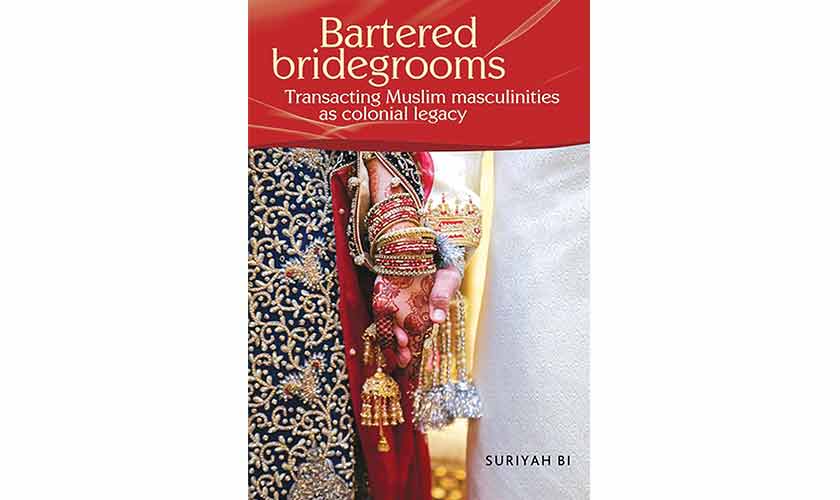
Bartered
Bridegrooms:
Transacting Muslim Masculinities as
Colonial Legacy
Author: Suriyah Bi
Publisher: Manchester University Press, 2025
Pages: 205
Price: £85 (hardback)
The reviewer is a Pakistan-born and Austria-based poet in Urdu and English. He teaches South Asian literature and culture at Vienna University