Print Story
X




Overshadowed by her sister Emily, Frances documented colonial India with remarkable clarity
| W |
hen it comes to the Eden family and their travels in the Indian subcontinent, attention has largely focused on George Eden and his sister Emily. Yet another sibling was also part of the travelling party: Frances Anne Eden, known to her family as Fanny. Born in England in 1801, she accompanied her brother and sister on their journeys across colonial India.
Emily achieved lasting recognition through her writing and art. She authored two novels and illustrated the celebrated album of hand-coloured lithographs, Portraits of the Princes and People of India, published in London in 1844 by J Dickinson & Son.
Frances was also a constant presence. From royal tours to imperial dinners, she recorded her observations in sketches and detailed journals. Although an amateur artist, she was an astute observer of colonial India. Quieter and less celebrated than Emily, Fanny deserves to be recognised and studied on her own terms.
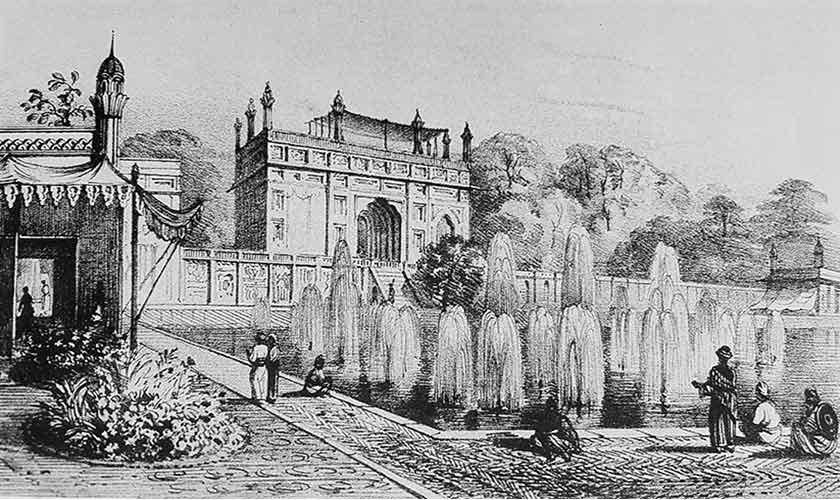
She observed Lahore from the illuminated terraces of the Shalimar Gardens to the mysterious silence of the Walled City during the winter of 1838.
She looked out across the distant landscape and the grandeur of Mughal architecture with a sense of careful astonishment. The new imperial family was neither Mughal nor drawn from the region’s Hindu ruling clans. Instead, it belonged to the first Sikh dynasty to establish dominion over a unified Punjab, with Lahore as its capital.
George Eden, the governor-general of India (1836-42), and his sister Emily are generally regarded as the principal narrators of their stay in the subcontinent. Frances Eden, however, enriches that narrative through her own keen observations. Though brief, her writings are valuable, authentic and deserving of attention, functioning like illuminating footnotes to the larger story.
Frances Eden accompanied her brother and elder sister when they arrived in Calcutta in 1836. The following year, they embarked on a 30-month journey across the northern regions of the subcontinent, travelling from the shores of Calcutta to the hills of Simla.
The imperial entourage, comprising thousands of people, hundreds of camels and elephants and 60 horses, passed through Sikh-administered Punjab and stayed briefly in Lahore, the capital, in December 1838.
Throughout this remarkable journey, Frances Eden kept a journal. The manuscripts remained in the India Office Library and Records for almost 150 years before they were published in 1988 as Tigers, Durbars and Kings: Fanny Eden’s Indian Journals, 1837-1838, edited by Janet Dunbar.
Fanny’s letters were included in the second volume of Emily Eden’s Letters from India, compiled by their niece Eleanor Eden and published in 1872.
In the introduction to Tigers, Durbars and Kings, Janet Dunbar reflects on Frances Eden’s character and literary style: “Hers [Fanny’s] is still a thoroughly un-Victorian approach, that of an Austen-esque lady, ‘strolling about on an elephant,’ as she puts it, and quizzing India with tolerance and irony.”
Fanny’s accounts and sketches, in contrast with those of her elder sister Emily, are private and deeply subjective: intimate, detailed and arguably more candid than literary or ornamental in style.
She encountered Lahore in late 1838, when the Sikh court of Ranjit Singh was approaching a period of crisis. His death in June 1839 marked the beginning of the empire’s decline.
Frances Eden describes the grandeur of the Lahore court, its lavish ceremonies and its opulent treasures, diamonds, precious stones and jewels as an observer rather than as a chronicler of court life.
“Fireworks were going all round us and nautch girls dancing before us all the time we were there, I got him [Ranjit Singh] to show us his Sea of Light, [Koh-i Noor] a diamond for which he starved Shah Soojah. It is as large as a small egg.”
Her sketches, which serve as illustrations to her writing, focus on ordinary people as well as flowers and architectural details of the city. They are unsentimental and unembellished.
Today, her writings and sketches offer a more immediate and authentic record of their time. Her drawings are unpretentious and her prose is not overtly literary. Yet her powers of observation anticipate the methods of modern reportage and photojournalism.
Scholars of British women’s travel writing on India often place Frances Eden alongside Maria Graham and Fanny Parkes, noting that they generally refrained from overt political narratives or explicitly colonial positions. Instead, they are recognised for the precision of their description, vocabulary and careful documentation in both their written and visual accounts.
At times, Frances Eden’s journal also reveals a sensitivity to architectural grandeur and a spirit of adventure.
“We went yesterday to Jehan Gher’s tomb – an alarming expedition as we had to cross the river on elephants... It covers an enormous space of ground, but like all fine buildings in this country is going fast to decay.”
Frances Eden’s sketches and writings together form an empirical record, reflecting her responses to unfamiliar people and places with curiosity and a descriptive colonial perspective.
Her drawings are not as accomplished as those of her sister Emily Eden or Lady Charlotte Canning. They do, however, retain an unpolished authenticity rooted in the places where they were made. In Fanny’s sketches and journals, the reader can almost feel the heat of the camps, the sway of the elephants and the gaze of a young woman travelling through an unfamiliar land, impressions that remain rough, yet strikingly immediate.
Together, the Eden sisters offer a stereoscopic view of northern India, including Lahore: the elder through a literary and artistic lens, the younger through a more personal and observational one.
Fanny died in 1849, the year Lahore was annexed by her countrymen. She did not live to witness the establishment of the British Raj in 1858. She did, however, observe and record the advancing presence of colonial rule as it spread across the subcontinent, leaving its mark on both the land and its people.
The writer is an art historian, a critic and a curator teaching at the College of Art and Design, University of the Punjab, Lahore. He may be reached at [email protected].