Print Story
X




Walkability is not failing because people dislike walking but because the city makes walking difficult
| I |
slamabad has all the ingredients for a walkable city. But years of car-centric planning have turned walking from being an ordinary part of life into an inconvenience, reserved for those who have no other choice. The city is investing in flyovers and roundabouts while neglecting the simple infrastructure that makes urban life possible.
The value of walkability
Walkability is linked to happiness. The act of walking is deeply human and associated with well-being and belonging. From simple acts like walking to a school or a mosque to walking as a form of worship during a pilgrimage, there are signs that walking fires up something in our brains. This value is deeply understood and is often referred to as a culture of walking.
In cities, walking is more than simply getting from one place to another. It has social and cultural value. Pedestrians make the city safer by providing eyes on the street. Walking creates opportunities for chance encounters—you run into neighbours, friends and familiar faces from your community. People from different classes and social backgrounds cross paths. Walking builds appreciation for community assets and care infrastructure: old shady trees; the corner of the street where children play cricket; and the neighbourhood park. These are signs of an evolved, caring society and a cultured people.
This culture does not exist or thrive on its own. It depends on the city promoting walking and making it a pleasant experience. Islamabad was initially designed as a city conducive to walking. Markaz, neighborhood and sectors connected in a predictable pattern. Daily errands could be run within short distances on foot. Green belts and shaded footpaths created a pleasant environment. But the city has moved away from that original vision of a calm, serene capital and grown into a hodgepodge of new roads and flyovers that is increasingly unrecognisable.
Killing the walking culture
Instead of building on the ingredients of walkability, the authorities seem to be working to make Islamabad unliveable, except for the city elite. Footpaths are treated merely as elements of the right of way—an afterthought to roads, rows of pavement that can be eaten up whenever roads need expansion. The CDA is responsible for everything—from large-scale planning to the distribution of basic services—yet no one seems responsible for the humble footpath. Without a dedicated department looking after pedestrian infrastructure, there is little hope for walkability.
The dignity and pleasure of a simple walk seems lost. But walkability is not failing because people dislike walking; it is failing because the city makes walking difficult.
The kind of development projects making headlines are roundabouts, flyovers and underpasses. Car infrastructure brings in more cars, increases dependence on private vehicles and contributes to growing social disparity, congested roads and a city that slowly shrinks around parking lots and roads built for SUVs that seem to grow bigger every year.
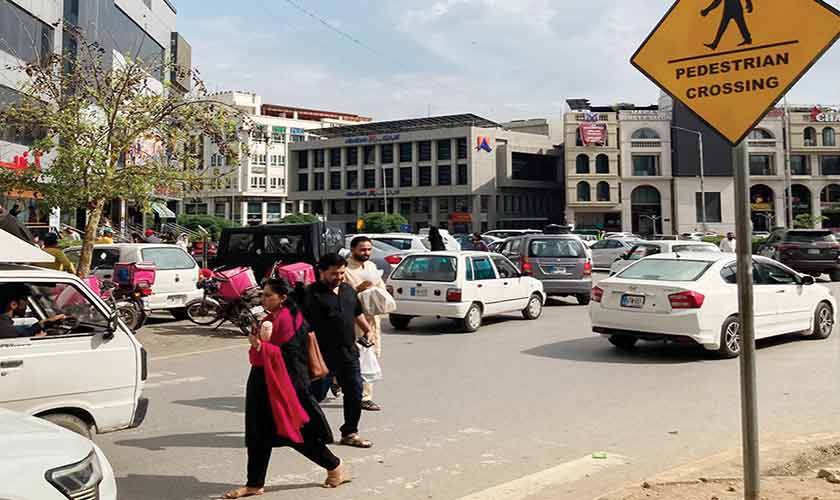
Today, when you step out of your house, you are likely to see more cars than people and that has deep social implications that people rarely think about. Beautification projects focus on how the city looks through a windshield: streetlights, landscaping and roads designed to serve vehicles first. Much of this development assumes that everyone drives. Those who walk, cycle or depend on public transport are treated as an afterthought. The result is a city that works best for those who can afford to insulate themselves from it.
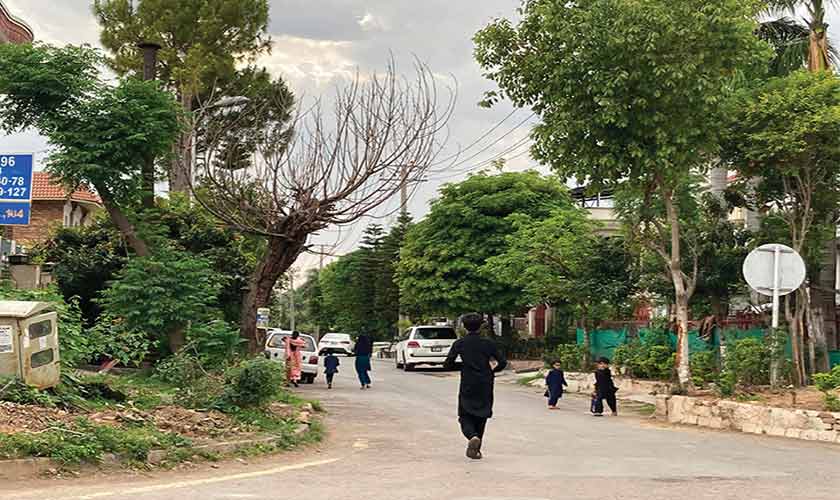
Much of this development assumes that everyone drives. Those who walk, cycle or depend on public transport are treated as an afterthought.
Walkability is not a pedestrian bazaar
Walkability is also not about a few pedestrian streets. In the face of all the windshield urbanism, one pedestrian street is no more than a token gesture. The irony is hard to miss: people must drive to the pedestrian street and park at a nearby plaza before they can enjoy walking.
Pedestrianisation is not about closing one street to cars. It is about making walking possible everywhere in coexistence with other forms of mobility. What we need are connected streets that serve economic and social life—density, public transport and public spaces that support the needs of a neighbourhood and the proper functioning of a city. Sustainable change can only come when walkability becomes a mainstream part of planning, not an isolated project.
The test of walkability
The simplest indicator of a walkable city is whether you can see women and children walking on the streets? Women are often the ones who sustain neighbourhood life through simple acts such as walking children to school; shopping for groceries; visiting parks; and using public transport. When walking becomes unpleasant or unsafe, these everyday routines become harder and public life begins to disappear.
Women, children and the elderly experience the city differently. The inconvenience of a broken pavement; the absence of shade and public seating; and the difficulty of crossing wide roads are felt more acutely by those who experience the city on foot. Many daily trips begin and end on foot. A metro bus ride, for instance, is only as good as the walk to and from the station.
The absence of women and children from public space is telling. Children are rarely seen walking independently; women often wait for buses on the margins of roads with little shade or seating. Empty and hostile streets turn walking into a nuisance rather than a routine.
What does it take to build a walkable city?
The answer is surprisingly simple. It starts with the basics: footpaths across all city streets—in old sectors, new housing societies and everything in between—well-maintained, safe and well-lit; street trees to provide shade and comfort; safe zebra crossings, traffic calming and traffic rules that require drivers to stop for pedestrians; slower speeds and strict enforcement and penalisation of bad driving needs to be harsher; protection from encroachments by parked vehicles, private houses, shops and retailers; density and mixed-use neighbourhoods that support the desire to walk and rekindle the culture of walking.
Then come cultural spaces: open streets, school streets, market streets and pedestrian food streets.
So, what kind of city does Islamabad want to become?
Modernity is often confused with speed and infrastructure megaprojects. But cities are judged by how comfortably people live, the quality of their public spaces and the vitality of seeing women and children participating in urban life.
The answer lies in a simple question: can you comfortably walk to nearby places?
Walking is not backward or nostalgic. The world’s most liveable cities are rediscovering what they once took for granted. A city built for pedestrians is one that values social fabric and everyday life. A city that cannot accommodate its pedestrians stops feeling like a city at all.
The writer completed her master’s in urban management from Pratt Institute, New York, on a Fulbright scholarship. She now leads the Sustainability Lab at atomcamp, working at the intersection of climate change and cities.