Print Story
X




Suleman Aqeel Khilji’s Transmission turns fleeting moments into meditations on migration and loss
| Q |
uetta, Lahore, London, Oslo and Paris are marks on the world map. These cities are also significant in the cartography of Suleman Aqeel Khilji’s practice. Born in Quetta, educated in Lahore, living and working in London, having twice participated in a residency in Oslo, and currently presenting a solo show in Paris, the artist has, like all living beings, drifted from one place to another and gathered physical, pictorial and intangible material from each location. All of this shapes his imagery and helps us contextualise it.
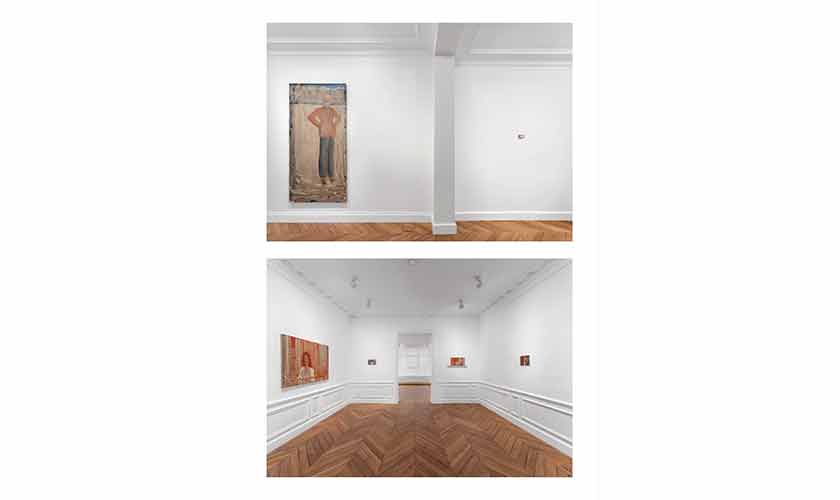
Khilji’s exhibition, Transmission, at White Cube, Paris, provides points of reference for decoding his past, present and projected future. As an artist, he remains an eager observer who transforms what survives in the realm of the ordinary into an unforgettable and sensitive substance. His gaze and subjects are stitched to his surroundings - perpetually shifting. These range from human models to photographs, TV clips, pieces of music, lines of poetry and fragments of personal recollection. Friends, acquaintances, strangers and dogs enter his surfaces, seeking a permanent yet ethereal presence.
During his student years at the National College of Arts, Lahore, Khilji would, on his walk to college each morning, pass an elderly homeless man sleeping on the pavement with his mutt. The image became a recurring motif in varying forms, suggesting the alienation of a person in a crowded environment. Not dissimilar to memory, a refugee surrounded by countless fragments of frozen moments: photographs preserved in family albums, drawers, boxes, discs, USBs, hard drives, smartphones and iCloud; on Facebook, Instagram, Google and other internet colossi with seemingly unlimited storage capacity.
In Khilji’s recent paintings, on display at White Cube, Paris (June 11 to July 25), one recognises traces of people, places and objects. They are not rendered at full density but appear as fleeting as feelings and emotions. The artist’s choice to knead, rather than unearth, his imagery through thin layers of pure pigment reinforces a condition of erasure with which all of us are burdened. In that sense, his paintings are both in synchrony with and in disagreement with photography, a medium that has profoundly altered our perception and through which we now increasingly experience the world. In one of his essays, the German poet Hans Magnus Enzensberger reflects on this phenomenon: “It’s difficult, it’s almost impossible, for us to imagine how our forebears perceived their surroundings before the camera existed. The camera is our omnipresent and insatiable third eye.”
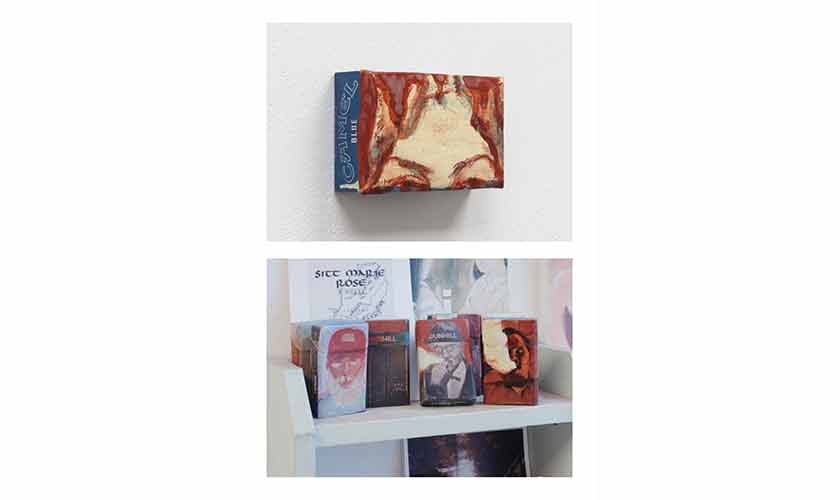
Besides paper and linen, Khilji has used old book jackets, empty cigarette packets and wooden tablets (objects which, in the artist’s words, “become those detours, small pauses that guide me back to painting. I think of them as thoughts, extending themselves onto other surfaces beyond the canvas”). These articles rekindle distant and immediate moments in his life: swimming in the streams of Balochistan (Sarab/ Mirage I, III); a section of a familiar female face (Nazia); a man posing next to a structure with fading trees (Green Park); another man sitting in a traditional shalwar qamees against a large grey door (1996: A Studio Visit); a figure in cricket whites stretching both arms out to signal a wide delivery (Umpire II); and the torso of the same figure in a similar position (Study of an Umpire), both postures echoing, in an uncanny way, Christ’s last appearance on Earth; a smaller painting of a man touching, or adjusting, his tilted hat (Teacher); and a portrait of someone wearing glasses raised to his forehead (Host). Each of these works recalls the slow, gradual process of removal.
To communicate a modification of this sort, Khilji has developed a technique of carefully rubbing out, smudging and wiping away details, contours and sharp lines from his imagery, producing a world shaped by subtraction, diffusion, recession and disappearance. His palette, to reinforce and convey this quality, consists of hazy yet primary colours: blue, yellow and red. As the artist notes, “Pozzuoli Earth, Persian indigo and lemon yellow are rooted in the geology and architecture” of the land of his origin.
The titles of his paintings, which reveal the sources of his imagery and are often integral to recognising the floating world the artist has fabricated. Though fluid, in flux, transitory and translucent, it is not temporary but endowed with the power to possess and reside within an individual. It is articulated through Khilji’s softened yet distinct visual diction, refined during his years in London and populated by people who are estranged, lost and disoriented in every territory, whether native or foreign.
A person travelling from one address to another, regardless of the duration of the journey or length of stay, is suspended in an ‘elsewhere’ or a ‘nowhere’. This condition is heightened by the visual dossier we assemble mechanically. We happily capture selfies, group photographs, pictures of loved ones, snapshots of incidents and accidents, building details, aerial views of localities and interiors of houses. Yet, as soon as these images, recorded on our smart devices, are saved as files, they enter an incomprehensibly vast databank, never to be looked at again. They accumulate, converting everything around us into bytes of junk, only to end up in the graveyard of amnesia.
Suleman Khilji’s work is probably a reaction to these acts, structure and system of erasure. He records passing moments not to store them, but to share and thus immortalise them. As seen in If I Cannot Carry It, Then You Must, which portrays a girl in the midst of lighting a cigarette, the flicker of a short-lived flame causes an instant to repeat itself every time a spectator sets eyes on the piece. Two small paintings on cigarette packets depict men exhaling smoke, a vanishing substance. Another canvas is composed from a clip on PTV (which, for many decades, was the sole and unchallenged television channel in Pakistan), showing a woman with 1970s hair and dress seated behind a reflective counter, perhaps a table.
By incorporating such easily forgotten scenes, Khilji’s art is populated by mundane characters, abstract entities (for instance, Raag III and Study of Raag, based on Indian classical music) and other familiar occurrences. It revives bygone fragments of human existence. Elevation (2025-26), featuring a man with a dog, though set against a different background and in different attire, recalls his earlier canvases from 2011 that contain similar subjects and elements. Likewise, the lone figure standing in Green Park resembles figures from several of his canvases depicting a bearer boy serving at a tea stall.
One may detect a paradox in Suleman Khilji’s aesthetics: the technique is one of rubbing out, while the intention is to recall what has been left behind. As the artist explains: “A lot of things on my canvases or in my drawings are things that I can’t really explain with paint or can’t really draw. I write sometimes just to be reminded of something.”
More than a contradiction, however, his work confirms a function of art that we often overlook. What are painting, sculpture, drawing, video and photography if not ways of summoning individual and collective memory in different forms and for different purposes? It is an inherent quality of art that, by its very nature, resists the doctrine of forgetting, whether imposed, prescribed or practiced by the state, society, faith or ethics.
The writer is a visual artist, an art critic, a curator and a professor at the School of Visual Arts and Design, Beaconhouse National University, Lahore. He can be contacted at [email protected].