Print Story
X




The real danger to jobs is not AI, but doing nothing to change education and skills
| G |
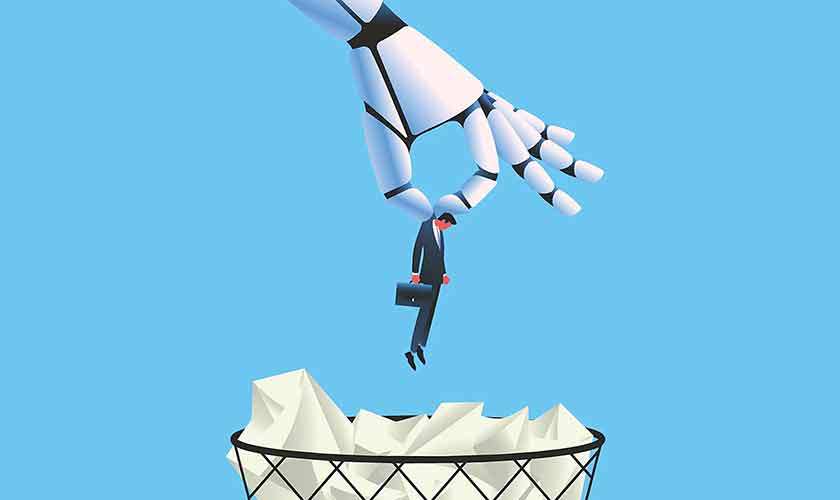
o to any university hostel in Lahore or Karachi tonight. You will hear the same worried joke. Study hard for four years. Collect your degree. Then watch a computer do the same job for free.
The fear behind the joke is real. Every year, close to a million young Pakistanis start looking for work. Our economy finds it hard to give them jobs. Now they hear that machines can write, design, answer customers and do arithmetic in seconds. So they ask: will there be any work left for people at all?
The honest answer is: yes, AI will change our jobs. But changing a job is not the same as taking them away. History shows us the difference again and again.
Look at the factories of Germany, Japan and Korea. When machines arrived, workers were told the assembly line would take over from them. Some jobs did disappear. But new jobs came too. People were needed to fix the machines, write their software and check their work. The same thing happened in the 1990s, when computers reached the office. Many feared the worst. Instead, brand new fields appeared.
AI seems to be walking down the same road. We should look at both sides of it with open eyes.
Start with the hard side. Some of the work is truly at risk. A computer can now write a simple article, make a basic logo or send a first reply to a customer in seconds.
Now the other side, the one we keep forgetting. The same wave of AI is creating fresh demand. It needs people who can do what the machine cannot. Someone has to guide the tool, check its work and add real judgment. And Pakistanis are not standing on the sidelines. Last year our IT exports reached $3.8 billion. More than two million Pakistanis now freelance.
The lesson here is simple. AI helps the workers who use it. It hurts the workers who pretend that it is not there. A writer who lets AI handle the research can finish three articles in the time one used to take. A young coder who works beside AI can do the job of a small team. A designer can ask it for ten ideas before breakfast and pick the best one. The Pakistani freelancer who learns this will not lose to AI. He or she will only lose to the freelancer next door who learned it first.
So the real danger to our jobs is not the technology. The real danger is sitting still and doing nothing.
If we are serious, the work must begin in the classroom. For too long, our schools have rewarded memory over thinking. But memory is the one thing machines do best and the thing humans no longer need to sell. A person taught to think, ask questions and solve problems will always stay ahead of the machine. A young person taught only to copy will be the first to be copied. School alone is not enough, though. Millions of people are already working. They need a real chance to learn new skills. That means treating digital training as a true national goal, not as a one-day event with a photo for the newspaper.
There is simpler work to do as well. We call our freelancers heroes who bring foreign money into the country. Yet many of them still cannot get paid easily. Some of the tools that the rest of the world uses without a second thought, such as PayPal, are still not available here. We ask our youth to compete with the whole world, and then we tie one of their hands behind their backs. A country that earns half a billion dollars from this work in just six months should build the proper roads to carry it. It should protect these workers and bring them into the formal system, instead of leaving them to manage alone across many time zones.
None of this will happen by itself. Technology will keep moving whether we are ready or not.
AI is not magic and it is not the enemy; it is a tool. Like every tool before it, it will reward the people and the countries that learn to use it well. Pakistan happens to have the one thing this new age needs most. We have young people, and we have a great many of them. Almost two out of three Pakistanis are under the age of thirty. That is not a problem to be feared. It is the advantage we have, if only we choose to use it.
So the old question - will AI take Pakistani jobs - is the wrong question. It gives all the power to the machine and none to us. The better question is this: will we do the hard, slow and unglamorous work of preparing our people in time? Get it right, and AI becomes the finest tool a young and hungry country ever had. Get it wrong and we will have no one to blame but ourselves.
The writer is a chartered accountant and a business analyst.