Print Story
X




Lady Charlotte Canning’s sketches of the subcontinent remain an important visual archive of colonial India
| T |
he visual culture of colonial India was shaped by profound encounters between indigenous traditions and European ways of seeing. Few artists documented this moment of transition as extensively as Lady Charlotte Canning, whose watercolours now provide a valuable record of the subcontinent in the mid-19th Century.
Born Charlotte Stuart on May 31, 1817, she married Charles Canning in 1835. He was the first viceroy of India from 1858 to 1862.
In her own right, she was a prolific artist whose watercolours constitute a significant part of the Victoria and Albert Museum’s collection, numbering some 350 works. Lady Canning lived in India from 1856 to 1861 as the wife of Lord Charles Canning.
In this capacity, she travelled extensively across the subcontinent, capturing the beauty of the Himalayan landscapes of Simla, Kangra and Darjeeling; the fertile plains of the Punjab; and its forts, gardens and rivers. Her work encompassed everything from architectural splendour to luxuriant foliage. Alongside the Mughal cities of Delhi and Agra, Lady Canning also depicted the diverse landscapes of Jabalpur in central India, the Nilgiri Hills in the south and the riverside surroundings of Barrackpore in Bengal.
At Barrackpore, she developed a keen interest in botany and art. This resulted in a prolific body of work devoted to nature and landscape. Her sketchbooks from the subcontinent comprise approximately 150 illustrated works, revealing the multi-layered ideologies of social segregation and acculturation while also offering a distinctly colonial vantage point.
Lady Charlotte Canning enjoyed considerable privilege while travelling across the subcontinent, often seated in a howdah on the back of an elephant. She viewed her subjects from an elevated vantage point, one that functioned as both a physical and metaphorical expression of the colonial gaze.
Charlotte Canning’s watercolours, like the sketches of Emily Eden, stand as observational studies by a visitor, marked by the sense of wonder of a travelling artist encountering distant landscapes and unfamiliar people. At the same time, these works subtly reinforce the structural hierarchies of the colonial subcontinent, viewed through the eyes of an imperial figure occupying the highest ranks of the establishment.
As the first Vicereine of India, she enjoyed royal protocol across the vast expanse of the subcontinent. This imperial position mediated her vision and shaped her perception as a travelling artist. Her technique was European, her status was royal, her viewpoint elevated and her historical moment colonial. Together, these elements formed the visual prism through which the Indian landscape was framed and represented.
From a post-colonial perspective, Lady Charlotte Canning’s watercolours can be analysed as records of the colonial structures of privilege, power and social segregation that shaped the mid-19th Century.
Between 1858 and 1861, Charlotte Canning travelled extensively across the subcontinent. Her peripatetic artistic practice, expressed through a remarkable body of watercolours, resulted in a rich visual record of the period.
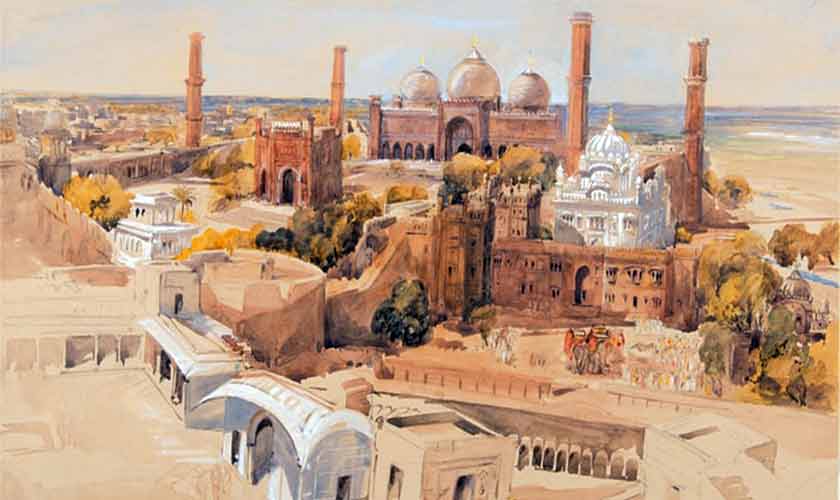
Her landscapes capture both the scenic beauty of the northern plains and the architectural grandeur of the subcontinent. She travelled through Lahore and across the Punjab in 1860, in the aftermath of the 1857 War of Independence and the consolidation of British rule, more than a decade after Lahore had been annexed from the Sikh kingdom of Maharaja Ranjit Singh.
As Fakir Ijazuddin notes in his book Sketches from the Howdah: “Charlotte Canning’s artistic legacy lies not merely in what she depicted, but in a manner of observation that contemporaries described as ‘acute and sympathetic’.”
In simple terms, the question of how she saw often outweighed what she saw. This is particularly evident in her two monumental landscapes of Lahore: The Shalamar Gardens (1860) and The View of the Badshahi Mosque from Lahore Fort (1859).
From Lahore, Charlotte’s journeys north and north-west reveal her interest in the region’s striking topography. Rohtas Fort (1860), Rawalpindi with Murree Hills (1860), Guru at Hassan Abdal (1860) and Attock Fort (1860) constitute rare visual record, offering valuable insight into regions that passed from Sikh rule to the British Raj in the aftermath of 1857.
It is interesting to note that the renowned Scottish war artist William Simpson (1823-99) accompanied Lady Canning on many of her sketching and painting excursions, particularly through territories that fell under the administration of the first viceroy, Lord Canning. This association with Simpson may have encouraged Lady Canning to develop a more disciplined and precise approach to her chromatic interplay and atmospheric sensibility, distinguishing her from many of her contemporary colonial artists in the 19th-Century subcontinent.
As a female artist in the mid-19th Century, Charlotte Canning made a significant contribution to the visual culture of colonial India. She produced hundreds of works that today serve as some of the earliest visual archives of the subcontinent rendered through a Western realist approach. Her work is now regarded as an important primary source for artists and historians seeking to revisit and reconstruct the socio-visual framework of the colonial past. Her legacy extends beyond image-making; it offers an artistic engagement that transcends the boundaries of both gender and geography.
She travelled across plains, rivers and mountains in pursuit of nature’s beauty. Tragically, she died of malaria in Calcutta on November 18, 1861, shortly after returning from a journey to Darjeeling. She was buried at Barrackpore.
The writer is an art historian, a critic and a curator teaching at the College of Art and Design, University of the Punjab, Lahore. He may be reached at [email protected].