Print Story
X




Colorful opening ceremonies across Mexico, Canada and the US launched the biggest World Cup in history
The FIFA World Cup has always been football’s grandest celebration, but the 2026 edition has already demonstrated that it is much more than another tournament. By the time readers pick up this Sunday edition, the world will have witnessed a historic beginning to the biggest World Cup ever staged-a competition spread across three nations, featuring a record 48 teams and carrying the hopes of billions of football fans.
The tournament officially kicked off on June 11 with a spectacular opening ceremony in Mexico City before hosts Mexico faced South Africa in the opening match. What followed over the next two days was unlike anything football had experienced before.
Rather than relying on a single opening ceremony, FIFA embraced the unique identity of this tri-nation World Cup by organising interconnected celebrations in Mexico City, Toronto and Los Angeles. Together, they reflected the cultural diversity, entertainment power and global appeal of modern football.
Mexico City, the spiritual starting point of the tournament, paid tribute to Latin American heritage through indigenous performances, traditional music and contemporary artistic displays. Global music icons Shakira and Burna Boy captivated audiences with the debut of the official World Cup anthem, “Dai Dai,” while stars including J Balvin, Alejandro Fernández, Lila Downs, Belinda, Danny Ocean and Tyla added further glamour to the festivities.
The celebrations continued in Toronto on June 12, where Canada showcased its multicultural identity through a ceremony built around the theme of a “cultural mosaic.” Performances by Alanis Morissette, Alessia Cara, Michael Bublé, Jessie Reyez and Nora Fatehi highlighted the country’s diversity and reinforced the message that football remains one of the world’s most inclusive sports.
Hours later, Los Angeles concluded the opening festivities with a high-energy entertainment showcase at SoFi Stadium. International stars including Katy Perry, Anitta, Future, Lisa, Rema and Tyla helped underline the scale and ambition of a tournament that has already rewritten several records before a ball was even kicked.
Yet beyond the music and spectacle lies the real significance of FIFA World Cup 2026.
For the first time in history, 48 nations are competing instead of 32. Over six weeks, 104 matches will be played across 16 stadiums in the United States, Mexico and Canada before the final on July 19 at MetLife Stadium in New Jersey.
The expanded format has dramatically increased global representation. Africa, long regarded as one of football’s richest talent pools, is represented by a record 10 teams. Senegal, Morocco, Egypt, Ghana, Algeria, Tunisia, Ivory Coast, Cape Verde, South Africa and the Democratic Republic of Congo are all part of the historic field.
The Arab world is also celebrating an unprecedented milestone. Eight Arab nations-Algeria, Egypt, Iraq, Jordan, Morocco, Qatar, Saudi Arabia and Tunisia-qualified for the tournament. Not long ago, four Arab teams at a World Cup was considered remarkable. Today, that number has doubled, reflecting football’s growing reach beyond its traditional power centers.
Equally fascinating are the debutants. Cape Verde, Curaçao, Jordan and Uzbekistan are experiencing the World Cup for the first time, offering fresh narratives and expanding the tournament’s global footprint. Their presence highlights FIFA’s belief that football’s future depends on giving emerging nations a seat at the sport’s biggest table.
Of course, every World Cup ultimately belongs to the players.
This tournament may well represent the final World Cup appearances of two of football’s greatest icons. Lionel Messi, now appearing in a historic sixth World Cup, is attempting to guide Argentina to another title and further strengthen an already unparalleled legacy. Across the field stands Cristiano Ronaldo, leading Portugal in what many expect to be his final appearance on football’s biggest stage.
Their presence alone guarantees global attention, but the future of football is equally compelling.
France’s Kylian Mbappé remains the tournament’s most feared attacking force. England will look to Jude Bellingham’s creativity and leadership, while Norway’s Erling Haaland finally gets the opportunity to showcase his extraordinary goalscoring abilities on the World Cup stage. Brazil’s Vinícius Júnior arrives as one of the most electrifying players in world football, capable of deciding matches with a single moment of brilliance.
Among the younger generation, Spain’s teenage sensation Lamine Yamal has emerged as one of the most anticipated players of the tournament. Germany’s Florian Wirtz, Mexico’s teenage prodigy Gilberto Mora and Ivory Coast’s Yan Diomande represent the next wave of global stars eager to announce themselves to the world.
The numbers behind this World Cup are equally remarkable. A total of 1,248 players from 48 nations have been selected. While 357 have previous World Cup experience, 891 are appearing on football’s biggest stage for the first time. The age gap between Scotland’s 43-year-old Craig Gordon and Mexico’s 17-year-old Gilberto Mora perfectly symbolizes the blend of experience and youthful ambition that defines every World Cup.
Then there is the trophy itself-the ultimate prize in sport.
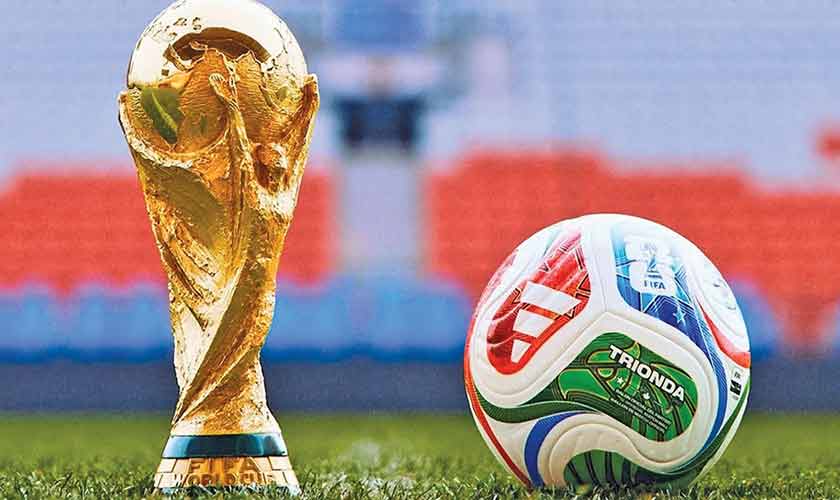
Crafted from solid 18-carat gold and weighing approximately 6.175 kilograms, the FIFA World Cup Trophy remains one of the most recognizable symbols in global athletics. Featuring two athletes lifting the globe in triumph, it represents far more than sporting success; it symbolizes immortality in football history.
Unlike the Jules Rimet Trophy, which Brazil retained permanently after its third triumph in 1970, the modern World Cup Trophy never leaves FIFA’s ownership. The original remains securely protected and is only briefly presented to champions during the trophy ceremony, while winning teams receive a gold-plated replica.
As the tournament moves beyond its opening weekend, one thing is already clear: FIFA World Cup 2026 is not merely bigger than previous editions-it is fundamentally different. It is a World Cup built on inclusion, expanded opportunity and unprecedented global participation.
Whether it is Messi’s final dance, Ronaldo’s last challenge, the rise of a teenage superstar, or the dream of a debut nation, this tournament promises stories that will resonate far beyond the final whistle in New Jersey on July 19.
The World Cup has always belonged to the world. In 2026, more than ever before, the world truly belongs to the World Cup.