Print Story
X




Sindh’s EV transition shows gains and gaps
| A |
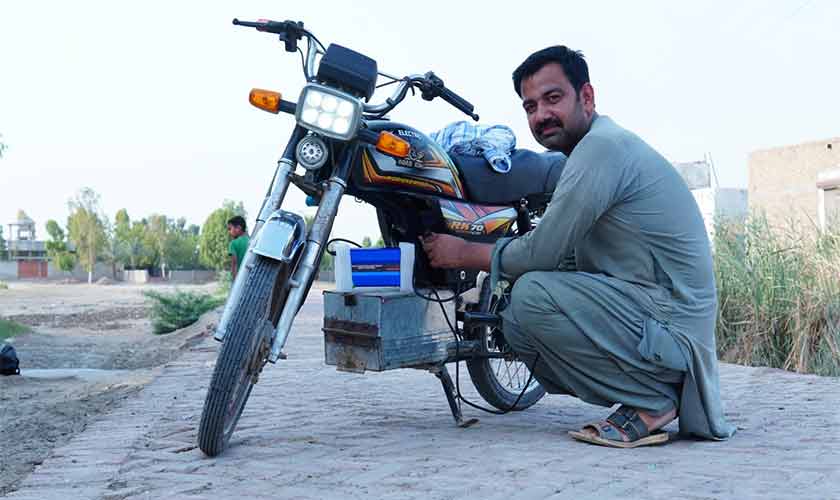
bdul Ghaffar Chang, a 30-year-old private wedding videographer from Khadro town in Sindh’s Sanghar district, purchased a second-hand electric bike about a year ago – the first electric vehicle (EV) in his family. He did not use it for some time due to a battery fault inherited from the previous owner, requiring Rs 70,000 for repairs. Instead, he continued using his petrol bike for daily commuting. However, a 60 per cent increase in petroleum prices in Pakistan following the 2026 Iran war – among the highest in the world – forced Chang to repair the battery and use the e-bike to reduce his war-driven financial burden. It worked.
Chang has switched from a petrol-powered Chinese 70cc bike to a Chinese 70E electric bike. He says, the e-bike is more affordable in terms of energy costs, maintenance and repairs, value, battery lifecycle and consumables. However, the purchase price and battery replacement are major expenses.
“One year ago, I bought the e-bike expecting that it would cut fuel and maintenance costs to a sixth or seventh. After the war-driven fuel price hike, it has come to a tenth,” Chang told TNS.
“Before the petrol price hike, I used to ride a petrol-powered bike. The e-bike has increased my mobility, meaning increased income,” he added.
Chang points to the absence of public charging stations in his area. He charges his e-bike battery at home. This takes around four hours. A fast charging stations could cut this down to a few minutes. He prefers charging the batteries using solar energy. However, he notes that even when charged on grid electricity, it is cost affective. On a fully charged battery, he can travel up to 80 kilometres. For longer travels, he uses his petrol-powered bike due to the lack of public charging stations.
“I realised that EVs are more environmentally friendly than fossil fuel vehicles. However, I bought the e-bike to lower my fuel expenses. The decision has paid off for me,” he added.
Sindh’s EV transition
As a part of its nationally determined contributions (NDCs), Pakistan aims to reduce its projected emissions by 50 per cent by 2030. The New Energy Vehicles Policy 2025-30 aims at a reduction of greenhouse gas emissions, improvement of air quality, enhancing the productive use of excess electricity generation capacity in the system and lowering oil imports. To achieve this, the policy envisions converting 30 per cent of new sales to new energy vehicles in two and three-wheeler, passenger cars, light commercial vehicles, buses and trucks by 2030
With a population of 55 million, Sindh is the second most populous and second-largest energy-consuming province in Pakistan. The province is advancing its EV transition, including vehicle adoption, establishing charging infrastructure and boosting local vehicles manufacture.
At the infrastructural level, the government has signed a public-private partnership agreement with China’s ADM Group and the Malik Group of Companies to establish 300 EV charging stations across the province.
“After a survey, 691 potential locations have been identified across Sindh for establishing EV charging stations. However, the agreement, worth Rs 750 million, covers the installation of 300 EV charging stations only across the province,” Malik Khuda Baksh, chairman of the Malik Group of Companies, told TNS.
“Under the agreement, the government will provide land, civil works and electrical infrastructure. We will be responsible for supplying and installing the EV charging equipment. Maintenance will be delivered through a third party,” Baksh added.
National Energy Efficiency and Conservation Authority, an Islamabad-based federal agency overseeing EV charging infrastructure and related regulations, points to charging ecosystem development as one of the main challenges in Pakistan’s EV transition, including in Sindh.
“From NEECA’s perspective, one of the key challenges in EV adoption is the development of a reliable, accessible and investor-friendly charging ecosystem. This includes the need for wider deployment of charging infrastructure, site readiness, grid/ load considerations, consumer awareness, coordination among relevant federal and provincial stakeholders and the creation of a complete EV ecosystem where vehicles, charging infrastructure, tariffs, regulations and consumer confidence develop together,” Mahwish Khan, the NEECA director told TNS via email.
Pakistan’s first lithium battery production plant is expected to become operational in Karachi next year. Atom Power, a sister concern of EV Technologies Pvt Ltd, a Karachi-based engineering firm, has submitted its plan to the Engineering Development Board for the manufacturing of Li battery cells. As per plan, initially the plant will manufacture 2,000 lithium batteries for electric bikes, e-scooters and electric vehicles per month.
“Some of the key challenges currently restricting large-scale local Li-ion battery cell production include a lack of a complete upstream supply chain; heavy dependence on imported machinery, chemicals and cell-grade materials; high duties and taxes on manufacturing equipment; energy reliability; limited testing and certification infrastructure; and lack of specialised local technical expertise,” Huma Khattak, CEO of EV Technologies, told TNS.
She also highlighted the problem of e-waste management in line with rising EV adoption.
Currently, there is no localisation of EV auto parts in Pakistan. Auto parts manufacturers argue that localising is essential to reduce upfront prices, strengthening the domestic industry and achieving the government’s 30 per cent EV transformation target by 2030.
“Most EV parts are still being imported and assembled through CBU (completely built unit), SKD (semi-knocked down), CKD (completely knocked down) systems,” Mashood Khan, a Karachi-based auto parts manufacturer capable of manufacturing EV-related components, told TNS.
EVs and air pollution:
Pakistan ranked as the world’s most polluted country in 2025 with concentrations of hazardous small particles known as PM2.5 up to 13 times higher than the recommended World Health Organisation level, according to annual air quality data compiled by IQAir.
The IQAir report pointed out that vehicles, in particular, poor-quality ones running on fossil fuels, are a large contributor to pollution in Pakistan.
IQAir’s 2025 World Air Quality Report also found that several cities in Pakistan, including Lahore and Karachi, ranked among the world’s 25 most polluted cities.
Dr Aamir Alamgir, an assistant professor at the Institute of Environmental Studies, University of Karachi, said the transition from fossil-fuel-based vehicles to electric alternatives was estimated to rapidly increase total EV electrical energy demand in Pakistan from 24.61 GWh to 2,862.54 GWh by 2030.
“Real emissions reduction will depend on linking EV charging infrastructure with renewable energy sources such as solar and wind. Without expanding clean power generation and phasing out older high-emission diesel fleets, the environmental benefits of EV adoption in Sindh could be limited,” said Dr Alamgir.
The writer is a Karachi-based journalist. He tweets@ZulfiqarKunbhar