Print Story
X




The language of climate conferences needs a rethink
| H |
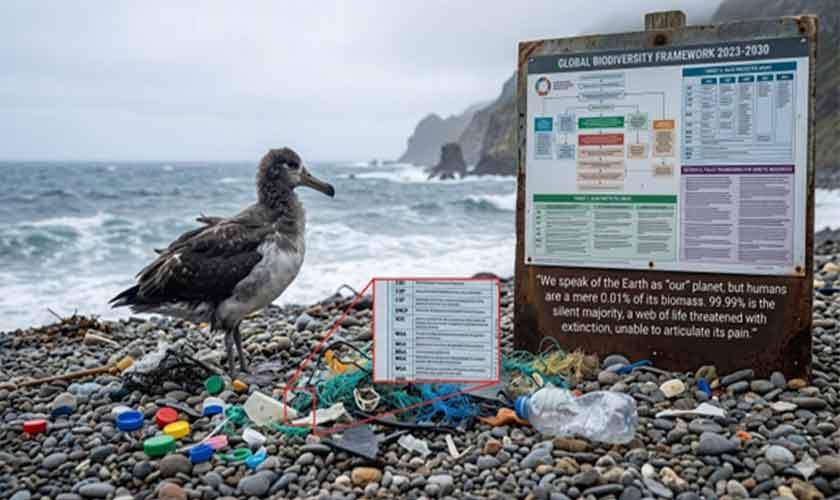
umans often speak of the Earth as their planet. However, they are a tiny minority among its animate population. We make up a mere 0.01 per cent of all life on Earth. The remaining 99.99 per cent is a vast, interconnected web of life, plants, bacteria, fungi and millions of animal species with whom we share this home.
Yet, the vast majority on this planet, currently threatened by a human-driven mass extinction, has never been able to articulate its fears, its pains or its opinions.
Consider a young albatross on the coast of the Pacific Ocean. It has the largest wingspan of any living bird. Facing the bitter sea wind, lonely on the shore, the young bird sits waiting. He received his last meal from his parents a few days ago and is preparing for his first-ever flight. But that flight will never happen as his belly is filled with sharp, toxic plastics accumulated over some time of parental feeding. He is going to die soon on that shore, never having tasted the freedom of oceans.
What if a global plastic treaty were being negotiated and an albatross could speak for itself. It would articulate the stakes of our ecological failure with a raw, piercing clarity that no human diplomat can ever match.
We hold massive climate conventions and international conferences, but they are conducted in a language that we do not share with the rest of the living world. To a tiger losing its forest, or a polar bear stranded on a melting ice floe looking for a place to breathe, the distance between human bureaucracy and reality is huge. But this linguistic barrier does not just alienate other species; it also alienates our own.
Instead of speaking from the heart, most climate conventions and summits rely on an excess of exaggerated jargon. This creates a wall, distancing everyday people from a movement meant to protect them.
Maria Dalby of GRID Arendal points out the danger in this trend. “Right now, excessive use of acronyms is a problem in climate communication. If you name something that does not convey its meaning, it creates distance. Language can actually have a central role. We need to call things what they are; it is as simple as that. We often use language to sound smart and not convey what is meant to be communicated through it. This happens at all levels - from local to global,” she says.
The current state of climate discourse places an unfair burden on those who are often the most capable of bringing about real change. Indigenous peoples, the most effective guardians of global biodiversity, have to fight just to get a seat at the table. To be heard, they must learn English and master complex bureaucratic jargon. Those who do make it are still met with a wall of acronyms and legalistic terms that take years to learn.
Nathaniel Phillippe Rerez of the National Commission for Indigenous People in the Philippines notes that this is a persistent hurdle. “At times, the technical language of the climate conferences and conventions ends up confusing indigenous people. I went to visit one of the communities with these laws, but they had a hard time grasping it. When I explained it in their context and language, they told us that these practices had been embedded in their culture for centuries.”
This disconnect harms developing nations. These countries are forced to spend precious time, money and human resources just trying to cope with and decipher fancy, hyper-complex documentation, rather than implementing actual solutions on the ground.
There are indigenous languages on this planet that do not have words for concepts like mitigation or adaptation. There is a need to think about how we are supposed to collaborate with communities on climate action when our foundational terminology cannot even be translated into their languages.
While scientific accuracy and precision are important, the excess of jargon can potentially transform a global convention into an exclusive club.
We routinely see thousands of pages of reports filled with glowing promises of what the world will achieve by 2030. Yet, we consistently fail to meet these milestones. Sometimes, these documents are no more than pretty words on paper, devoid of actionable plans, clear timelines or actual funding.
We need to make climate change accessible. Mehr Husain, a journalist and sustainability consultant at CARE, explains why localisation is the only way forward. “We need localised language in climate action for two fundamental reasons. First, globalisation has repeatedly shown its limits and localisation has demonstrated remarkable resilience.
“Communities rooted in local systems have adapted and endured through wars, political instability, economic crises, natural disasters and a global pandemic. Climate impacts are experienced locally and the most effective responses are often shaped by local realities, resources and knowledge. If climate challenges are local in their manifestation, then the language used to understand and address them must also be local.
“International frameworks, while important, are often constrained by limited time horizons, changing political priorities and uneven impacts on the ground. Climate action cannot rely solely on top-down approaches. Local problems require localised solutions and localised solutions require localised languages,” she says.
There is no substitute for indigenous and community-based knowledge, much of which is embedded in local languages, cultural practices and generations of lived experience. Respecting and using local languages is therefore not simply a matter of communication; it is a question of respect, inclusion and effectiveness. Engaging communities at the grassroots level in their own language enables deeper participation, more nuanced understanding and genuine co-creation of solutions. It allows climate practitioners and policymakers to learn from communities rather than merely deliver information to them.
Mehr Husain says the Global North must recognise that awareness of colonial legacies is far more widespread than is often assumed. Communities around the world have experienced repeated attempts to impose external structures, systems and ways of living. Many of these approaches have failed to deliver lasting resilience. Climate action risks repeating those patterns if it privileges external frameworks over local knowledge and voices.
This sentiment resonates across the board. Journalists trying to report the truth, NGOs working on the frontlines and researchers looking at the data all feel the same exhaustion. We are drowning in documentation while the living world drowns in our footprint. If we want to save our shared home, we must bridge the gap. We must strip away the unnecessary complexity and remember the true weight of what we are fighting for: the people left outside the conference halls, and the silent, beautiful 99.9 per cent of the planet that has no voice at all.
The writer is a climate journalist based in Lahore. This story was produced as part of a reporting fellowship to the Eighth GEF Assembly supported by Internews’ Earth Journalism Network