Print Story
X




How a guided tour of Aitchison College, an elite colonial-era institution, turned into an exercise in historical listening
| O |
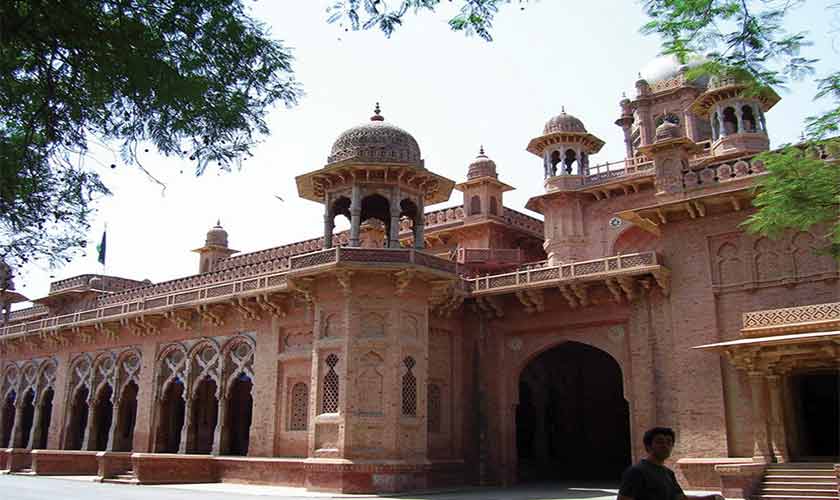
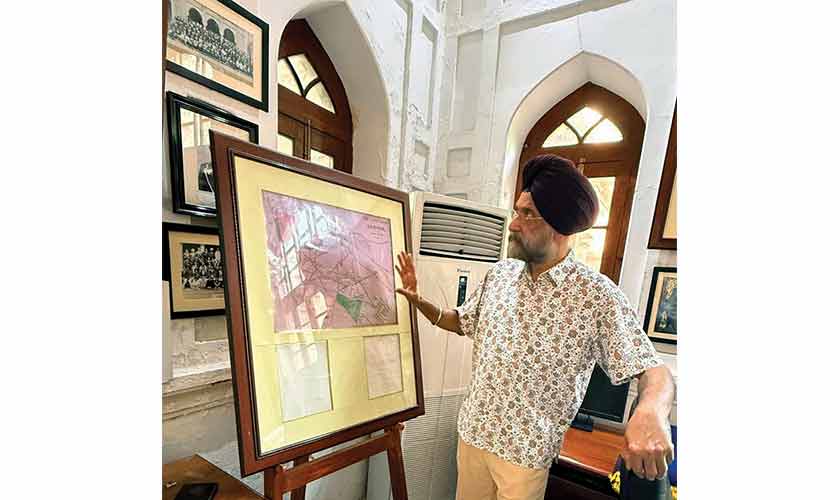
ur visit to the campus of Aitchison College, Lahore, was led by Dr Tarunjit Singh Butalia, Honorary Envoy at Aitchison College, and associate professor at Ohio State University, USA. We were joined by two other scholars: Dr Mazhar Abbas, who teaches at Government College University, Faisalabad; and Dr Ejaz Hussain, who has a PhD in political science from Heidelberg University and a post-doctoral fellowship at the University of California-Berkeley.
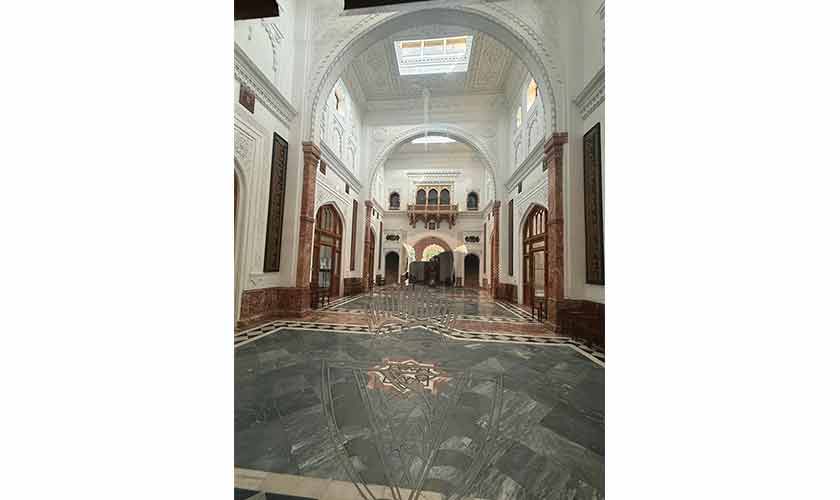
The visit was not a simple guided tour of an elite colonial-era institution. It became an exercise in historical listening—where architecture, memory and narration began to overlap. Silence itself seemed structured by interpretation.
Had we toured the campus on our own that June afternoon, its imposing buildings would have stayed silent. But in Dr Butalia’s Punjabi, it seemed the very walls and corridors had come alive.
His locus standi as a narrator is an interesting case study. In a Fabian sense — where history is never a finished past but a field continuously re-assembled in the present — Dr Butalia became less a guide than an interpreter of temporal fragments. His father, grandfather and great-grandfather were all Aitchisonians. He, however, could not follow in the footsteps of his ancestors due to the Partition. Instead, he undertook a journey to the United States, where he now lives. Yet his return to Lahore was not merely nostalgic; it was archival and methodical in its attempt to recover dispersed familial time.
Through his narration, it often seemed that he was trying to patch together the childhoods and teenage years of his father and grandfather: they lived in this room, they ate here, they studied here… The campus became, through him, a site where biography and institution folded into each other.
In the oldest building of the college, we encountered two commemorative plaques carrying the names of Muslims, Hindus and Sikhs who had fallen in the Great War. What did they know that within another few decades they would no longer be considered martyrs, but reframed in a different political grammar, their loyalties reclassified by history?
Here, hindsight imposes clarity where foresight was structurally impossible. It is easy to see what has passed, but not what is to come. And yet one is still compelled to acknowledge the courage of men who fought and died in Mesopotamia, Aden and France.
This tension leads us into the rationale behind the establishment of this elite institution: to educate the sons of native chiefs in the British tradition, an effort to Anglicise them. But this equation was never one-directional. Colonial power was not only imposed; it was also mirrored, absorbed and subtly reworked in local contexts. The rulers’ project of cultural formation did not remain intact in the way it was imagined. Instead, it produced a hybrid institutional order in which modernity and tradition were not opposites, but cohabiting forces.
Aitchison College thus becomes less an instrument of cultural replacement and more a site where historical intentions and historical outcomes diverge. More than a century later, it persists not as a purely colonial artifact, but as a sedimented structure of competing temporalities.
This is already visible in the earliest surviving group photograph of students arriving from the predecessor institution, accompanied by their staff and teachers. Their turbaned heads signal not assimilation but continuity — an insistence that colonial schooling did not erase local identity, but negotiated with it in uneven and unpredictable ways.
| W |
e were also taken to the mosque, gurdwara and mandir located near the separate hostels for Muslim, Sikh and Hindu students. The arrangement immediately raises a question that cannot be settled retrospectively: were the rulers producing division, or administering it? Were they imposing order upon perceived fragmentation, or constructing a controlled model of coexistence within a bounded space?
From a purely retrospective position, the experiment appears ambivalent. Partition in 1947 seems to confirm its failure on a sub-continental scale. Yet, within the limited geography of the campus — its 200 acres — one can still trace the possibility of a managed pluralism that did, in fact, function.
The question then becomes less whether it succeeded or failed and more what kind of historical imagination it enables. What if such an institutional logic had extended beyond its enclosure? What if the colonial (and post-colonial) rupture had taken a different form? At this point, the imagination moves into a counterfactual register, recalling narratives such as The Man in the High Castle, where history does not end but bifurcates.
In that sense, we were not merely touring the past, but also the future. We were moving through layered temporal possibilities — some realized; others interrupted; and still others never fully allowed to emerge. The campus became not a relic of history, but a structure through which history continues to think itself.
Asim Riaz is a PhD scholar whose research focuses on post-colonial literature, cultural memory and the relationship between history and narrative