Print Story
X




Days into the gruesome acid attack on Dr Mahnoor Nasir in Quetta, questions regarding safety of women enrage her colleagues and the society at large
| I |
t was a regular Saturday morning. Around noon, 29-year-old Dr Mahnoor Nasir, working in the Surgery Ward of Quetta’s Sandeman Civil Hospital, was attacked with acid by Humayun Shah, a lift operator. He had knocked on the door and when she came out, thrown acid at her and fled the premises.
“I had initially believed it was an accidental splash of some acid. Later, when I called them again, I was shocked,” Farhat Nasir, brother of Dr Nasir, said as he waited outside the ward where she had been admitted after the attack.
A Pashtun, hailing from a province where the number of school-going girls is less than boys due to the dominance of patriarchal norms, Dr Nasir had shifted to Quetta a few years ago with her family, from their ancestral town, Duki.
“She wanted to become a surgeon. Our father supported her throughout her career,” says Farhat Nasir.
“I shrieked in horror when I heard that Mahnoor had been attacked with acid,” says Dr Palwasha Kakar, Dr Nasir’s classmate. “Like her, I was preparing for our exams while working at the hospital,” she says.
“At first, when I got the news, a colleague said that she may have lost most of her vision.” Dr Kakar says she prayed for her colleague. “I prayed to Allah, please don’t let her lose her eyes. She holds many dreams in those eyes.”
Dr Nasir received immediate medical attention from her colleagues and supervisors. She was then shifted to a nearby private hospital on Young Doctors Association’s demand. Later, she was shifted to Aga Khan Hospital in Karachi by an air-ambulance. A provincial government notification stated that the government would bear the expenses for her treatment.
Dr Nasir suffered 13 percent burns to her body. “Thankfully, the burns on her face are superficial; her eyes can differentiate colours,” Bakht Kakar, the provincial health minister told The News on Sunday.
“In case of chemical burns, the depth of a wound is more important than the area,” says plastic surgeon Dr Majid Khan. “A deep two percent burn that has affected muscles is more damaging than a relatively higher percentage [by area],” he says.
Why was Dr Nasir not treated at her own hospital?
Quetta’s Sandeman Civil Hospital is one of the largest public healthcare service providers in Balochistan. The government claims that public hospitals have adequate facilities to treat burns. The YDA claims that hospitals across Quetta have no such facilities.
“We have 12-14 top plastic surgeons here in Balochistan. However, we can’t treat a patient with even 5 to 10 percent burns,” says Abdul Hai Baloch, the YDA-Balochistan president.
“The burn ward is an independent service provider in the hospital. It has its own hierarchy and isn’t under the Civil Hospital medical superintendent,” says Dr Hadi Kakar, the medical superintendent.
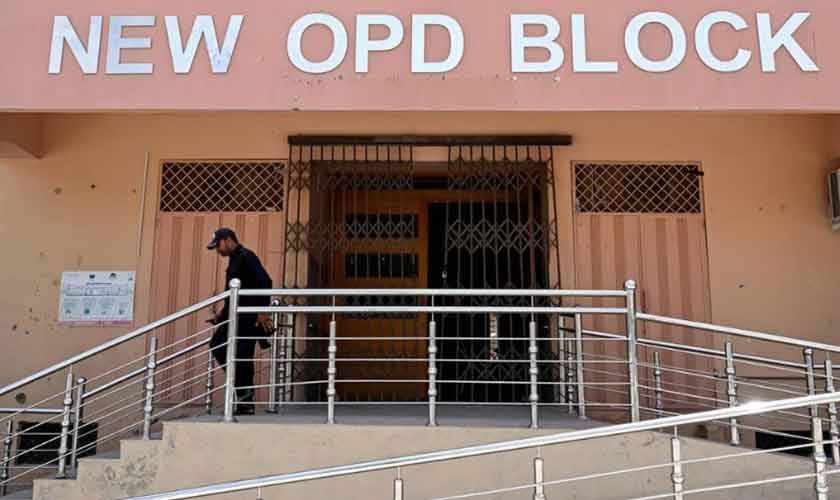
“We have all sorts of facilities to treat burn cases. This was a high-profile case. At the demand of the doctors’ community, we shifted Dr Nasir to another hospital in order to avoid any untoward situation at the Civil Hospital,” the health minister says.
This isn’t the first such attack in the province.
In 2014, two teenage girls returning from the market were sprayed with acid carried in syringes. Four other women, aged between 18 to 50, were attacked with acid in Quetta’s Sariab area. In all these cases, the survivors had not known their assailants.
“Cases of gender-based violence are increasing in Quetta,” says Alaudin Khilji, Aurat Foundation’s resident director in Quetta. Sharing data regarding the prevalence of these cases, he says murder and beating are the most frequent reported forms of violence against women in Quetta.
In 2025, 90 women were murdered across Balochistan, 58 of them for so-called honour. Over the last six years (2019 to 2025), 472 incidents of violence against women have been reported. In 2025, 123 incidents of violence against women were reported.
Women and Juvenile Facilitation Centre is the only operational facility for women and juvenile victims of criminal violence in Balochistan. According to Israr Umrani, the centre’s AIG, “More than 400 cases of gender-based violence have been reported at the WJFC. 90 percent of the cases have been resolved through mediation and counselling of the accused and the survivors.”
The police have confirmed the identity of the prime suspect, Humayun Shah, using CCTV footage. He was shot near Nushki bus stand by the police “within half an hour” of the incident.
DIG Imran Shoukat said the chief minister was personally concerned about the case. “We mobilised the force and within half an hour the suspect was shot down.”
“Such incidents must be prevented. Else, challenges for the government and law enforcement as well as the rest of the society will only increase,” says Khilji.
Recently, Justice Hashim Khan Kakar of the Supreme Court issued a landmark judgment imposing a ban on the sale of acid to private persons accused in cases involving acid attacks. The Supreme Court also directed federal and provincial governments to strictly observe the directions.
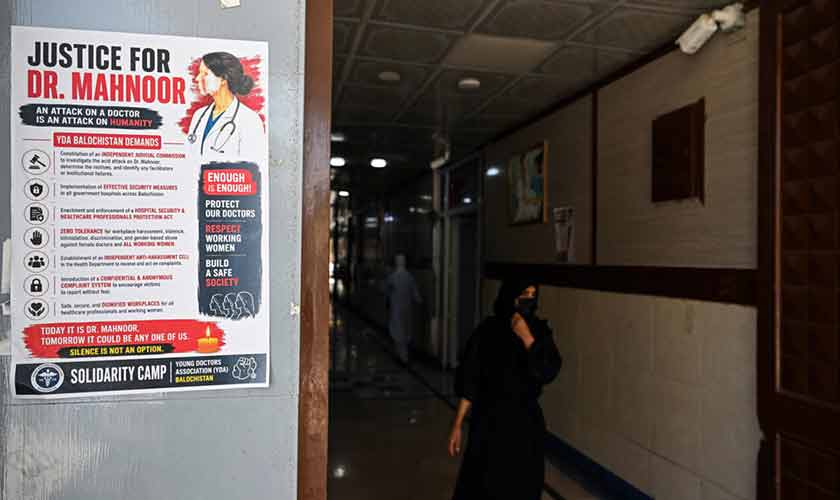
“I used to think that we only protested in the streets because we were students pressing for our demands. After two decades in the medical field, we are still out on the streets, this time for our safety,” says Dr Tahira Baloch, a member of the PMA.
“If a woman isn’t safe in this profession, imagine the women in professions requiring them to be out in the open among strangers,” says Sharmin Rahman, an advocate.
The Young Doctors Association has called for a boycott of services in the OPDs across the province. Doctors in the private hospitals are working as usual.
“We haven’t forced anyone. Doctors from various places are calling us to report that they feel insecure at the hospitals,” says Dr Baloch. The YDA claims that in-patients are being treated.

“Acid attack survivors are typically left shocked and in disbelief,” says Dr Fozia Bangash, a psychologist. She says that following such incidents, a survivor faces emotional distress, leading to post-traumatic stress disorder.
“In our society, victim-blaming is the ultimate weapon used against survivors of such attacks. This has severe repercussions on the survivor and their family,” she says.
Farhat Nasir says following the attack on his sister, the YDA leadership has remained close to them. “Her colleagues were always there for her.”
The writer is a journalist based in Balochistan. He reports on conflict, migration, governance, climate and human rights. He can be reached at [email protected].