Print Story
X




A young,as-yet unnamed hippopotamus has quickly become a major attraction for visitors at the Lahore Zoo. This raises some ethical concerns
| T |
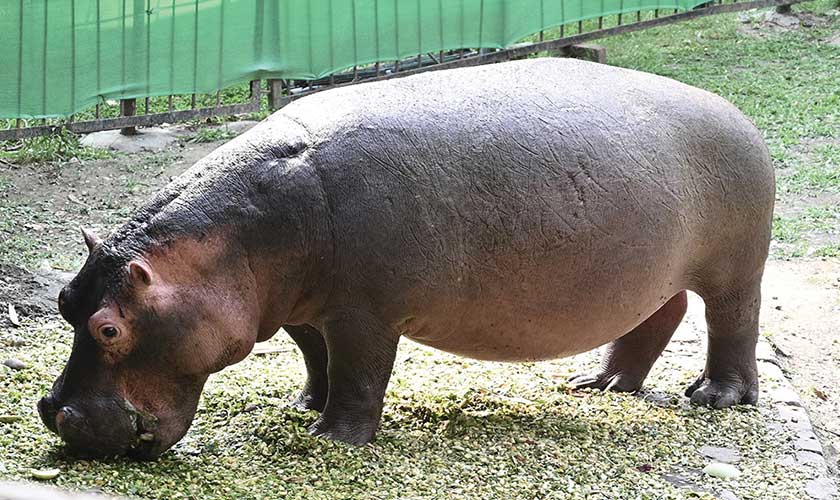
he Lahore Zoo recently welcomed an extremely cute and charming young, common hippopotamus, a three-year-old male. He currently has access to a pool and a grassy outdoor paddock, where his transport crate has temporarily been repurposed as his indoor area. As he had already become familiar with the crate during transport, the hippo appears comfortable using it as a shelter and resting space.
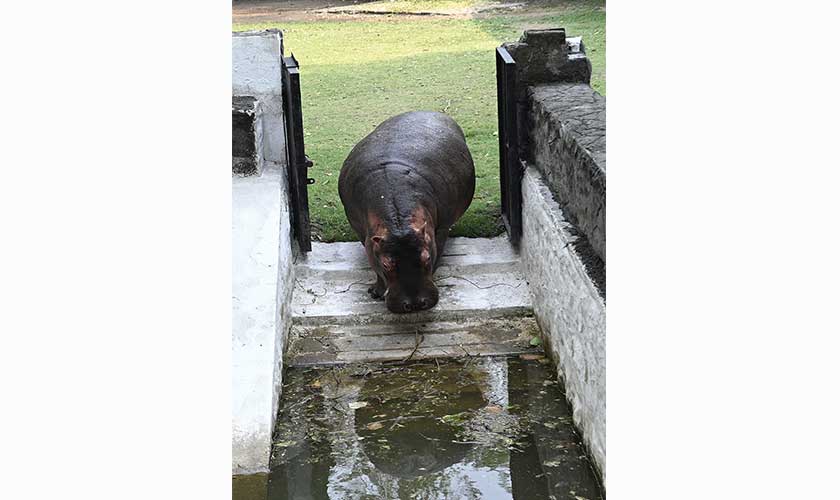
From visitors’ perspective, the visible presence of the crate also offers an educational opportunity, illustrating the practical realities of wildlife transportation and animal management. The as-yet unnamed juvenile has quickly become a major attraction for visitors. Young animals invariably draw public attention and this calf— small, endearing and highly active - is especially engaging. Visitors are captivated as he rolls playfully in the water, briefly surfaces for breath, then disappears beneath the surface before carefully climbing the steps back into the paddock.
Despite his undeniable appeal, it remains unclear why the zoo “purchased” this hippo from South Africa for Rs 25 million. He is still too young and physically immature to be paired with the adult female hippo. The female has been separated from him by both a fence and a green visual barrier, creating physical and visual separation — a sensible strategy commonly used for the gradual introduction of unfamiliar animals. The proposed future pairing was presented as part of the Revamping of Lahore Zoo Project.
In theory, male hippos in captivity may reach sexual maturity between six and eight years of age, and eventually attain full adult size. Females are capable of breeding well into their forties. Biologically, therefore, there remains a possibility that the pair could eventually reproduce. However, the prospects appear limited. History may be repeating itself. When the current female, Rani, arrived at the zoo in 2006 at approximately six years of age, the resident male, Raja, was already over forty years old. Although the two animals socialised and coexisted peacefully, breeding or mating behaviour was never evidenced. Raja, who had also been imported from Africa in 1974, eventually died in 2015. The Raja-Rani dream to produce an heir did not materialise. They were obviously not a compatible pair.
Another important consideration is the species’ breeding behaviour. Hippos typically mate in water, often in relatively shallow areas where buoyancy helps support their immense body weight. It is therefore possible that the enclosure pool may not provide sufficient space or depth to facilitate natural mating.
Transporting an adult common hippopotamus is possible, but it involves considerable logistical, financial and welfare risks. Hippos are classified as dangerous animals. An adult male can weigh anywhere between 1,500 and 3,000 kilogrammes. For this reason, zoos generally prefer to acquire juveniles or sub-adults, which are comparatively easier and safer to transport and manage.
| T |
he practice of acquiring juvenile hippopotamuses for zoo collections, particularly where individuals are separated from their mothers, raises significant ethical concerns related to animal welfare, developmental needs and conservation justification. Juvenile hippos maintain strong, long-term bonds with their mothers, essential for survival, learning and behavioural development.
Hippos are social animals living in structured groups (pods) of females and offspring with a dominant male. Despite some solitary behaviours (e.g., grazing), hippos’ core life occurs in group settings, particularly in aquatic environments. Evidence across social mammals indicates that early-life isolation leads to impaired cognition, social dysfunction and long-term behavioural issues.
Social animals such as hippos also learn social etiquettes through groups, for example things like recognising mating cues and approaching mates.
In accordance with the government procurement procedures, zoos issue a ‘tender’ to acquire animals. This acquisition of a male hippo was perfectly legal. However, the tendering process is inherently wrong. Animals are living beings, but they are treated as commodities — the process of getting them is the same as buying furniture.
We need separate rules to have animals for zoos that do not include animal dealers but include acquisition through donations, animal exchange and cooperation. For that, zoos in Pakistan need to work with one another.
This is not the story of a single animal. It reflects a broader and recurring pattern — a cycle involving numerous large mammals housed in zoological collections without a clear, long-term collection plan, coordinated breeding strategy or realistic assessment of space, welfare and future management needs.
Hippopotamus is listed in Appendix II of the Convention on International Trade in Endangered Species of Wild Fauna and Flora (CITES). When an animal needs to be purchased, a case is put forward to the CITES Management Authority under the Ministry of Climate Change to grant permits to acquire animals for pairing and/or to create social groups. This system proliferates animal dealers who are not concerned about the animal welfare or genuinely considering compatibility of individuals or ethical sourcing. For them animals are commodities; the current rules treat them as such.
The proposal to transfer the common hippopotamus from Appendix II to Appendix I of the Convention on International Trade in Endangered Species of Wild Fauna and Flora was rejected primarily because a majority of parties concluded that the species had not yet met the biological and trade criteria required for an Appendix I listing across its entire range — about 29 countries in Africa.
Several African range states argued that, although hippo populations are declining in parts of the continent due to habitat loss, illegal hunting and trade in teeth and ivory substitutes, substantial and viable populations persist in a number of countries, particularly in southern and eastern Africa.
Opponents of the up-listing maintain that regulated trade under Appendix II, combined with national management measures, has remained sufficient for conservation and that an Appendix I listing could unnecessarily restrict legitimate trade, including zoological transfers and trophy hunting revenues used for wildlife management.
Some states also worry that stronger trade restrictions could reduce economic incentives for local communities and governments to conserve hippo populations and wetlands.
Ethical frameworks emphasise balancing animal welfare with conservation goals, rather than prioritising one over the other. In the case of hippos, they are not typically reliant on captive breeding for survival. Removal of juveniles provides limited conservation value and many zoo populations are not linked to reintroduction programmes.
As a rule, all captive facilities and zoos in Pakistan need well-designed collection plans, which means we carefully select what we can house, in appropriate social groups; how many individuals; and ask questions considering the area, resources, capacity, previous records, climate suitability, ease of legal acquisition and sustainability of the populations. It can be a mix of visitors’ attractions and conservation priorities without compromising their well-being. Well-being is not about merely providing balanced diet; it is also about maintaining correct social groups so that animals can display their natural behaviour repertoire.
Dr Uzma Khan has over 20 years of experience with the WWF. Her work bridges science, policy and practice in conservation. She leverages her field expertise across Asia to advise on strategic planning