Print Story
X




According to the Election Commission of Gilgit-Baltistan, 403 candidates are contesting the polls. 131 are running on formal party tickets
| E |
lectioneering in Gilgit-Baltistan reached its peak last week.
Pakistan Muslim League-Nawaz appears to be in a position to secure a majority, either independently or in a coalition with some religio-political parties.
The GB Assembly comprises 33 seats — 24 general, 6 reserved for women and 3 for technocrats. Electoral politics in the region has witnessed shifting alliances and legal turbulence. The last general elections were held in November 2020. Pakistan Tehreek-i-Insaf had then emerged as the single largest party. PTI’s Khalid Khurshid was elected chief minister. However, his tenure ended abruptly in July 2023 when the GB Chief Court disqualified him. Following Khurshid’s disqualification, a coalition government was formed by a group of PTI dissidents, the Pakistan Peoples Party and PML-N, with Haji Gulbar Khan taking office as chief minister.
The assembly completed its five-year term on November 24, 2025. Under Article 48-A(2) of the Government of Gilgit-Baltistan Order, 2018, elections must be held within 60 days of the assembly’s dissolution. Acting on this provision, President Asif Ali Zardari announced January 24, 2026, as the polling date. Chief Election Commissioner Raja Shahbaz Khan subsequently issued the election schedule for both the GB Assembly polls and the long-delayed local government elections.
However, extreme weather in the mountainous region forced a postponement. In December 2025, following consultations with major political parties, the Election Commission announced a postponement of the elections. June 7, was finally notified as the new polling date.
According to the Election Commission, 403 candidates are contesting the polls, 131 of them on formal party tickets. The candidates include established politicians as well as emerging leaders. Notably, eight women are contesting general seats — a modest but symbolically important fact given GB’s conservative socio-cultural context. Of the women candidates, five are independents; a candidate each represents the PPP, the Istehkam-i-Pakistan Party and the Pakistan National Party.
The Pakistan Peoples Party-Parliamentarians has fielded 23 candidates, followed closely by the PML-N’s 22. Istehkam-i-Pakistan Party has fielded 15 candidates; Pakistan Muslim League-Quaid 11; Islami Tehreek Pakistan and Pakistan Nazriyati Party 10 each; and Jamiat Ulema-i-Islam-Fazl 9. Majlis Wahdat-ul-Muslimeen has nominated 7 candidates and Jamaat-i-Islami and Muttahida Qaumi Movement 6 each. Awami Workers’ Party has 4 candidates in the fray.
The most significant development involves the PTI, which had won the 2020 elections. Having been denied a symbol by the Election Commission, the PTI has been forced to field ‘independent’ candidates on all seats. This has created both organisational challenges and a narrative of victimisation that the party has aggressively highlighted in its campaign.
The most significant development involves Pakistan Tehreek-i-Insaf, the party that won the 2020 elections. Denied an electoral symbol by the Election Commission, the PTI has been forced to field ‘independent’ candidates on all seats.
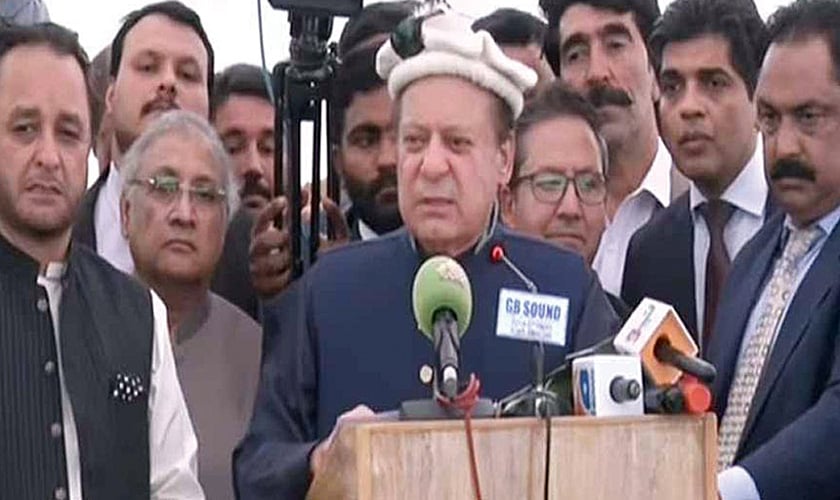
Top leaders of the PML-N and the PPP have addressed large rallies and corner meetings across GB. Nawaz Sharif has visited the region and addressed a major public gathering. Criticising the state of infrastructure, he expressed concern over poor roads and a lack of development. “During our previous tenure in the GB, a lot of work was done on hospitals, powerhouses and hydropower projects. There will be more development work this time,” he told voters, urging them to support the PML-N on account of its track record.
PPP chairman Bilawal Bhutto Zardari also campaigned extensively in GB last week. Addressing rallies, he framed the election as an opportunity to establish constitutional rights. “The new generation of PPP workers will get you your right to govern… the GB will gets constitutional protections, facilities and powers provided in the 18th Amendment,” he said. He urged voters to choose between a “people-friendly government” and an “anti-people” one, emphasising PPP’s “three generations of pro-poor governments.”
The PTI alleged systematic barriers to its campaign. Party leaders and content circulating on social media suggested that PTI’s senior leadership was barred from entering GB, preventing them from addressing rallies.
PTI’s secretary general Salman Akram Raja condemned these restrictions, calling them “an attempt to restrict our constitutional right to free movement and political activity.”
“Such measures cannot suppress the voice of the people or their democratic aspirations. The nation has already made its decision: it stands with Imran Khan and the cause of freedom,” Raja said. The PTI maintains that it was denied a level playing field. The claim is central to its campaign narrative despite fielding independents.
Political observers say that the PML-N has a visible advantage. The presence of over a dozen federal ministers and parliamentarians in GB signals how seriously Islamabad is taking these elections. For its part, the PML-N rejects allegations of using state machinery.
The PPP leaders have repeatedly called for transparent elections. The demand seems to reflect lingering mistrust from the 2020 polls, when PPP alleged that nine of the seats it was winning were “stolen” through rigging.
All three major contenders — the PML-N, the PPP and PTI-backed independents were claiming voter support as polling began. Yet the final verdict rests with GB’s electorate, whose turnout and choices will determine the final outcome.
The author is a staff reporter. He can be reached at [email protected]. He tweets at @waqargillani