Print Story
X




The restoration of the Picture Wall at Lahore Fort shines a bright light on the work of local craftspeople and conservation experts
| T |
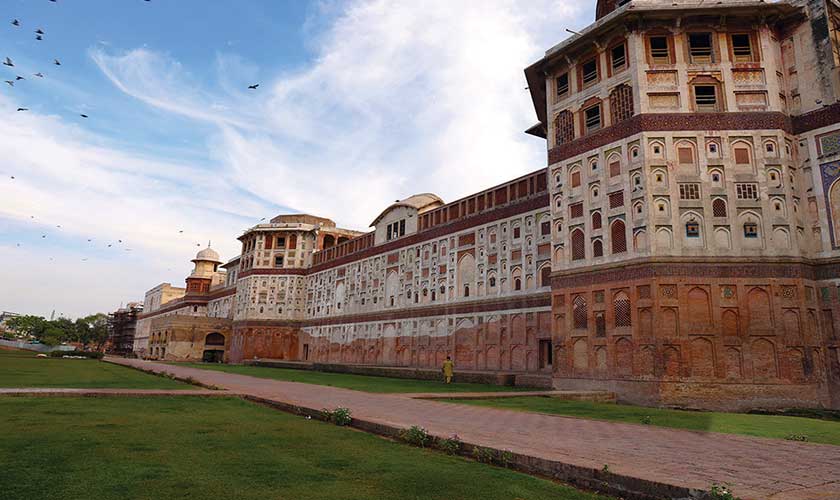
he Lahore Fort’s striking façade along its northern and western sections, popularly known as the Picture Wall, is one of the world’s largest murals. Extending nearly half a kilometre and rising to 60 feet, this majestic symbol of Mughal glory celebrates diverse cultural and artistic traditions with multiple decorative panels lining the wall.
Appearing on the wall are glazed tile mosaics (kashi kari), fresco panels (naqqashi), brick imitation, filigree work, marble and red sandstone lattice screens (jaali work) and terracotta relief (designs carved and moulded from a clay background).
The Picture Wall resembles a vast canvas embellished with a plethora of vivid imagery drawn from court life, mythology, folklore and nature, reflecting Indo-Persian artistic traditions. Every morning, as the first rays of sun permeate the indigo sky, the wall begins to come alive. Its northern section, the first to catch the light, is a patchwork of vibrant imagery. The Mughal-era collage comprises around 2,000 panels, each depicting a distinct scene. The scenes span processions, hunting expeditions, elephant fights and mythical figures such as angels, demons, dragons and fairies, alongside animals, geometric and floral patterns and figurines from the royal court.
After almost a decade of sustained efforts, the conservation of the iconic 17th-Century structure was finally completed in April this year. The United Nations’ Educational, Scientific and Cultural Organisation recently hailed it as “a landmark conclusion,” calling the project “one of the most ambitious heritage conservation endeavours in Pakistan.”
Referring to the Picture Wall restoration project, Fuad Pashayev, the country representative of UNESCO in Pakistan, underlined that “[UNESCO is] proud to have witnessed this journey.”
Before conservation work began, the Picture Wall had long suffered deterioration and neglect, marked by the detachment of structural units, powdering of lime-based surfaces, structural cracking and biological growth such as algae, soiling and pollution deposits. Outdated drainage systems had also caused water seepage and moisture damage.
The revival of this complex structure, an enduring legacy of Mughal emperors Jahangir and Shah Jahan, was carried out in multiple phases. Heritage professionals from a range of disciplines were mobilised. They included conservators, architects, engineers, practitioners of fine arts and craftspeople, who worked in close coordination with one another.
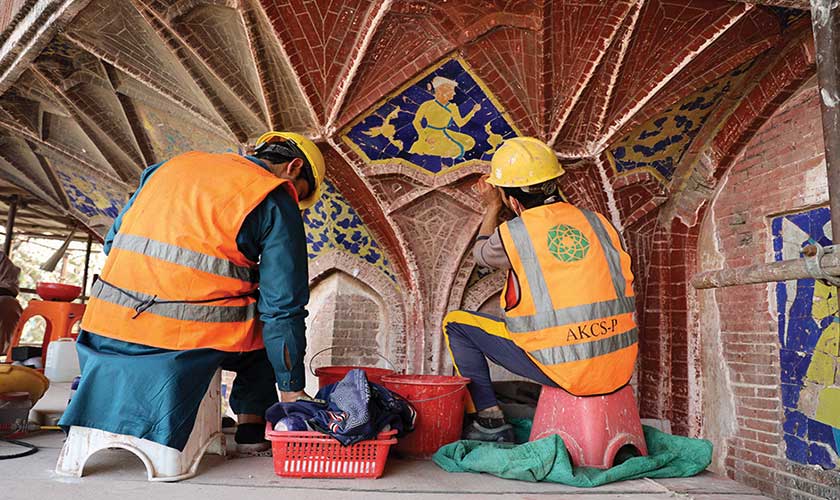
The project also brought together a range of local and international stakeholders whose contributions complemented one another. The government provided institutional backing through the Walled City of Lahore Authority. Aga Khan Cultural Service-Pakistan, the local affiliate of the global Aga Khan Trust for Culture, offered technical and financial support and led all conservation-related interventions. International funding came from the Royal Norwegian Embassy, the German Federal Foreign Office via the German Embassy and the US Ambassadors’ Fund for Cultural Preservation.
A distinct aspect of this project is the use of rigorous scientific methods in conservation practice. In the first phase of the project, which began in 2017, detailed documentation of the Picture Wall was undertaken using cutting-edge technologies, including 3D laser scanning, electronic distance measurement devices and high-resolution ortho-rectified photography.
As a preliminary exercise, a section of the western side of the Picture Wall was used as a prototype to test the effectiveness of the interventions. An international workshop with conservation experts was subsequently held to analyse the results. This informed the project’s roadmap for the future. Surface conservation on the western façade was started in July 2018 and completed in 2019. Work on the northern façade began thereafter.
According to officials, their approach has been to restore the structure to the fullest instead of complete reconstruction. To preserve the integrity of the original design and craftsmanship, all additions to surface decoration have been made in accordance with stringent guidelines.
In areas where decorative frescoes and filigree motifs had disappeared over time, conservation specialists carefully studied the surviving fragments, historical evidence and recurring design patterns to guide their restoration strategy. As a result, some of the restored sections of the Picture Wall retain an incomplete appearance.
Zeina Naseer, a conservation scientist with a degree in chemistry from Columbia University, was at the forefront of the conservation work on the Picture Wall. When I visited her, seated at an old wooden desk in a compact science laboratory, with a cluster of artifacts arranged near the edge, she was performing a water absorption test on a tile fragment, holding a steady dropper in her gloved hands. The lab was a sandwich-panel structure within the Lahore Fort, overlooking the Picture Wall on one side and a courtyard dotted with neatly arranged potted plants on the other. The air carried the lingering smell of chemicals from crushed mortar samples recently dried in an oven. After completing the test, she paused to share her perspective on the significance of the project.
“The role of science in this project is symbolic of a broad shift in the field of conservation towards preservation, and of a growing sensitivity to the material authenticity of our heritage,” she said.
Reflecting on the difficulties encountered in maintaining the sanctity of the original work, she said, “The most challenging part was the preservation of tile-work. It required a detailed analysis of historical materials, manufacturing techniques and deterioration patterns, as well as the selection of appropriate conservation methods.”
| T |
he multifaceted project went beyond restoring the centuries-old artwork. It empowered local communities to find livelihood opportunities rooted in local knowledge passed down through generations, equipping them to play a direct role in conserving their heritage.
In addition to safeguarding tangible heritage, measures were taken to preserve intangible cultural heritage. By employing traditional craftspeople whose livelihoods had declined with reduced demand for their craft and enabling them to transfer their skills to others, the project helped revive and sustain indigenous conservation expertise.
International conservation experts were brought in as trainers to enrich the project team’s skill set. A confluence of indigenous techniques and international best practices enabled robust and dynamic interventions.
Muhammad Khan, who served on the project as a store and labour supervisor, mentored and trained his junior colleagues, leveraging years of experience. When I visited him, sitting on his haunches on a scorching summer afternoon at the entrance of the Fort’s Curator’s House, laid out with bricks, Khan was instructing two masons preparing separate pasty grey mixtures in a steel pot, specifying precise ratios. One mixture was for grouting, to fill gaps in the structure and prevent the accumulation of debris; the other was for preparing plaster to be combined with the soil of a pit designated for planting. The materials used were lentils, sugarcane, sand and cement.
As Khan talked of the process, his olive-green tunic, a bright red measuring tape and a muddied, half-cut plastic cola bottle lay on the floor. He claimed that he had introduced the freshly recruits to conservation materials and techniques and briefed them on security protocols and other important procedures. He also built a team of master trainers responsible for passing the skills on to others.
The project also provided him with an opportunity to strengthen his own technical expertise by learning global conservation practices. “In 2019, I participated in an on-site training programme supported by the French embassy. I was joined by seven other workers. Through the programme, I was able to hone my skills and build my capacity. This informed my future work,” he adds.
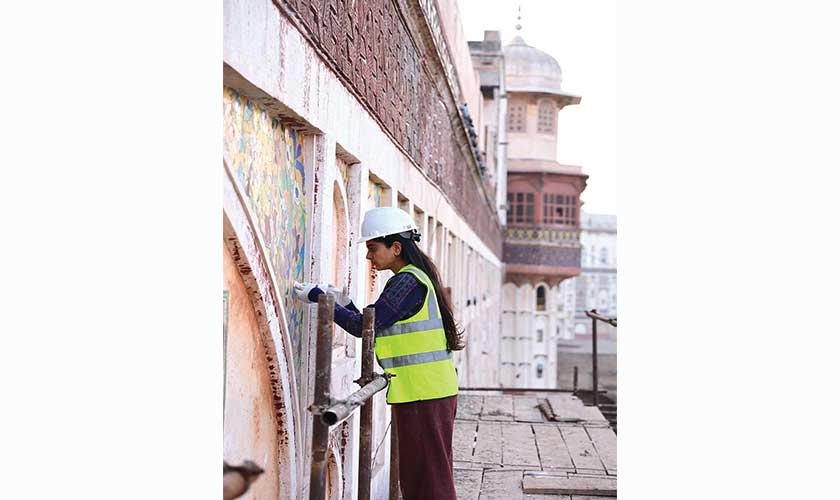
A key spillover of the Picture Wall restoration project has been the creation of a cohort of passionate young conservation professionals, mostly women, through capacity-building initiatives. Standing on scaffolding rising nearly 60 feet above the ground, braving Lahore’s sweltering summer heat, winter’s biting cold and rain spells, these women contributed to the meticulous restoration of various sections of the wall with great dedication.
Syed Abbas Hussain is a communications specialist and development sector professional with a background in journalism, theatre, music and documentary production