Print Story
X




In meeting with Prime Minister Shahbaz Sharif, President Xi Jinping praises China-Pakistan ties
| “N |
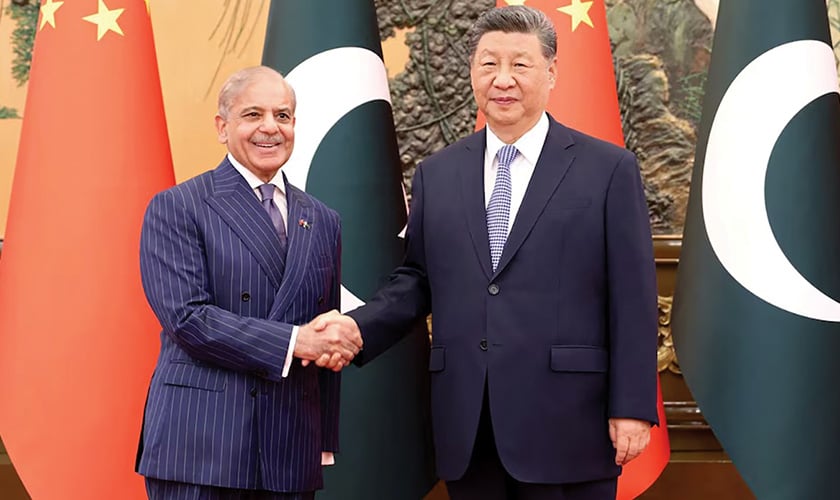
o matter how the international situation changes, in its neighbourhood diplomacy, China will always prioritise the development of China-Pakistan relations,” President Xi Jinping told Prime Minister Shahbaz Sharif in Beijing on May 25.
By describing the relationship as “unbreakable” and reaffirming Pakistan’s priority in China’s regional diplomacy during the commemoration of 75 years of diplomatic ties, President Xi has signalled sustained strategic commitment to Islamabad. This comes despite shifting regional alignments and intensifying great-power competition.
Prime Minister Sharif, for his part, once again described China and Pakistan as “iron brothers,” underscoring Islamabad’s alliance with Beijing as its most consistent strategic and economic partner.
Pakistan recognised the People’s Republic of China in 1950 and established diplomatic relations in 1951. Early interactions laid the groundwork for mutual trust, particularly at the 1955 Bandung Conference, where Prime Minister Mohammad Ali Bogra reassured Premier Zhou Enlai that Pakistan’s participation in SEATO was not directed against China. Pakistan also maintained neutrality on Tibet and supported China’s seat at the United Nations Security Council.
Building on this foundation, the Pakistan-China friendship is often described as “higher than the mountains and deeper than the seas.” Its substance lies in mutual support through wars, disasters and crises. One such instance was Pakistan’s facilitation of Henry Kissinger’s 1971 secret visit to Beijing that paved the way for the 1972 US-China rapprochement. During the 1965 war, China extended diplomatic and material support to Pakistan. In 2008, following the Wenchuan earthquake, Pakistan airlifted its entire stockpile of tents in support of relief and rehabilitation efforts. It also provided relief supplies and $2 million in aid.
Early diplomatic assurances have clearly developed into a durable pattern of strategic reciprocity and political trust, reinforcing what has since become one of the most stable bilateral relationships in the region. Pakistan’s former ambassador to China Khalid Masood recalls that Chinese public sentiment towards Pakistan remains strongly positive.
The two countries share a unique designation in Chinese popular discourse: Ba Tie. This term, widely used in Chinese media and online platforms, combines Ba (for Pakistan) and Tie (iron), to symbolise a reliable partnership. Khalid Masood notes that during visits across China, ordinary citizens often referred to Pakistani visitors using this term. He also mentioned that at the Beijing Winter Olympics, the Pakistani contingent received a standing ovation from the audience, a rare gesture that reflected strong public goodwill.
The relations between the two countries have weathered the Cold War and the post-Cold War challenges. Today, given the multipolar uncertainty, while the United States remains influential, China, too, is a major global actor, and the Global South is increasingly demanding a stronger voice in global governance.
The Munich Security Report 2025 warns that the negative effects of multipolarity may intensify if divisions among major powers deepen and the cooperation weakens. This warning is particularly relevant for Pakistan and China as both have an interest in ensuring that multipolarity does not evolve into fragmented geopolitical rivalry, says former ambassador to China, Naghmana Hashmi.
“In this context, Pakistan and China have articulated a shared vision of an equitable multipolar order based on sovereignty, institutional reform, development-centred globalisation and peaceful coexistence, rather than spheres of influence or bloc confrontation.”
In the evolving multipolar environment, Hashmi says, Pakistan should pursue strategic autonomy rather than dependency. While its relationship with China serves as a key anchor, Pakistan must continue to maintain balanced ties with the United States, the European Union, the Muslim-majority countries, Russia, Central Asia, the ASEAN and Africa. Such a broad equilibrium will contributes to regional stability, which is also in China’s interest. China can only benefit from a stable and resilient Pakistan. “Such a partner will support South Asian connectivity, contribute to regional security and provide a voice within the Muslim world. At the same time, China seeks to secure its western periphery and protect overseas interests while managing concerns related to strategic encirclement.”
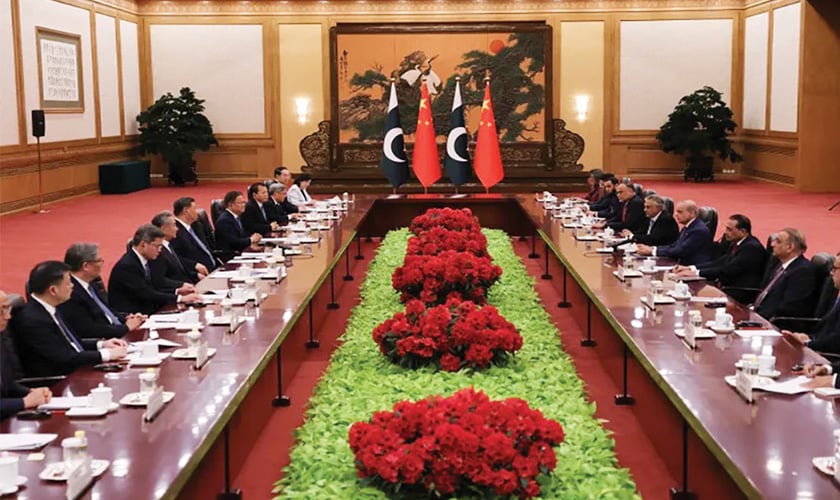
The two countries have weathered the Cold War and post-Cold War challenges. The United States remains influential, China is a major global actor; the Global South is increasingly demanding a stronger voice in global governance.
At the regional level, the partnership is also shaped by Indo-Pacific dynamics. Pakistan must maintain strategic balance, strengthen its economy and preserve regional peace. As Hashmi notes, the partnership can contribute to deterrence and regional stability only if supported by restraint, dialogue, effective crisis management and respect for international law.
Pakistan–China cooperation at the United Nations and other multilateral forums is particularly relevant for the Global South, which seeks a more representative international order without being drawn into bloc rivalries. In an emerging multipolar system, such diplomatic capacity is important as weaker states risk becoming objects rather than subjects of international politics.
The Belt and Road Initiative gives practical expression to this multipolar vision, argues Hashmi. The CPEC is one of the flagship corridors of the Belt and Road Initiative. In a multipolar world, regional integration will matter as much as great-power diplomacy. Its success will demonstrate that infrastructure, industrialisation and connectivity can provide developing countries with alternatives to dependency. Multipolarity will only be attractive if it offers people better livelihoods, dignity, infrastructure, education, health and security, she says.
“Pakistan and China should think of the CPEC not only as a bilateral corridor, but as a platform for regional connectivity. Entire South Asia can benefit from the BRI.”
Ambassador Khalid Masood describes South Asia as one of the least economically integrated regions in the world and home to large-scale poverty. Regional prosperity, he argues, requires cooperation among all South Asian states. China seeks a cooperative relationship with South Asia through economic engagement and connectivity projects. Pakistan also advocates sovereign equality and non-interference.
“Regional stability cannot be achieved without dialogue and peaceful resolution of disputes. As the largest state in South Asia, India carries a particular responsibility to foster stability rather than deepen regional tensions,” says Masood.
He describes the CPEC, the Pakistan-China component of the Belt and Road Initiative, as “a critical node in the emerging multipolar order.”
The concept of China-Pakistan connectivity is often associated with the Mao era. Pakistan was viewed as a key bridge towards West Asia, a framing reflected in diplomatic discourse during the mid-1960s, with references to Chairman Mao’s statements in 1966.
The CPEC has significantly enhanced Pakistan’s regional profile. With a population of over 250 million and a strategic location linking South Asia, Central Asia and the Middle East, Pakistan has strong potential as a connectivity hub. Its ports provide access to landlocked Central Asia and Afghanistan.
The CPEC represents a key instrument for advancing Pakistan’s geo-economic priorities and foreign policy objectives. Hashmi says achieving these goals depends on regional stability - peace within Pakistan, stability in Afghanistan, improved border management - infrastructure modernisation and stronger trade facilitation. In this stability framework, Afghanistan is central to both risk and opportunity.
Ambassador Masood builds on this, noting that Pakistan and China share convergent views on the need for stability in Afghanistan and preventing cross-border militancy. “A stable Afghanistan,” he argues, “could serve as a bridge between South Asia, Central Asia and Western China. Continued instability would threaten all three regions. Sustained political engagement, humanitarian support and connectivity initiatives are essential to reducing Afghanistan’s isolation,” he adds.
While Afghanistan stabilises, the Regional Cooperation for Development—bringing together Turkey, Pakistan and Iran—has been reactivated, as evidenced by the launch of goods trains linking the three countries. Meanwhile, the ongoing conflict involving Iran has opened up new opportunities. The linkage of Gwadar and Karachi ports with Iran’s Gabd allows for trans-shipment of stranded Iranian containers. This can also opens alternative trade routes for Pakistan to Europe, the Middle East and Africa, bypassing the Strait of Hormuz, the Bab el-Mandeb, the Suez Canal and the Bosphorus. Pakistani containers are now reaching Central Asia bypassing Afghanistan.
“There is a need now to formalise this trans-shipment arrangement as well as the operational links between Gwadar and Chabahar through a framework agreement with Iran in the broad context of regional integration and the emerging multipolar world order,” says Hashmi.
“A Pakistan-brokered Iran-US peace agreement will greatly facilitate such regional alignment, linking Europe, Africa, the Middle East and Central Asia,” she says.
Improved connectivity could enhance Pakistan’s role as a regional hub. Under the CPEC, Gwadar is envisioned as a centre for logistics, industry and urban development. Hashmi notes that its strategic value will depend on governance, security, local inclusion and integration with national infrastructure networks - including power systems - and customs modernisation.
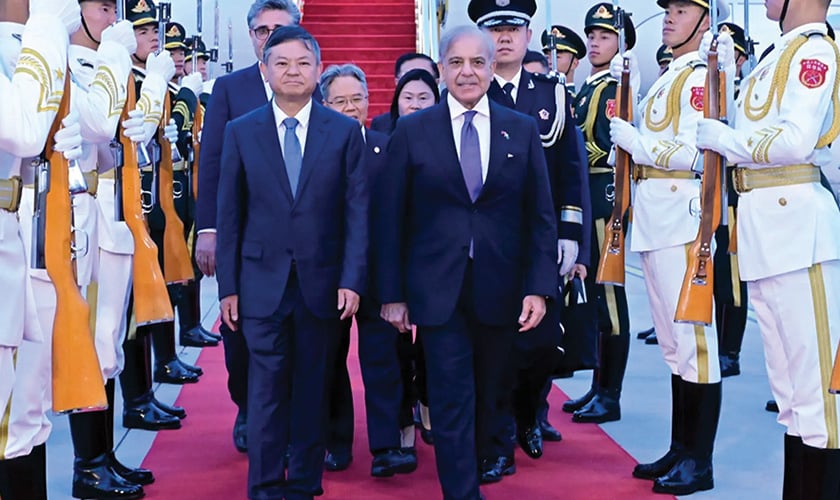
Attacks on Chinese nationals and CPEC projects highlight that security is not only a law-and-order issue. It is also central to Pakistan’s development trajectory and strategic partnership with China.
Khalid Masood notes that “Pakistan has strengthened security arrangements for Chinese personnel, with ongoing improvements in protocols and several other important undertakings.” “China can contribute through technology transfer, equipment support, joint training and real-time intelligence-sharing.”
Khalid Masood also points to domestic governance challenges in Pakistan as “the more persistent constraints.”
Despite these challenges, “CPEC Phase II is expected to focus on industrial cooperation, including Special Economic Zones, trade facilitation and manufacturing development.” Hashmi says the transition is essential for shifting from infrastructure-led growth to productivity and export-oriented development.
“Pakistan should seek Chinese cooperation in agriculture, renewable energy, climate-resilient infrastructure and digital and AI technologies to build human capital and reduce technological dependence. CPEC’s long-term success hinges on financially viable, export-oriented projects that generate employment, boost productivity and ensure fiscal stability.”
Beyond economics, Hashmi says, development must be socially inclusive, ensuring that communities across Pakistan view CPEC as a source of opportunity and participation.
The writer is a senior The News staffer in Karachi.