Print Story
X

| E |
very morning, the city feels bedazzling as any. It comes to life, not right away, but gradually. It stirs awake, its narrow streets and wide tree-lined avenues begin witnessing signs of life.
At the heart of the city, where neighbourhoods still grow in their organic, haphazard manner, dejected old men line the alleyways, gangly gangs of teenage boys take their positions at the corners, staking out a claim on various territories to the dismay of women whose hopes of going out that day are dashed by their presence. The random boy is out to get yoghurt for the family; there are children that need to be sent to school.
Depending on where one is, the air smells either grassy green or of sewage. The Rohi drain gets domestic as well as industrial waste. It merrily drains into the Ravi (yes, the river from folklore) near Mohlanwal. Not many care about that.
Lahore is a city of contradictions. Here old charm clashes with modern box-like architecture, symptomatic of a dearth of input from urban planners and architects with an imagination. Not much can be said about the periphery, except that the boundary keeps on expanding.
When Mahmud posted Ayaz to Lahore, it may have been a great favour. Today, much about the city offends normal sensibilities.
One worries that the strobing lights on the Mall will someday cause a traffic catastrophe and wonders what to make of the eclectic mix of decorations erected in the canal (dolphins, lotus flowers, ducks, ducklings, a model of the mausoleum of Quaid-i-Azam, little gnome houses on the banks, swirling dervishes and what are presumably Heer and Ranjha).
Lahore has an artificial lake in the CBD. Now, it also has a winter-land. It is clearly trying to hard.
The city is still bewitching. Were it not for some of its contradictions, one would be swept off their feet by the spectacles it has to offer.
Consider the Walton flyover. Above it, the road is clean. A pixie-faced actress beams on billboards, her teeth gleaming. She is selling clothes, beauty soap, jam and an energy drink. Cruising over the highest point of the flyover, one can see the skyline. Alongside one are men and women of distinguished pedigree racing their land cruisers and SUVs and Sportages like there’s no tomorrow. Apart from that, there is no sign of life. For a fleeting moment, the country has no problems, except maybe a shortage of models, homogeneity in beauty standards and commodity fetishism.
Under the flyover life thrives in a pulse and rhythm that brings to mind an ancient Sanskrit poem:
Hopefully the next time you whizz by on a flyover, you will think about and feel for the life brimming under it.
“A marvel
O poverty,
Great powers you have given me,
I see the whole world and no one sees me” — Anon
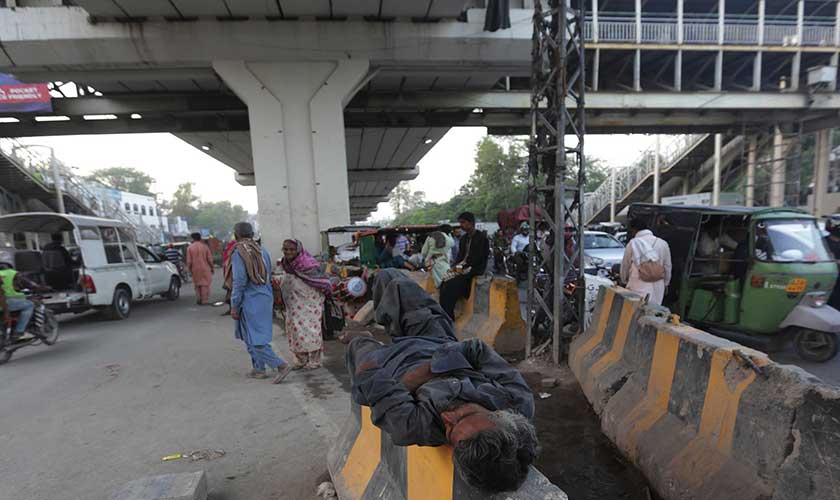
In one corner, a man sits with a crate of bananas. Half-clad children walk through the phaatak (level crossing) casually to head to the slums. In a huddle sit a group of drug addicts and non-addicts playing cards. Right next to them is a man out to sell his goat. He has to do it soon as yesterday. Several working-class men sit and stand in a file, hoping to get hired for the day.
An old woman on a charpoy braiding the hair of a younger woman, who is selling bangles in all colours of the rainbow. It is the same flyover; just the other side of it.
The contradictions could not be more pronounced. Do the poor end up beneath the Walton flyover by sheer luck or preference? Does the city actively invisiblise them? According to Foucault, modern cities use a combination of spatial management, surveillance and architectural design to quarter up space in such a way that inequality is hidden from the public view. This gives the state a veneer of dignity, without having to go through the hassle of actually fixing the root cause of structural inequity.
The Walton flyover does not have a footpath. It was designed exclusively for vehicles. Its underside is another story. There is shade, curbs and pavement. There is room enough space for a few people to unfold their mattresses and lie down. They remain under the gaze and heavily policed but the point is there can still rest.
Hopefully the next time you whizz by on a flyover, you will think about and feel for the life brimming under it. As Faiz would say, Laut jaati hai udher ko bhi nazar, kya kijiye [How can one absolutely ignore such sights? ].
Aamna Shahid is a staff member