Print Story
X




Moscow acknowledges Afghanistan as an epicenter of terrorism but is pursuing military cooperation with Taliban
| R |
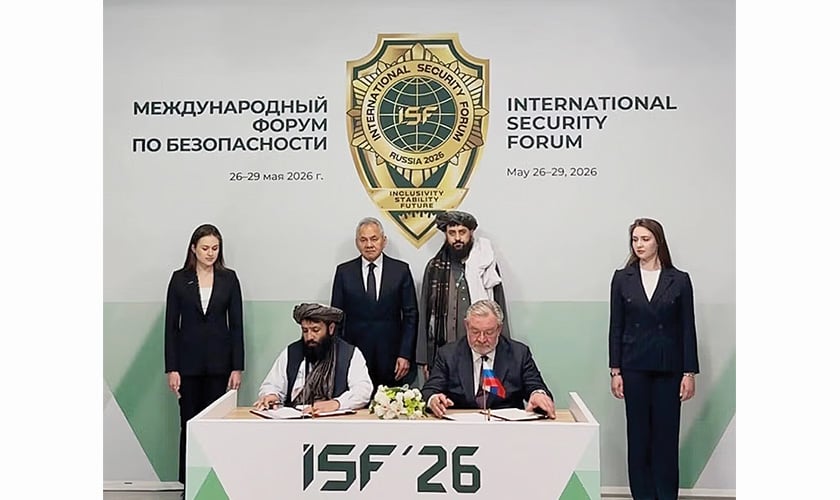
ussia’s decision to deepen engagement with the Taliban regime marks one of the most consequential strategic shifts in Eurasian geopolitics. Taliban Defence Minister Mullah Mohammad Yaqoob’s recent visit to Moscow, culminating in agreements for military and technical cooperation, signals a new phase in bilateral relations. Russian officials have publicly emphasised security engagement, defence cooperation and expansion of ties. This growing partnership raises a profound question: why strengthen a regime that presides over one of the world’s most concentrated hubs of trans-national terrorism?
The timing of the engagement is particularly striking. Just days before formalising deeper cooperation, Russia’s security leadership had issued stark warnings about escalating terrorist threats emanating from Afghanistan. Alexander Bortnikov, head of Russia’s Federal Security Service (FSB), highlighted the growing operational capacity of ISIS-K (Islamic State of Iraq and Syria-Khorasan Province), noting its recruitment across Central Asia and Russian migrant communities. According to Bortnikov, clandestine networks, financing channels and planning infrastructures are expanding across the Commonwealth of Independent States, posing a direct threat to Russian national security.
Sergei Shoigu, secretary of Russia’s Security Council, warned of the influx of foreign militants from Syria into Afghanistan and estimated that between 18,000 and 23,000 terrorists are currently operating on Afghan territory. These figures align with several international assessments that identify Afghanistan under Taliban rule as a dense ecosystem of extremist organisations, including ISIS-K, the Tehrik-i-Taliban Pakistan, the Al Qaeda, the Eastern Turkistan Islamic Movement and the Islamic Movement of Uzbekistan.
This presents a glaring strategic paradox. On one hand, Moscow acknowledges Afghanistan as an epicenter of trans-national terrorism. On the other, it is pursuing military cooperation with the regime governing that territory. The contradiction carries real and immediate security implications.
Under Taliban rule, Afghanistan has effectively evolved into a multifaceted hub for extremist activity. It simultaneously serves as an operational sanctuary, recruitment base, logistical corridor and ideological incubator for a wide array of militant groups. Successive reports from the United Nations Monitoring Team, alongside findings from the Special Inspector General for Afghanistan Reconstruction and regional intelligence assessments, have consistently documented the persistence of terrorist safe havens, mobility networks and recruitment pipelines within Afghanistan.
The Taliban’s record further amplifies these concerns. Estimates suggest that between 5,000 and 7,000 TTP militants operate from Afghan soil, alongside 2,000-3,000 ISIS-K fighters. Al Qaeda, despite being weakened, continues to maintain a presence. This is not an isolated insurgency landscape; it is a network of extremist actors operating within a geopolitical space.
Russia’s willingness to engage in military cooperation raises serious questions about risk assessment and long-term strategic intent. The Taliban inherited vast stockpiles of military equipment following the withdrawal of US and NATO forces in 2021. Since then, concerns have persisted regarding the proliferation of these weapons across regional militant networks. Reports have documented instances where abandoned military hardware has surfaced in the hands of terrorist groups operating beyond Afghanistan’s borders.
In entering into defence cooperation agreements, Moscow risks contributing to the strengthening of a military apparatus embedded in an environment saturated by extremist actors. Even if the intention is to stabilise Afghanistan or counter specific threats like the ISIS-K, the broader effect could be the aggravation of an already volatile security ecosystem.
Russia’s engagement with the Taliban appears to be driven by a mix of strategic calculations. Viewing the group as a potential counterbalance to Western influence and a pragmatic actor in regional stability, it maintained contacts with the Taliban even during its insurgency years.
The financial dimension adds another layer of complexity. Despite the Taliban’s international isolation, Afghanistan continues to receive substantial inflows of foreign aid, including weekly cash transfers of approximately $40 million from the United States. These funds are intended for humanitarian purposes, but the overlap between financial inflows, governance structures and security apparatuses raises concerns about indirect support for militarisation. Where a narcotics economy, illicit financing and extremist recruitment networks remain active, the risk of resource diversion cannot be dismissed easily.
Regional consequences of Afghanistan’s instability are evident. Pakistan, for instance, suffered over 600 terrorist attacks originating from Afghan soil in 2025 alone. Cross-border infiltration by militant groups continues to strain bilateral relations and undermine internal security. Central Asian states, including Tajikistan and Uzbekistan, have also expressed growing concerns about border security and extremist spillover.
Russia itself is not immune. Recruitment efforts by the ISIS-K targeting Central Asian nationals and Russian migrants underscore the trans-national nature of the threat. China, too, has faced security challenges linked to extremist elements with connections to Afghan territory, particularly concerning Xinjiang-related groups such as the ETIM.
Against this backdrop, Moscow’s engagement with the Taliban appears to be driven by a mix of strategic calculations. Viewing the group as a potential counterbalance to Western influence and a pragmatic actor in regional stability, Russia maintained contacts with the Taliban even during its insurgency years. Today, this relationship seems to be evolving into a more formalised partnership.
A possible rationale could be that Russia seeks to draw the Taliban into its strategic orbit, thereby gaining influence over Afghanistan’s security trajectory. By engaging directly, Moscow may aim to shape Taliban behaviour, counter the ISIS-K and limit Western re-entry into the region. Facing international isolation, the Taliban may view Russia as a crucial partner for political legitimacy, military support and economic engagement.
Such an approach carries significant risks. By providing political cover and potential military support, Russia may inadvertently legitimise a regime that continues to host and sustain terrorist networks. The Taliban could leverage this engagement to strengthen its internal control while maintaining its existing relationships with extremist groups.
The use of terrorism narratives to justify engagement could backfire. While Moscow positions its cooperation as a means to counter terrorism, the reality on the ground suggests a more complex dynamic. Strengthening a regime that governs a territory densely populated with militant actors may ultimately undermine the very security objectives Russia seeks to achieve.
Russia’s Taliban policy represents a high-stakes geopolitical gamble. It reflects a willingness to engage with a maverick actor in pursuit of strategic influence. Whether this approach will yield stability or exacerbate existing threats remains an open question.
Afghanistan under Taliban rule continues to pose a multifaceted challenge to regional and global security. Any effort to engage with this reality must carefully weigh the risks of legitimisation and militarisation against the projected benefits. The stakes could not be higher.
The author works for The News. He can be contacted at [email protected]