Print Story
X




Understanding GEF-9 cycle’s emphasis on integrated programmes
Imagine a remote town that needs access to a nearby city to enhance employment and trade opportunities. The Highway Authority decides, in good faith, to construct a national highway to bridge the gap. Once the road is built, however, the Wildlife Department discovers that the infrastructure blocks critical wildlife corridors, preventing animals from grazing and migrating, resulting in high mortality rates and severely impacting their natural habitats. Concerned that urban expansion is exacerbating the urban heat island effect, the city’s municipal committee suggests establishing entirely new urban centres rather than letting the existing city expand.
Taking the observations of the municipal committee and the Wildlife Department into account, the authorities decide to establish an industrial zone within the village to generate local employment rather than build a highway to the city. The industrial zone is created. A year later, it is discovered that the factories are polluting the water supply as adequate waste management and chemical disposal infrastructure was not put in place. Authorities rush to install a waste disposal plant. However, it has to be constructed on land belonging to members of an indigenous community, who were unwilling to give up their land—even for good money. The land is expropriated because ‘development’ is being fast tracked, leaving no time for meaningful consultation with the indigenous community. The project development cycle continues, generating one problem after another.
This scenario illustrates a critical issue: environmental and development projects—even when executed in good faith—inevitably falter or worsen secondary issues if they remain isolated interventions that fail to integrate broader economic, social and ecological dimensions.
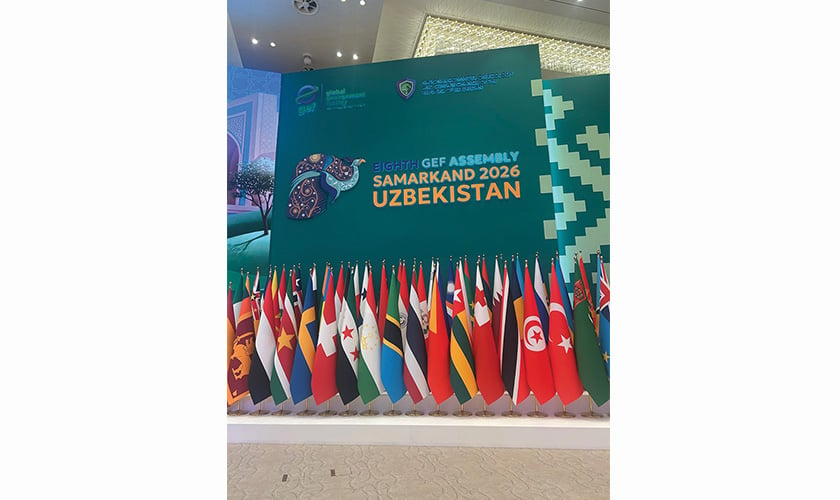
This highlights the shortcomings of the project-based sustainability approach prevalent over the recent decades in which projects were envisioned and completed without a whole-society approach. This distinction, among others, was a topic of discussion at the Global Environment Facility’s eighth session being held in Samarkand, Uzbekistan.
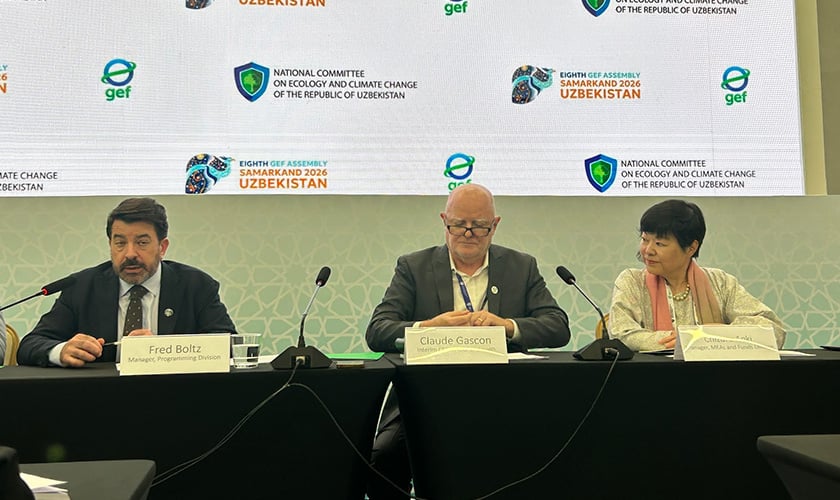
“We are trying to address this through policy coherence. We want governments to ensure that their various ministries—such as land, agriculture and climate—work collaboratively rather than in silos. A fragmented approach does not work; we need integrated approaches and integrated programmes,” Claude Gascon, the interim CEO and strategy and operations director at the Global Environment Facility, told the media.
The GEF is a multilateral environmental fund that prioritises integrated programming across countries, departments and sectors in its funding.
The GEF assembly strongly emphasises that project concepts must originate from the benefiting countries.
“When donors and projects are fragmented and pulling in different directions, they can never truly liberate countries from environmental crises. To avoid this fragmentation, countries must chart a clear path for themselves and anchor projects into their national agendas. They should align efforts with their environmental commitments and remain goal oriented,” said Carolina Rizzi Starr, agricultural officer at the FAO regional office for Europe and Central Asia.
The GEF assembly strongly emphasises that project concepts must originate from the benefiting countries.
“Project concepts, challenges and outcomes must be anchored in country needs and move from the country level up to the donors,” she added.
Furthermore, local communities on whose land a project is being executed must be engaged from the outset. A project may perform well for the duration of its funding cycle, only to collapse as soon as the financial support ends because the local government and communities lack the capacity to sustain it.
“We need sustainability beyond projects. This can only happen if local communities are involved from scratch when a project is being envisioned—not merely as beneficiaries but as active partners,” argued Aliou Mustafa, a representative of the GEF Indigenous Peoples Advisory Group.
“For a project to yield an enduring impact beyond its funding tenure, it is vital that institutional knowledge is transferred to the local level and municipal governments so they can replicate the model in the future. To achieve this, capacity building and community education must be core project objectives alongside environmental targets. In addition to documenting a project’s successes, we must also document its failures to better understand what works and what does not.”
“It is crucial to recognise that without transparent information sharing and active dissemination, communities will never be able to cultivate a sense of project ownership.”
Experts argue that such integrated programming frameworks must extend beyond national borders. Neighbouring nations, such as India and Pakistan, which share contiguous mountain ranges and river systems despite being at political odds, require transboundary integrated programming—even though persistent geopolitical friction remains a barrier.
Addressing this challenge, Kaan Evren Basaran, an international development and operations specialist at the UN’s Food and Agriculture Organisation, highlighted the role of mediating agencies in bridging these gaps.
“Environmental issues such as water scarcity and land degradation have escalated to a scale where individual countries can no longer afford conflicts that further aggravate these crises, causing irreversible damage to our planet,” he said.
“Mediating agencies that implement these projects can initiate dialogue between conflicting states on a technical level, utilising supporting data that can ultimately foster alliances. Historically, we have observed widespread conflicts between downstream and upstream nations that share a common ecosystem. These trans-boundary issues can be resolved through technical discussions and continued trust building.”
The writer is a climate journalist based in Lahore. This story was produced as part of a reporting fellowship to the Eighth GEF Assembly supported by Internews’ Earth Journalism Network.