Print Story
X




Casim Mahmood transforms everyday industrial material into a meditation on endurance
| S |
lavoj Zizek, in one of his essays, mentions that a worker from a state-owned factory in a former communist country in Eastern Europe used to leave at the end of his shift with an empty wheelbarrow. Security suspected that he was stealing something but were unable to figure out what it was. Actually, the man was stealing a wheelbarrow every day!
Whether it is a factual story, a fictional anecdote, or a joke, some artists can relate with the protagonist. For them, coarse material is more important to work with than precious stuff. The former provides the freedom to experiment, explore and express. Hence, some painters, water-colourists and sculptors turn impotent if confronted with expensive art supplies. Since the introduction of collage and assemblage techniques with Cubism, Dada and Surrealism, ordinary items have acquired the potential to become art. The practice is at its best in the work of Marcel Duchamp, particularly his Fountain (1917), a ready-made that transformed the idea, language and course of art.
Casim Mahmood, like a few other visual artists, has selected steel (or iron) as his medium of expression. The material is largely associated with the manufacture of functional objects. In contemporary art schools, a recurring project involves collecting pieces of metal sheets, old or new, to construct an insect, bird, animal or household object. Mahmood, a seasoned professional, has chosen steel deliberately, and for reasons that are both apparent and layered. In his recently concluded solo exhibition, Men of Steel (May 19-28, Sanat Initiative, Karachi), human figures fashioned from steel occupied canvas after canvas.
It is not the first time a familiar material has been employed in the creation of art. Gold, silver and copper can be found in artworks produced across continents and centuries. Gold and silver feature in medieval Christian icons and Mughal miniature paintings; numerous statues of the Buddha across South Asia, China and the Far East were cast in bronze; and many Hindu deities have been rendered in copper. Yet, it is uncommon to encounter a conventional sculpture of significant artistic value made from iron or steel, materials long regarded as unsuitable for religious or refined art.
The appropriation of a material as art is also tied to its monetary value. A hierarchy begins with gold, silver, copper, bronze, brass, zinc, aluminium and lead, descending to steel and iron at the bottom. Iron and steel surround us in abundance. On any street we encounter railings, bars, grills, gates, poles, barriers, bridges and scaffolding, as well as the machinery and chassis of vehicles. We favour steel utensils for cooking and, occasionally, for serving food, both at home and in restaurants. From keys and locks to needles, kitchen knives and railway tracks, iron and steel are integral to daily life, yet they rarely command our attention. The material remains largely inconspicuous. More often, once broken or rendered obsolete, it ends up in scrap markets. There, disjointed, rusted and disfigured pieces are sold by weight, destined to be melted down or recycled.
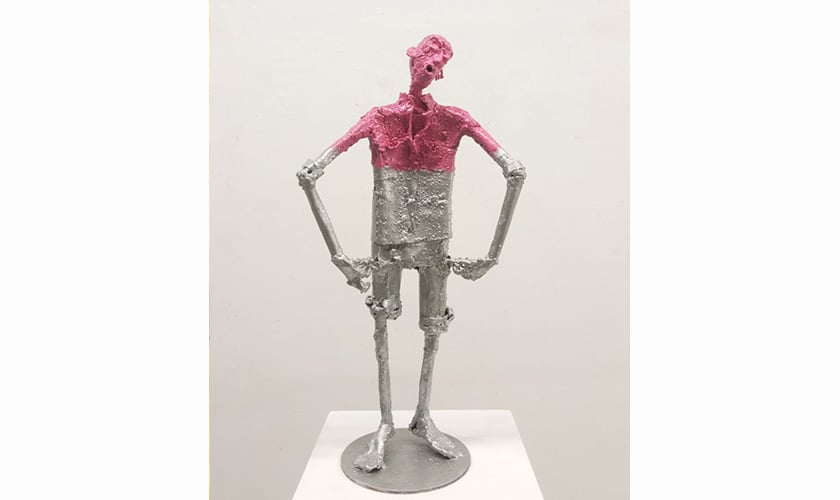
The process that continued around us without ever becoming part of ‘high art’ until the late 20th Century, when a number of Pakistani artists, now recognised as pioneers of Karachi Pop, began incorporating everyday materials into their work. David Alesworth, in particular, selected inexpensive iron and aluminium objects for use in his sculptures.
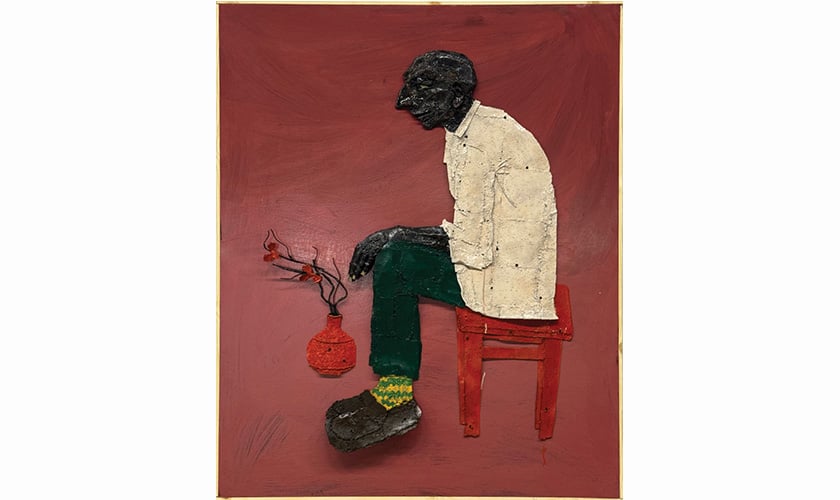
Casim Mahmood is a natural heir to that group, although his approach is distinct. Rather than radically transforming a material, he prefers to preserve its original identity, character and surface. The work in his solo exhibition comprised metal on board painted in industrial colours. Metal and board are common materials found in shops selling art supplies, but they usually remain subordinate to image and idea. In Mahmood’s work, however, the material is not silent; it becomes a central feature of the painting.
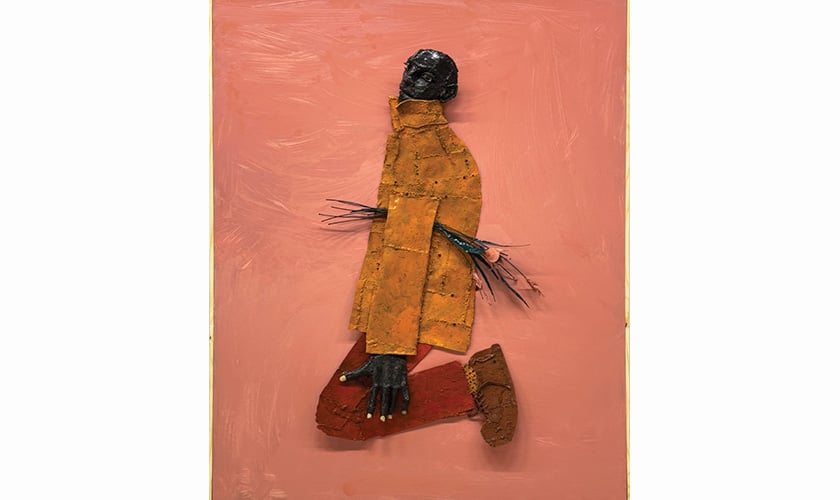
As the exhibition’s title suggests, all the paintings depict men made of steel in different states and situations. Each figure is distinct. Yet, they share the same physique and skin tone: tall, lanky and dark, with predominantly white fingernails. The description might evoke a jazz musician or a black rapper, but a closer look at their clothing places them firmly in the working class. This reading is reinforced by the condition of their worn garments, makeshift furniture and sparse surroundings.
Whether accompanied by flowers or not, and regardless of their poses, these men appear poor because of the material from which they are formed: torn, dented steel covered with uneven layers of industrial paint.
In one painting, an ebony-coloured man walks in a pair of cheap but striking orange flip-flops. In another, a figure leans against a raw red chair, holding a cigarette in one hand and a bottle with a straw in the other. Elsewhere, a man sits cross-legged on a hastily nailed stool. Another kneels on the floor with a bunch of flowers tucked beneath his arm. One figure, wearing yellow-and-green striped socks, gazes ahead beside a pot of dried stems placed next to his modest chair. Another slips both hands into a bright yellow jacket. A different figure poses in a rusty red one. Elsewhere, a man dressed in a pink-and-white shirt and brown trousers is balanced precariously on the edge of a stool.
All these images, with their varied backgrounds, postures and clothing, strongly convey a sense of solitude. They depict men isolated from their surroundings or inclined to remain separated from the mainstream. Even if one does not assume that the recurring figure in each painting is a self-portrait of the artist, although creators often leave traces of themselves in their work, the character inhabiting Mahmood’s canvases embodies the condition of an individual surviving in the solitude of his misery that is “turning him invisible, a perpetual outsider, a tourist of his own life,” to borrow Paul Auster’s description of his father in The Invention of Solitude.
The hard hands of these figures, reminiscent of labourers or construction workers, their rough clothing suggesting patched surfaces created through the joining of discarded pieces of metal; and their awkward, often uneasy postures burden them with an additional weight as they become subjects of the gallery-goer’s gaze.
Casim Mahmood introduces an element of concealed happiness into their work, to borrow the title of Milan Kundera’s novel, The Unbearable Lightness of Being, through the inclusion of flowers and stems in some works. These interventions occasionally appear imposed rather than organic. A pale yellow flower tucked behind a man’s ear, a cluster of dull yellow blooms emerging from a shirt, dusky branches clutched in a figure’s hand, easily mistaken for a straw broom, or an earthen-orange flower drooping from a man’s mouth can feel at odds with the emotional tenor of the paintings.
The works in which flowers, or their complete absence, seem integral to the composition are more convincing. They include a man in bright orange footwear carrying a bouquet and figures estranged within their sparse environments. Whether accompanied by flowers or not, and regardless of their posture, these men appear poor because of the material from which they are formed: torn, dented steel covered with uneven layers of industrial paint. The surfaces evoke abandoned sheets of metal reclaimed to assemble the shacks of informal settlements found in cities across the world. Yet these individuals remain resilient. Like steel, a word derived from a Proto-Germanic root meaning standing firm, they endure.
The writer is a visual artist, an art critic, a curator and a professor at the School of Visual Arts and Design, Beaconhouse National University, Lahore. He can be contacted at [email protected].